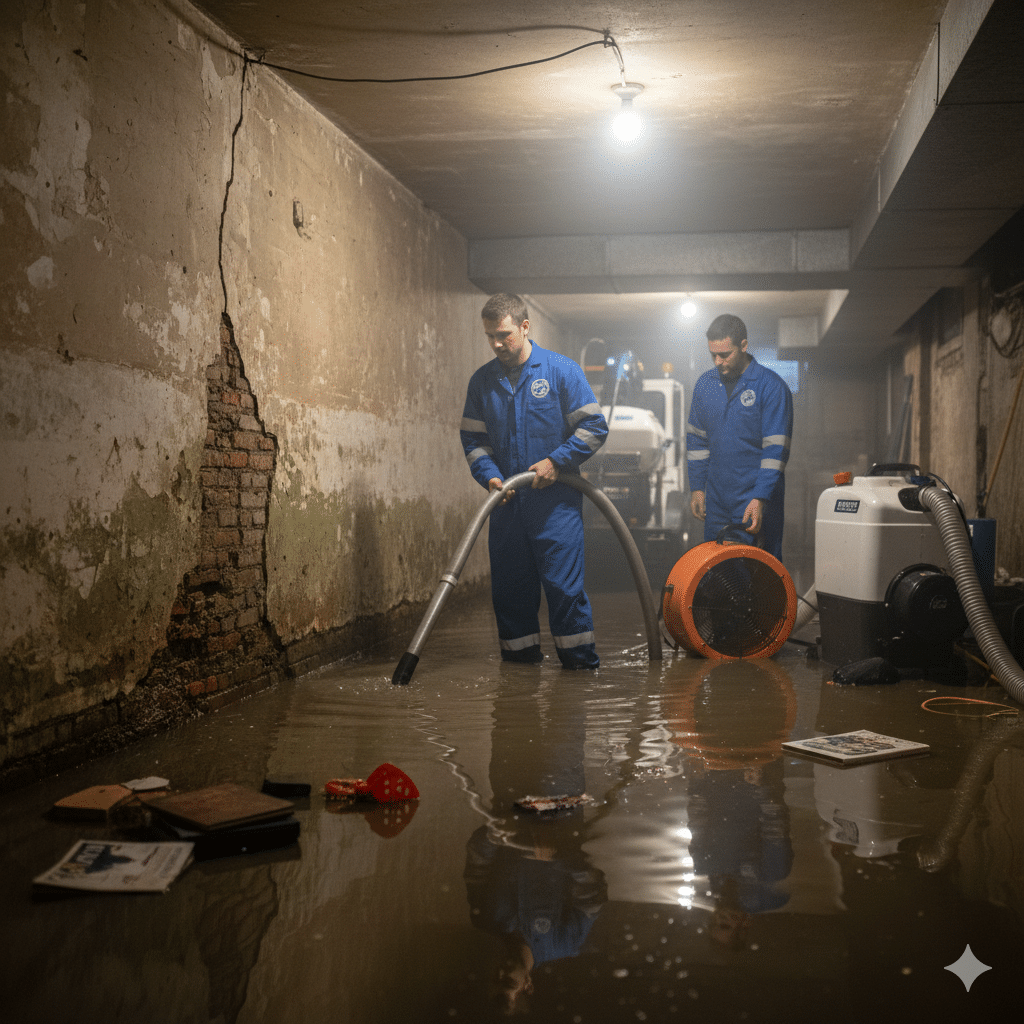
The rhythmic dripping of a failing pipe in a Pilsen garden unit or the sudden, violent surge of a sewer backup in Logan Square are sounds that haunt Chicago homeowners. In 2026, the Windy City’s relationship with water has become increasingly complex. As we navigate a year marked by “flash-thaw” events—where temperatures jump from a deep-freeze to a humid fifty degrees in less than forty-eight hours—the strain on our local infrastructure is at an all-time high. At Redefined Restoration, we see the aftermath of these environmental shifts every day.
In Chicago, IL, common causes of basement water damage include burst pipes from harsh winters, heavy rainfall overwhelming drainage systems, foundation cracks, sump pump failures, and the persistent humidity found in neighborhoods like Pilsen and Uptown. These aren’t just minor inconveniences; they are structural emergencies. We handle these crises with a precision-tuned response. With years of hands-on experience across Chicagoland, our team deploys IICRC-certified technicians who arrive in 60-90 minutes for a true 24/7 emergency response.
The “how” behind our process is rooted in advanced physics and local expertise. We utilize high-powered extraction equipment to remove bulk water and industrial-grade dehumidifiers to aggressively pull moisture from the air, which is essential for preventing mold growth in the uniquely humid environment of a Chicago basement. Our comprehensive process—from the initial forensic inspection to the final coat of paint in full reconstruction—is designed to be seamless. We coordinate directly with your insurance provider to handle the complex documentation required in 2026, backed by our 100% satisfaction guarantee. Homeowners from Logan Square to Uptown trust our proven expertise for restoring basements to their pre-loss condition efficiently, ensuring that a temporary flood doesn’t become a permanent structural liability.
The Environmental Anatomy of Chicago Sub-Grade Flooding
To understand how to fix a wet basement in Chicago, you must first understand the unique geological and meteorological forces at play in 2026. Chicago was built on a swamp, and while we have mastered the art of raising buildings, the water beneath our feet hasn’t gone anywhere.
The Hydrostatic Pressure Trap
In 2026, we are seeing a significant increase in hydrostatic pressure issues. Think of the soil around your foundation like a giant, saturated sponge. After one of our heavy Midwest spring rains, that sponge becomes incredibly heavy. This weight pushes against your basement walls. If there is a tiny fissure or a porous section of concrete, the water doesn’t just seep—it is forced in with the pressure of a fire hose. This is a primary driver of basement water damage in older greystones and bungalows.
The Chicago Sewer Surge
Our city utilizes a combined sewer system. During the extreme weather events of 2026, these systems can become overwhelmed in minutes. When the city pipes can’t take any more water, the flow reverses. It looks for the lowest point of exit, which is usually your basement floor drain. This is not just water; it is a biohazardous intrusion that requires specialized decontamination protocols that go far beyond what a standard mop and bucket can achieve.
Seasonal Vulnerabilities in the Chicagoland Area
The calendar is the best predictor of property risk in Illinois. Each season brings a specific set of challenges that Redefined Restoration is specifically equipped to counter.
| Season | Primary Risk Factor | Impact on Basement Integrity |
| Winter (Deep Freeze) | Pipe Bursts | High-volume, clean water flooding from thermal contraction. |
| Spring (The Great Thaw) | Sump Pump Failure | Ground saturation and mechanical fatigue of pumps. |
| Summer (Humid Peaks) | Condensation & Mold | High dew points causing “sweating” on cold concrete walls. |
| Autumn (Flash Storms) | Leaf-Clogged Drainage | Surface water redirection toward foundation window wells. |
The 2026 Winter Burst Phenomenon
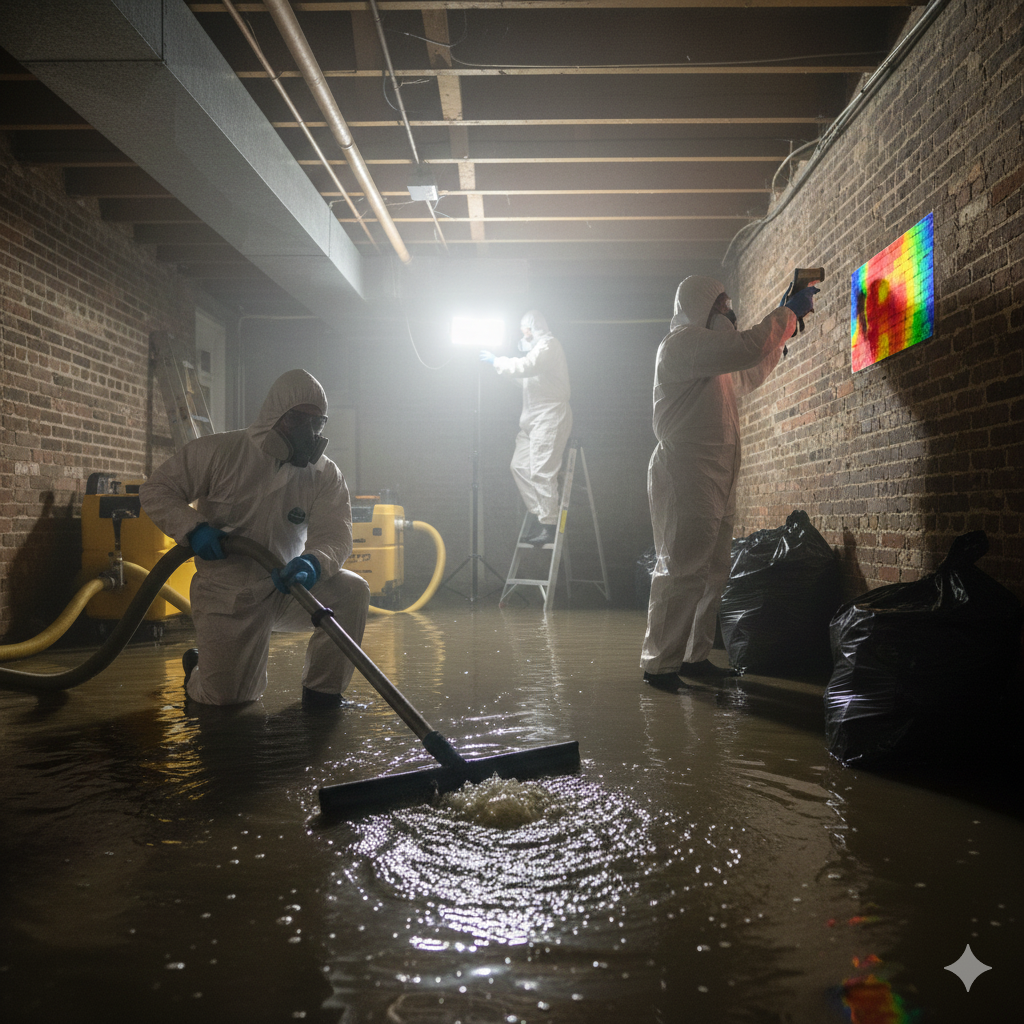
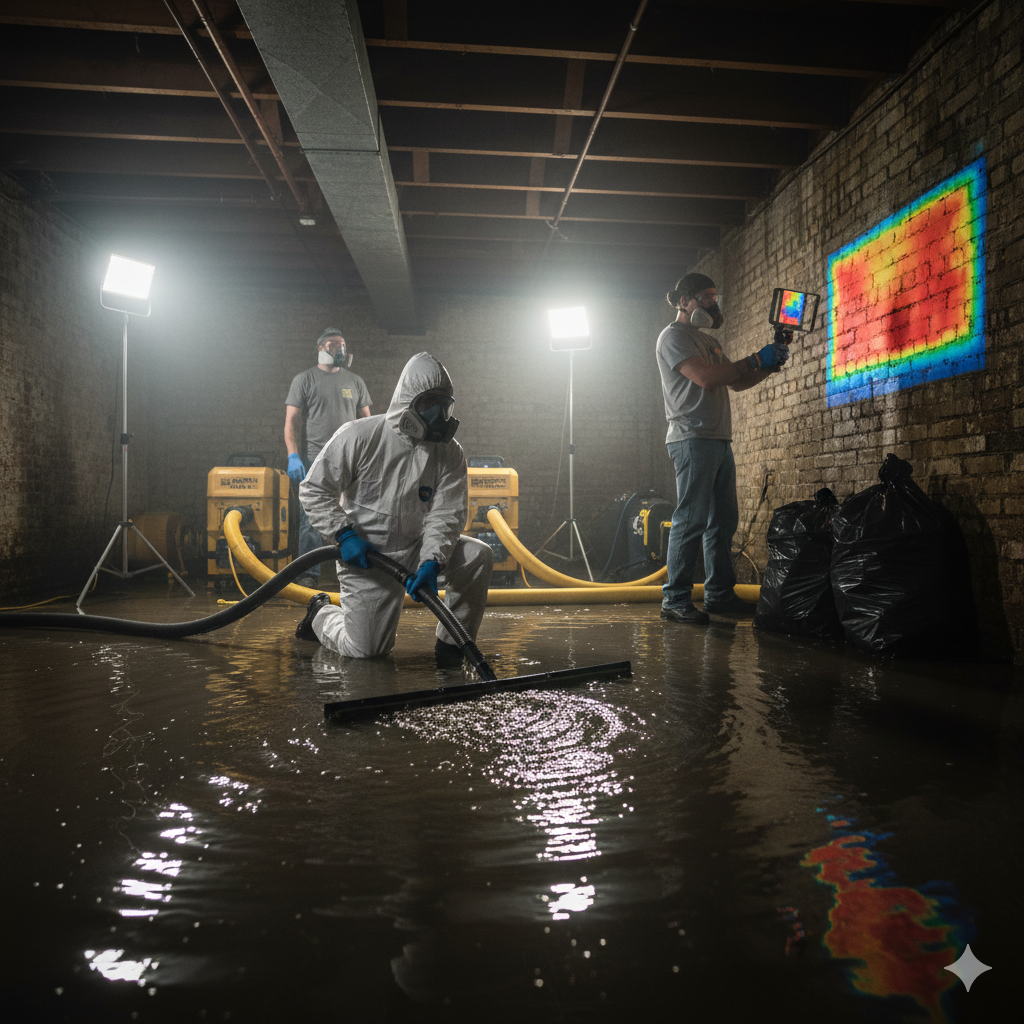
This past winter has seen unprecedented “frost heaves.” When the ground freezes deeply, it can shift your main water line. Even a microscopic shift can cause a copper pipe to snap. Because these pipes are often located in the coldest part of the basement, the resulting flood can go unnoticed for hours, saturating the “bottom plate” of your wall studs. At Redefined Restoration, we use thermal imaging to trace exactly how far the water has climbed behind your finished walls without needing to tear them down first.
Summer Humidity and Microbial Colonies
In 2026, Chicago’s humidity index has remained higher for longer periods. A basement doesn’t need a pipe to burst to suffer damage. When warm, humid air from the outside hits the cool concrete of a basement in Uptown, it turns into liquid water. Think of a cold soda can on a hot July day—that “sweat” is happening on your foundation walls. If you have stored cardboard boxes or furniture against those walls, you have provided the perfect buffet for mold growth.
Forensic Moisture Detection: Beyond the Naked Eye
One of the reasons homeowners choose Redefined Restoration over a general contractor is our focus on forensic detection. If you can see the water, the damage has already been happening for hours, if not days.
Infrared Thermal Mapping
We utilize FLIR (Forward Looking Infrared) technology during our initial assessment. This allows us to see “cold spots.” In the world of restoration, a cold spot usually indicates moisture that is trapped inside the cellular structure of your building materials. By identifying these pockets early, we can deploy targeted drying equipment to save materials that others would simply discard.
Non-Penetrating Moisture Meters
We don’t need to poke holes in your expensive trim to know it’s wet. Our 2026 sensor technology uses radio frequency to measure the moisture content of wood and drywall up to an inch deep. This data allows our Project Managers to create a “moisture map” of your basement, ensuring that we don’t stop the drying process until every structural component is back to its “dry standard.”
The Redefined Restoration Tactical Mitigation Sequence
When our crew arrives in that 60-90 minute window, we follow a strict, high-precision sequence to halt the damage.
Immediate Bulk Water Extraction
The first goal is to stop the migration of liquid water. Our truck-mounted extraction units are industrial-grade “vacuums” that can pull thousands of gallons of water out of your basement in a fraction of the time it would take a submersible pump. We don’t just clear the floor; we use weighted “extractors” to pull water out of carpet pads and subflooring, often saving the floor covering in the process.
Strategic Containment Zones
In 2026, energy efficiency in drying is paramount. We don’t try to dry your whole house if only the basement is wet. We establish “containment zones” using tension poles and heavy-duty vapor barriers. This allows us to create a micro-climate in the basement where our dehumidifiers can work at peak efficiency without being overwhelmed by the air from the floors above.
Advanced Structural Drying: The Physics of Evaporation
Drying a basement in Chicago is a science. It’s a delicate balance of three factors: Temperature, Airflow, and Dehumidification.
High-Velocity Air Circulation
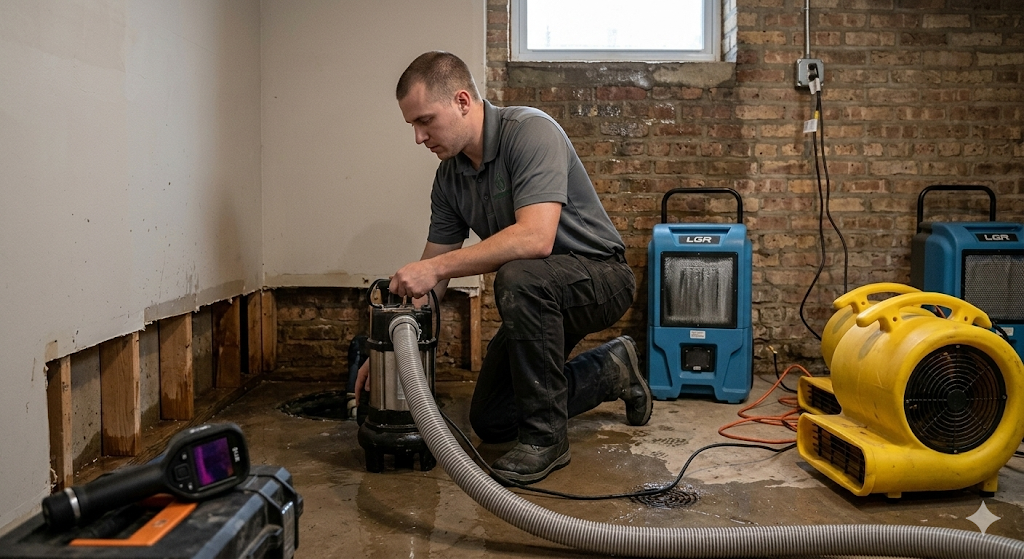
We utilize axial air movers that are designed to “hug” the wall. By pushing air directly across the surface of a wet material, we strip away the “boundary layer” of saturated air. This encourages the water molecules inside the wood or drywall to jump into the air. Think of it like a professional-grade blow dryer for your basement’s skeleton.
LGR (Low Grain Refrigerant) Dehumidification
In the basement environment, standard dehumidifiers are useless. We use LGR units that are capable of stripping moisture out of the air even when the humidity levels are already low. This creates “hungry air”—air that is so dry it aggressively pulls water out of deep structural timbers. This is the difference between a basement that “feels” dry and a basement that is truly, scientifically dry.
The Path to Reconstruction: Why the “Put Back” Matters
A major part of our Redefined Restoration philosophy is that mitigation is only half the battle. Once the basement is dry, the reconstruction phase begins.
Antimicrobial Stabilization
Before we even think about putting up new drywall, we treat every exposed surface with EPA-registered antimicrobial agents. This isn’t just a surface spray; it’s a deep-penetrating treatment that ensures any lingering spores are neutralized. In the humid 2026 Chicago climate, this is an essential insurance policy against future odors.
Moisture-Resistant Reconstruction
When we rebuild, we don’t just use the same old materials. We suggest “premium-tier” options like moisture-resistant purple board and mold-resistant insulation. If your basement is prone to the occasional Chicago “sweat,” these materials act like a lightweight raincoat for your walls, ensuring that the next humidity spike doesn’t lead to another restoration project.
Navigating Insurance Claims in 2026
The insurance landscape for water damage has shifted significantly this year. Adjusters are looking for more than just a list of items; they want data.
Real-Time Atmospheric Logs
Our Project Managers provide your insurance carrier with a comprehensive digital log. This includes daily readings of the “Grains Per Pound” (GPP) in the air and the “Percent Moisture Content” of the materials. When we can prove with a graph that your basement was dried according to industry standards, your claim is much more likely to be processed without the “investigative delays” common in 2026.
The Value of Professional Documentation
Think of our documentation like a forensic report. We record the “Category” of the water (whether it was clean, grey, or black) and the “Class” of the damage (how much of the area was affected). This authoritative approach ensures that you receive the full value of your policy, covering everything from the high-capacity pumps to the final trim work.
Localization: Why Pilsen and Logan Square Are Unique
Each Chicago neighborhood has its own architectural quirks that affect how we handle basement water damage.
The “Garden Unit” Reality in Logan Square
Logan Square is famous for its beautiful greystones and garden apartments. These units are particularly vulnerable because they are often partially below the water table. When we work in Logan Square, we pay special attention to the “baseboard line.” In many of these historic buildings, the original wood trim is irreplaceable. We use “Injectidry” systems that push air behind the trim without needing to remove it, preserving the 1920s charm while removing the 2026 water.
Foundation Materials in Uptown
Uptown features many buildings with diverse foundation types, from poured concrete to older “rubble stone” foundations. Stone foundations are incredibly porous. We treat these differently, often using specialized sealants after the drying process to help the old stone repel the groundwater that is so prevalent near the lakefront.
Sump Pump Failures: The Silent Basement Killer
In 2026, the sump pump remains the most important mechanical device in your home, yet it is the most frequently ignored.
Why Pumps Fail During Chicago Storms
A sump pump is like an athlete. If you haven’t used it in months and then ask it to run a marathon during a flash storm, it’s likely to fail. We often see pumps that have “locked up” due to sediment or those that have simply burned out their motors.
The Battery Backup Investment
At Redefined Restoration, we strongly advise our Chicago clients to invest in premium-tier battery backup systems. During our 2026 storms, power outages are common. A primary pump is useless without electricity. A backup system ensures that when the lights go out in Pilsen, your basement stays dry.
Health and Safety: The Microbial Threat
Water damage is more than a structural issue; it is a respiratory issue. In 2026, we are more aware than ever of the impact of “Damp Building Syndrome.”
Aerosolized Contaminants
When a basement stays wet for more than 48 hours, the air quality begins to degrade. Mold spores, bacteria, and volatile organic compounds (VOCs) become aerosolized. If your HVAC system is located in the basement, it will act like a giant fan, spreading these contaminants throughout your entire home.
HEPA Air Scrubbing
During our mitigation process, we deploy HEPA air scrubbers. These machines act like an industrial-grade “liver” for your home’s air. They pull air in, pass it through a series of high-efficiency filters, and exhaust clean, medical-grade air back into the space. This ensures that while we are disturbing the wet materials, your family isn’t breathing in the debris.
Structural Drying Comparison: Professional vs. DIY
Many homeowners are tempted to try a DIY approach using box fans and a shop-vac. In 2026, the physics of modern building materials makes this a risky gamble.
| Feature | DIY Approach (Box Fans & Shop-Vac) | Redefined Restoration Professional Tier |
| Extraction Depth | Surface water only. | Deep-tissue extraction from pads and pores. |
| Moisture Verification | “If it feels dry, it is dry.” | Scientific verification via radio frequency sensors. |
| Airflow Path | Random turbulence. | Laminar, high-velocity directed airflow. |
| Humidity Control | Negligible. | LGR Dehumidification (strips moisture to 10% RH). |
| Long-Term Risk | High chance of “phantom mold” behind walls. | 100% Satisfaction Guarantee and warranty. |
The “Iceberg” Effect of Water Damage
Think of a wet basement wall like an iceberg. What you see on the surface is only 10% of the moisture. The other 90% is tucked behind the drywall, inside the insulation, and deep within the wood studs. A DIY fan will only dry that 10% on the surface. The moisture behind the wall stays trapped, creating a dark, damp “greenhouse” for mold. Our Redefined Restoration equipment is designed to penetrate that wall and reach the other 90%.
The Psychological Impact of a Flooded Basement
We understand that a basement isn’t just a storage area; it’s often a playroom, an office, or a sanctuary. Seeing your possessions floating in water is a traumatic experience.
The Role of the Project Manager as a Guide
From the moment our PM steps onto your property, their job is to restore order to the chaos. They don’t just manage the fans; they manage the communication. They explain the “why” behind every piece of equipment and provide a clear timeline for when you can expect your life to return to normal.
Salvaging the Irreplaceable
In 2026, we have access to advanced “freeze-drying” techniques for documents and heirlooms. If you have wet photo albums or vintage records, don’t throw them away. Our PM can coordinate specialized “pack-out” services where these items are stabilized and restored in a controlled environment.
Summary: A Resilient Future for Chicago Basements
The reality of living in Chicago in 2026 is that water will always be a factor. Our city’s unique geography and the changing climate mean that basement flooding isn’t a matter of “if,” but “when.” However, having water in your basement doesn’t have to mean losing your basement.
By understanding the causes—from the hydrostatic pressure of our clay-heavy soil to the mechanical limits of 2026 sump pumps—and choosing a partner that uses forensic science instead of guesswork, you can protect your property’s value. At Redefined Restoration, we are proud to be a part of the Chicago community. We live in these neighborhoods, we understand these buildings, and we are dedicated to ensuring that every Logan Square bungalow and Uptown high-rise is restored with the highest level of authoritative care.
When the water rises, the clock is ticking. You need a team that doesn’t just show up, but shows up with the technology and the local expertise to “Redefine” your restoration experience. We are here 24/7, ready to turn back the tide.