

The scenario is all too familiar for residents of neighborhoods like Albany Park or Portage Park: a relentless January rain has just broken a fifty-year record, turning the snow-packed streets into slushy rivers. You head downstairs to grab a fresh lightbulb, and the first step off the bottom stair results in a heavy, cold soak that reaches your ankle. The silence of your basement has been replaced by the frantic, mechanical hum of a struggling sump pump and the unmistakable sound of water forced through the “cove joint”—that tiny seam where your basement floor meets the wall—under immense pressure.
In Chicago, basement water damage is rarely a simple “leak.” Because our city was famously built on a marsh, every subterranean structure sits in a high-density “clay bowl.” When the ground saturates, that water has nowhere to go but against your foundation. In 2026, as our weather patterns shift toward these intense, localized “thousand-year” bursts, the sheer weight of the water surrounding your home creates a hydraulic crisis. It isn’t just “wet”; it is being squeezed. To save a Chicago basement, you have to outsmart the physics of the soil and the chemistry of the city’s combined sewer system.
The Mechanical Trap: Why Chicago Basements Are Under Pressure
To understand why your basement flooded, you have to look at the ground around it. Chicago’s soil is rich in clay, which acts like a slow-moving sponge. During a heavy rain or a rapid spring thaw, this clay becomes fully saturated. Once the soil can’t hold any more, the “surplus” water creates hydrostatic pressure.
Imagine pushing an empty bucket into a swimming pool. The deeper you push, the harder the water tries to get inside the bucket. Your basement is that bucket. The water is constantly searching for a “path of least resistance.” In many older brick homes found in the area, that path is through the porous mortar between the bricks or through hairline cracks in the concrete floor. This is why you might see water “geysering” up from a floor drain or seeping through a wall that looked perfectly dry only an hour before.
The 2026 Standard: Restoration as a Biological Science
In 2026, we no longer treat floodwater as just “dirty water.” Because Chicago uses a combined sewer system—where rainwater and sewage occupy the same pipes—any water that enters your basement from a floor drain or a backup is technically “Category 3” or “Black Water.”
This water is a living environment. It contains bacteria, viruses, and organic pollutants that it picked up from the street or the city’s main lines. Simply “drying out” the area is not enough; if you dry a basement without neutralizing the biological load, you are essentially creating a petri dish. As the water evaporates, the contaminants remain behind on the surface, often becoming airborne as fine dust. Professional Redefined Restoration protocols involve a “knockdown” phase where we apply botanical, hospital-grade antimicrobials before we even begin the drying process. This ensures that the air being moved by our equipment is safe for your family to breathe.
Comparison: The Cost of Delay vs. The Value of Immediate Response
When a basement floods, many property owners consider waiting for the “rain to stop” before calling for help. However, in the world of structural drying, time is the only variable we cannot recover.
| Variable | The 24-Hour Response | The 72-Hour Delay |
| Microbial Growth | Prevented via rapid stabilization. | Visible mold colonies begin to form. |
| Structural Integrity | Materials can usually be saved and dried. | Drywall and insulation often require “gutting.” |
| Odor Development | Neutralized at the source. | Deep “musty” gases saturate the upper floors. |
| Resale Value | Fully restored with professional certification. | Permanent “flood history” markers (staining/rot). |
| Insurance Complexity | Clear data logs support the claim. | Risk of denial due to “neglected maintenance.” |
The “Wicking” Effect: A Hidden Structural Crisis
The most deceptive part of basement water damage is what happens inside your walls. Most Chicago basements are finished with drywall and wood studs. These materials are “hygroscopic,” meaning they act like a high-powered straw.
If you have two inches of water on your floor, that water doesn’t just stay at two inches. Through “capillary action,” the moisture travels upward through the porous drywall and the wooden framing. By the time you start your shop-vac, the water may have already climbed twelve to eighteen inches inside the wall. If a restoration company doesn’t use “cavity drying” techniques—where we inject dry air directly behind the baseboards—that moisture will stay trapped. This leads to “dry rot,” a condition where a fungus eats the strength out of your wooden studs, potentially compromising the support for the floors above.
The Precision of Modern Extraction: Beyond the Shop-Vac
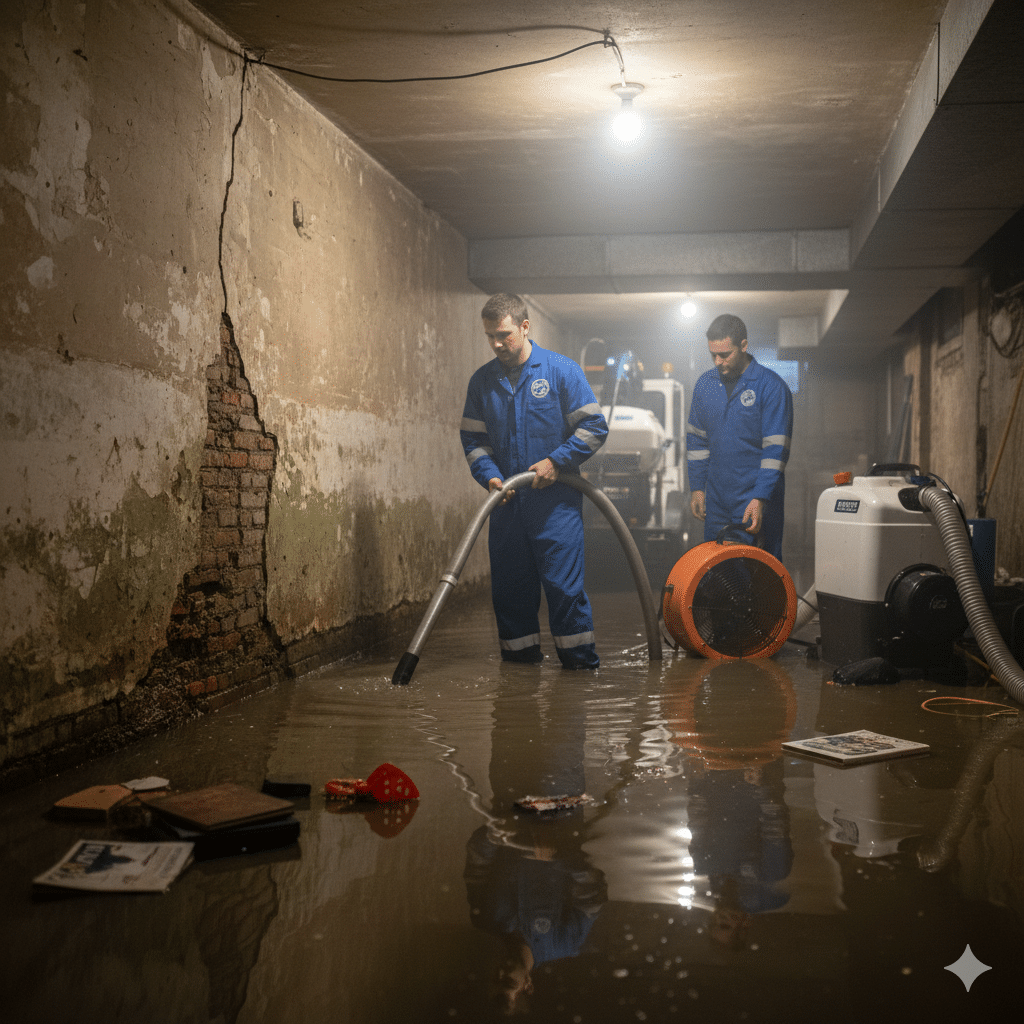
Many homeowners attempt to solve a flood with a standard wet-dry vacuum. While this removes the water you can see, it lacks the “lift” required to handle a professional-scale event.
At Redefined Restoration, we use truck-mounted extraction systems that utilize “weighted” tools. Imagine a tool that uses the weight of the technician to squeeze the water out of the carpet padding, similar to how you would squeeze a sponge. This allows us to remove 90% of the moisture in liquid form. This is critical because every gallon of water we “vacuum” out is a gallon of water we don’t have to wait for a dehumidifier to “evaporate.” In the race against mold, liquid extraction is our most powerful weapon.
Why “Thirsty Air” is the Key to Structural Health
Once the bulk water is gone, your basement might look dry, but the building materials are still “heavy” with moisture. This is where we use the science of “Psychrometry”—the study of air and its relationship with water vapor.
Think of the air in your basement as a passenger train. If the train is already full (high humidity), no more passengers (water molecules from your walls) can get on. Our industrial-grade dehumidifiers are like “empty trains.” They act like high-powered magnets for moisture, stripping the water out of the air and pumping it away. This makes the air “thirsty.” As this thirsty air moves across your wet floor joists, it naturally pulls the water out of the wood. In 2026, our equipment is “smart,” constantly adjusting its own temperature and airflow to maximize this “vapor pressure differential,” ensuring that we dry your home as fast as the laws of physics allow.
Navigating Chicago’s Unique Architecture and Local Challenges
Restoring a bungalow in Edison Park requires a different strategy than a garden-level condo in the Gold Coast.
The Historic Brick “Cove Joint”
In many older Chicago homes, the foundation isn’t a solid pour of concrete; it’s masonry. The “cove joint”—the area where the floor meets the wall—is a common point of failure. We often see water “seeping” here even when it isn’t raining, simply because the water table in Chicago is so high. We use specialized “moisture probes” to check the saturation of the soil beneath your slab, ensuring that we aren’t just drying the surface while a “swamp” remains underneath.
The Problem with “Rain Blockers”
The City of Chicago often installs “Rain Blockers” in street catch basins to prevent the sewers from overflowing. While this saves the city’s pipes, it turns the street into a temporary pond. If your basement windows aren’t properly sealed or if your “window wells” don’t have adequate drainage, this ponded water can pour directly into your home. Our basement water damage services include a “vulnerability assessment” to help you identify these local risks before the next storm hits.
The Health and Safety Protocols of 2026
We treat every flooded basement as a potential biohazard. Beyond the obvious sewage risks, a wet basement in Chicago can trigger several secondary safety issues:
- Electrocution Hazards: Water and electricity are a deadly combination. We never enter a flooded space until the “gas and power” have been cleared. In 2026, many homes have battery-backup systems that can stay “live” even if the main breaker is off; we use non-contact voltage testers to ensure the water is safe to enter.
- Airborne Spores: When you start drying a basement, you are moving air. If there was pre-existing mold or if the floodwater brought in contaminants, that air could become toxic. We use “Air Scrubbers” with HEPA filtration. These machines act like a giant lung for your house, filtering the air 4 to 6 times per hour to remove 99.97% of particulates.
- Gas Leaks: High-pressure water can sometimes shift appliances like water heaters or furnaces, causing “silent” gas leaks. Our technicians are trained to monitor air quality for more than just moisture.
The Insurance Advocacy Process
Dealing with a basement water damage claim in Chicago can be a bureaucratic nightmare. Insurance adjusters are looking for “mitigation” documentation. They want to know that you took immediate steps to stop the damage from getting worse.
We provide a “Data Package” for every job. This isn’t just a bill; it is a scientific record of your home’s recovery. It includes:
- Moisture Maps: Infrared photos showing the initial extent of the water.
- Daily Drying Logs: Proof that the “Grains Per Pound” (the amount of water in the air) was dropping every day.
- The “Dry Standard”: A comparison reading from a dry area of your home, proving that we returned the basement to its “normal” state.
By providing this data, we make it very difficult for an insurance company to “lowball” your claim. We speak the language of the adjuster so you don’t have to.
Long-Term Resilience: Preventing the “Repeat” Flood
Once the restoration is complete, our goal is to make sure we never have to see you for this problem again. In the Chicago landscape of 2026, “budget-friendly” prevention is the best investment you can make.
- Sump Pump Redundancy: We highly recommend a “primary and secondary” pump system. If the first pump fails or the power goes out during a Lakeview thunderstorm, the battery-powered backup takes over.
- Downspout Disconnection: Historically, Chicago required downspouts to be connected to the sewer. This is now a major cause of flooding. We help you redirect that water to your lawn or a rain garden, which acts like a “buffer” for the city’s system.
- Overhead Sewer Conversions: For homes in high-risk areas like Albany Park, an “overhead sewer” is the gold standard. It literally moves your sewer exit point above the basement level, making it physically impossible for the city’s sewer to back up into your home.
Structural Integrity and the “Sill Plate”
A house is only as strong as the wood that connects it to the foundation. This is called the “sill plate.” In many basement water damage cases, this wood stays wet for weeks because it is buried behind the wall. If it rots, the entire house can begin to shift, leading to cracked drywall on the second floor.
Our drying process is “bottom-up.” We focus our high-velocity air movers on the “cove” and the “sill” to ensure that the foundation of your home’s strength isn’t being slowly dissolved by hidden moisture. We aren’t just cleaning your carpet; we are protecting the skeleton of your house.
The Psychology of the “Musty Smell”
We often get calls from homeowners who “dried the basement themselves” months ago but can’t ge