
The sound of rushing water in a quiet Lincoln Park brownstone at 2:00 AM is a sound that triggers an immediate, visceral fight-or-flight response. In the early months of 2026, Chicago has faced a series of “flash-thaw” events, where rapid temperature swings from frozen tundra to a balmy forty-five degrees have put unprecedented pressure on municipal drainage and aging residential plumbing. When the inevitable happens, and you find yourself standing ankle-deep in a flooded laundry room, the fog of panic can make the recovery process seem like an insurmountable mountain.
At Redefined Restoration, we understand that the first hour of a flood is a period of high-stakes decision-making. This is why we have engineered our operations to provide a guaranteed emergency response within 60–90 minutes for most Chicagoland neighborhoods. Whether you are dealing with a catastrophic pipe burst in River North or a saturated basement near the lakefront, our team is already in motion while you are still on the phone. With over 15 years of deep-rooted experience in the local market, we have refined a deployment model that accounts for the unique logistical hurdles of the Windy City—from the congestion of the Kennedy Expressway to the tight alleyway access of historic Logan Square.
The “why” behind this rapid response is rooted in the biological and structural timeline of a building. Water is a persistent traveler; it doesn’t just sit on the floor. Within minutes, it begins to wick up drywall and seep into the microscopic pores of your subflooring. By the time our IICRC-certified crews arrive with high-capacity pumps and industrial extractors, we are fighting a race against secondary damage. Our technicians have seen it all: from frozen pipe disasters in Hyde Park to massive groundwater intrusions near Lake Shore Drive. We don’t just send “workers”; we dispatch a seasoned team led by a dedicated Project Manager who handles the intricate documentation required for insurance while you focus on your family’s safety. This speed, backed by our 100% satisfaction guarantee, isn’t just about customer service—it’s about preserving the structural skeleton of your property before microbial growth and wood rot can take hold. In 2026, where Chicago property values continue to climb, a 90-minute response is the most effective way to protect your long-term investment.
The Forensic Science of Urban Water Intrusion
Choosing between various water damage restoration companies often comes down to who understands the “invisible” damage. In 2026, we utilize forensic-grade moisture detection that goes far beyond what the naked eye can perceive.
The Capillary Action Effect
Think of your home’s drywall like a giant, vertical paper towel. When the bottom is dipped in water, the moisture doesn’t stay at the base; it climbs. This is capillary action. In many Chicago homes, especially those with traditional plaster walls, water can climb three feet up a wall in less than twelve hours. Our mission during that initial 60–90 minute window is to interrupt this upward climb before the water reaches the “structural headers” of your wall frames.
Hidden Reservoirs in Chicago Architecture
Chicago’s “Two-Flat” and “Three-Flat” buildings often feature “utility chases”—the hollow spaces behind walls where pipes and wires run. These spaces act like hidden canyons for water. A leak on the third floor in Wicker Park can create a hidden reservoir in the basement without ever showing a drip on the second-floor ceiling. We use thermal imaging to “see” through these walls, identifying these cold pockets of moisture before they turn into a permanent problem.
Navigating the Three Pillars of Structural Drying
At Redefined Restoration, we divide our recovery process into three distinct phases designed to stabilize and then reclaim your space.
Extraction: The Foundation of Recovery
The most critical step is removing the “liquid” threat. We use truck-mounted vacuum systems that are significantly more powerful than anything available at a local rental shop. Think of this like a high-powered medical “suction” for your house. We aren’t just getting the puddles; we are pulling moisture out from the deepest fibers of your carpet pad and the crevices of your hardwood floors.
Atmospheric Stabilization
Once the standing water is gone, the air becomes the enemy. In a Chicago summer, the humidity can reach levels that make drying nearly impossible without industrial intervention. We deploy LGR (Low Grain Refrigerant) dehumidifiers. These machines act like a “moisture magnet,” stripping water molecules out of the air and lowering the vapor pressure in the room, which encourages the water trapped inside your walls to evaporate faster.
Precision Monitoring
In 2026, we don’t rely on the “touch test.” We use moisture meters that provide a digital readout of exactly how much water is left in a piece of wood or drywall. We compare these readings to a “dry standard”—an unaffected area of your home—to ensure that we aren’t stopping until your home is mathematically dry.
Comparing Restoration Strategies for Chicago Homeowners
Not all water damage restoration companies use the same methodology. It is important to understand the difference between “rip and replace” and “structural drying.”
| Feature | Traditional “Rip & Replace” | Redefined Restoration Structural Drying |
| Material Impact | Walls and floors are immediately removed. | Focused on saving original materials. |
| Drying Time | 7-10 days due to reconstruction. | 3-5 days of high-velocity drying. |
| Living Impact | Major displacement of residents. | Often allows residents to stay in the home. |
| Long-Term Value | Higher investment in new materials. | Preservation of historic Chicago architectural details. |
| Moisture Verification | Visual inspection only. | Data-backed moisture logs and thermal mapping. |
The 2026 Chicago Environmental Reality
This year, the Chicago climate has presented unique challenges that require a specialized local touch. We aren’t just dealing with “rain”; we are dealing with a shift in how water interacts with our city’s footprint.
The Lake Effect Humidity Surge
Proximity to Lake Michigan means that our air is often saturated. When a home floods in a neighborhood like Edgewater or South Shore, the natural “evaporation rate” is significantly lower than it would be in a drier climate. Our 2026 protocols include “Closed System Drying,” where we seal off the affected area from the outside air, creating a micro-climate inside your home that is optimized for rapid water removal.
Modern High-Rise Pressurization
For our clients in River North or the Gold Coast, high-rise flooding is a different beast. Modern skyscrapers are pressurized to keep the air fresh. This pressure can actually push water deep into the elevator shafts and utility conduits. Our crews are trained to work with building engineers to manage these pressure differentials, ensuring that we aren’t just drying the apartment, but also the “veins” of the building.
The Role of the Project Manager: Your Insurance Liaison
One of the most stressful parts of a water emergency is the paperwork. This is why Redefined Restoration assigns a dedicated Project Manager (PM) to every Chicago loss.
Forensic Documentation for 2026 Claims
Insurance companies in 2026 are more data-driven than ever. They don’t just want to know if your house is wet; they want to see the “Psychrometric Logs”—the daily record of the temperature and humidity in the room. Your PM handles all of this. We document every step of the process with photos and digital readings, creating a “defensible file” that makes the claims process significantly smoother for you.
Coordination with Local Adjusters
Over 15 years, we have built relationships with the adjusters who work the Chicago territory. They know that when they see a Redefined Restoration report, the data is accurate and the mitigation was handled correctly. This local reputation often speeds up the approval process, getting your life back to normal faster.
Advanced Technology: Why We Invest in the Best
The tools we use in 2026 are a world away from the simple fans of the past. We treat your home with the precision of a high-tech lab.
High-Velocity Axial Air Movers
Think of these as the “jet engines” of the restoration world. They don’t just blow air; they create a laminar flow that hugs the surface of your floor and walls. This “boundary layer” of air is what actually pulls the moisture out. By using these specialized fans, we can dry a room in half the time of standard box fans.
Injectidry Systems for Hardwood
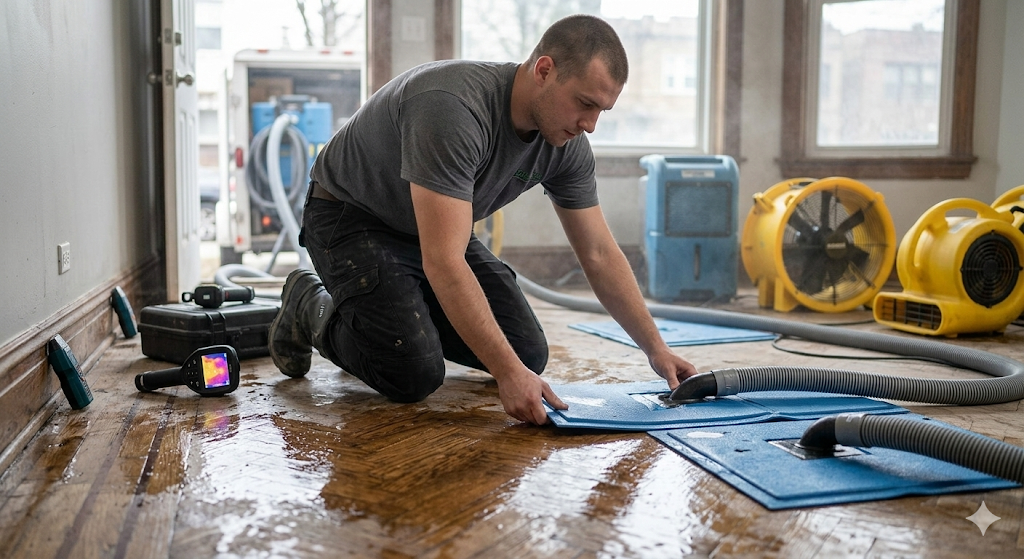
If you have historic Chicago oak floors, the last thing you want to do is tear them up. We use the Injectidry system—a series of vacuum mats that seal to the floor and pull moisture directly through the wood grain. If we get there within our 90-minute response window, we have an incredibly high success rate of saving hardwood floors that other water damage restoration companies would simply discard.
The Invisible Threat: Why Speed Prevents Mold
In the Chicago environment, mold is a constant shadow. It doesn’t need much to thrive—just a food source (like the paper on your drywall) and moisture.
The 48-Hour Biological Window
Microbial growth typically begins within 24 to 48 hours of a water intrusion. This is why our 60–90 minute response is so vital. By extracting the liquid water and lowering the humidity within the first few hours, we can often keep the mold spores in a “dormant” state. If you wait until the next day to call, the cleanup often shifts from “water mitigation” to “mold remediation,” which is a much more complex and invasive process.
HEPA Air Scrubbers: Cleaning the Breath of Your Home
Even if you can’t see mold, the air can become heavy with particulates after a flood. We utilize HEPA air scrubbers that filter the air in the affected room several times per hour. Think of this as a “liver” for your home’s air, removing 99.97% of all particles, including dust, soot, and potential mold spores, ensuring that your family is breathing clean air even while the work is being done.
Understanding Water Categories: The Clean, The Grey, and The Black
During the initial assessment, your Redefined Restoration technician will categorize the water. This dictates the safety protocols and the types of materials we can save.
| Category | Description | Typical Source | Restoration Approach |
| Category 1 | Clean Water | Broken supply line, sink overflow. | Focus on drying and salvaging all materials. |
| Category 2 | Grey Water | Dishwasher or washing machine discharge. | Sanitization required; some porous materials removed. |
| Category 3 | Black Water | Sewage, river flooding, stagnant water. | Heavy sanitization; most porous materials discarded. |
The 2026 Urban Flood Reality
In 2026, we are seeing more “Category 3” intrusions in the city due to aging infrastructure. When a Chicago sewer backs up, the water is considered “Black Water” because of the bacteria it carries. In these cases, we prioritize your health over your carpet. We use EPA-registered antimicrobials to decontaminate the area before we even begin the drying process.
Structural Integrity: Protecting the “Skeleton” of Your Home
Water doesn’t just damage the finishes; it can weaken the very frame of your house. This is especially true in Chicago’s wood-framed bungalows.
The Swelling of the “Sill Plate”
The sill plate is the piece of wood that sits directly on your foundation. When it gets wet, it swells and can actually shift the walls above it. By arriving quickly and using targeted heat drying, we can stabilize these structural components before the wood “checks” or cracks, preserving the long-term stability of your home.
Corrosion Mitigation for Modern Electronics
Most Chicago homes in 2026 are “smart homes.” Water and electronics are a disastrous mix. However, the real killer isn’t always the liquid—it’s the corrosion that follows. High humidity causes “evaporative corrosion” on circuit boards. By dropping the humidity in your home within the first 90 minutes, we help protect your smart-home sensors, thermostats, and entertainment systems from permanent failure.
The Human Element: Empathy in a Crisis
At Redefined Restoration, we never forget that we are working in your private sanctuary. We treat every home as if it were our own.
Transparent Communication
Your Project Manager will walk you through every step of the process. You will never be left wondering “what happens next.” We provide daily updates on the drying progress and coordinate with any other trades—like plumbers or electricians—that might be needed to solve the original problem.
The 100% Satisfaction Guarantee
We stand by our work. If you aren’t satisfied with how the mitigation was handled, we will make it right. This commitment to the Chicago community is why we have survived and thrived for over 15 years while other