The skyline of Chicago is an architectural marvel, but beneath the soaring glass and historic masonry lies a complex, aging infrastructure that is increasingly at odds with the erratic weather patterns of 2026. Imagine it is a Tuesday evening in late March. A sudden, torrential downpour—what local meteorologists are now calling “micro-monsoons”—has overwhelmed the combined sewer systems near Albany Park. Within minutes, the pressure in the municipal pipes reverses, and a dark, forceful surge of water begins to bubble up through your basement floor drain. This is the moment when the clock starts ticking against the structural integrity of your home.
At Redefined Restoration, we have engineered our operations to meet this exact crisis. When flooding strikes your Chicago home or business, time is the only variable that dictates the difference between a successful dry-out and a total structural loss. Our team responds within 60-90 minutes, 24/7, to begin immediate mitigation. This window is not an arbitrary goal; it is a clinical necessity. Within the first two hours of water intrusion, porous materials like drywall and softwoods begin to swell at a cellular level. By arriving on-site before this swelling becomes irreversible, our licensed and certified emergency response team can stabilize the property and prevent the cascading failures that lead to long-term rot.
With over 40 years of combined experience serving the Chicagoland area, we have refined a rapid-deployment model that accounts for the city’s unique logistical hurdles. Whether it’s navigating the gridlock of the Kennedy Expressway during a storm or accessing tight mechanical rooms in a Gold Coast high-rise, our proximity and local knowledge ensure we are the first line of defense. We understand that fast action prevents structural issues and the inevitable colonization of mold growth, which, in the humid 2026 climate, can begin in as little as 24 hours. This dedication to speed has made us the trusted choice for Chicago residents who need immediate, authoritative relief from water damage emergencies. When you contact Redefined Restoration, you aren’t just calling a contractor; you are activating a high-precision recovery sequence designed to “Reset” your property to its pre-loss condition before the water has a chance to become a permanent resident.
The 60-Minute Window: Why Chicago Floods Require Forensic Speed
The physics of a Chicago flood are unique. Unlike a slow-rising river in the plains, urban flooding in our city is often “hydrostatic.” This means the water isn’t just sitting; it is pushing.
The Hydrostatic Pressure Trap
Think of the soil around your Chicago bungalow like a giant, saturated sponge. After a heavy 2026 rain event, the ground becomes so heavy with water that it exerts massive pressure against your foundation walls. If that water isn’t extracted immediately, the pressure can cause “bowing” in the masonry or cracks in the floor slab. Our 90-minute response is designed to relieve this pressure through high-volume extraction, effectively “pulling the plug” on the stress being applied to your home’s skeleton.
The Biological Clock of Urban Water
In an urban environment like Chicago, floodwater is rarely “clean.” In 2026, the city’s combined sewer overflows mean that basement flooding often contains “Category 3” contaminants. The longer this water sits, the more it permeates the microscopic pores of your building materials. By arriving within the hour, we can often extract the bulk of the contaminants before they “hitch a ride” deep into your wall studs or subflooring.
Navigating the Three Pillars of Flood Damage Restoration
A successful recovery is built on a sequence of technical phases. At Redefined Restoration, we treat flood damage restoration as a clinical process rather than a simple cleanup.
Phase One: The Surgical Extraction
Extraction is the most critical step. We utilize industrial-grade truck-mounted vacuum systems that are significantly more powerful than anything available at a local hardware store. Think of this like a “deep-tissue” massage for your floors; we are pulling moisture out from the deepest layers of the carpet pad and the crevices of the floorboards.
Phase Two: Atmospheric Stabilization
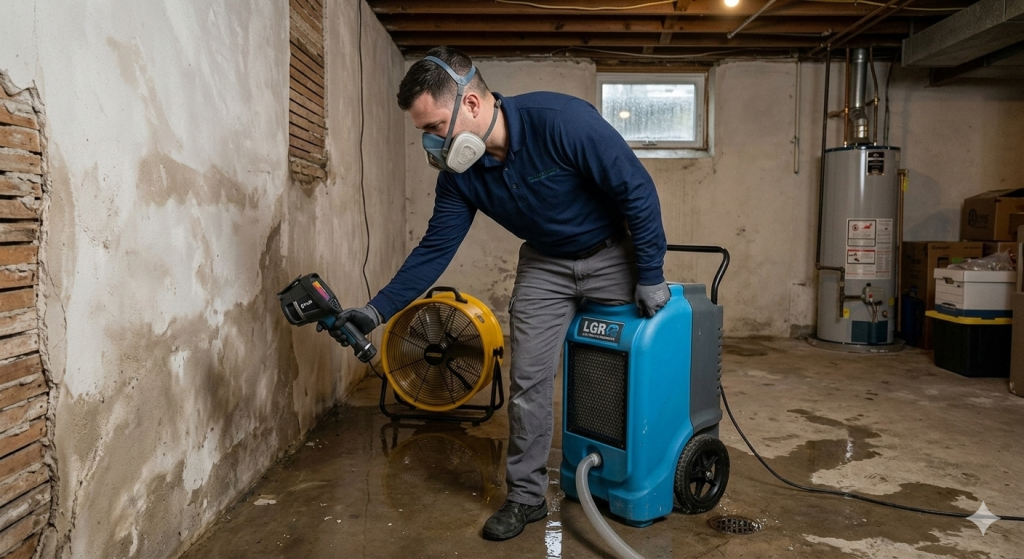
Once the standing water is gone, the air remains the enemy. In the humid 2026 Chicago summer, the “vapor pressure” in a flooded room is so high that water will actually stay trapped inside the walls. We deploy LGR (Low Grain Refrigerant) dehumidifiers. These machines act like a “moisture magnet,” stripping the water molecules out of the air and lowering the humidity to a point where the walls can finally “breathe” the moisture out.
Phase Three: Forensic Drying Documentation
In 2026, insurance companies require more than just a dry floor; they require proof. We use “moisture mapping” technology to document the drying progress. We take readings from “dry standards”—areas of your home that weren’t affected—to ensure that we aren’t stopping until your home is mathematically back to its natural state.
Chicago-Specific Challenges in the 2026 Restoration Landscape
Restoring a home in Chicago isn’t the same as restoring one in the suburbs. Our city’s architecture and density create specific hurdles that only a local expert can clear.
The Historic Masonry Dilemma
Chicago is a city of brick and stone. While these materials are beautiful, they are incredibly “thirsty.” If a historic greystone in Lincoln Park floods, the brick can hold moisture for weeks. Traditional drying methods often fail here because they only dry the surface. We utilize “Directed Heat” technology, which focuses warmth on the masonry to speed up the molecular movement of the water, forcing it out of the stone before it can cause the brick to “spall” or flake off.
High-Rise Vertical Flooding
In the Loop and along Lake Shore Drive, we often deal with “vertical” floods—water that starts on the 20th floor and travels down. In these scenarios, the water follows the “utility chases” (the paths for pipes and wires). Our 24/7 team is trained to trace these paths, ensuring that we aren’t just drying the apartment where the leak started, but also the “hidden” moisture trapped in the ceilings of the neighbors below.
Comparative Technology: Professional Mitigation vs. DIY Efforts
Many Chicagoans are tempted to handle a small flood themselves. However, the technology gap in 2026 makes professional flood damage restoration a much more cost-effective long-term investment.
| Feature | DIY / Shop-Vac Approach | Redefined Restoration Professional Tier |
| Extraction Power | Low (Surface level only) | High (Truck-mounted deep extraction) |
| Moisture Detection | Visual / Touch | Infrared Thermal Imaging & Protimeters |
| Airflow Science | Box Fans (Circular airflow) | Axial Air Movers (Laminar, high-velocity) |
| Dehumidification | Residential Grade | Industrial LGR (Low Grain Refrigerant) |
| Contaminant Control | None | EPA-Registered Antimicrobial Treatments |
| Documentation | None | Certified Moisture Logs for Insurance |
The “Iceberg” Analogy of Water Damage
Think of water damage like an iceberg. What you see on the surface—the wet carpet or the puddle in the corner—is only 10% of the problem. The other 90% is “hidden” moisture tucked behind baseboards, under cabinets, and inside wall cavities. A shop-vac only addresses the 10%. Our infrared cameras allow us to “see” the 90%, ensuring we don’t leave behind the moisture that leads to structural “rot” and toxic mold.
The 2026 Environmental Context: Why This Year is Different
As we navigate 2026, Chicago’s environment has become more challenging for property owners. The “Urban Heat Island” effect combined with increased precipitation means our city stays warmer and wetter for longer periods.
The “Thaw-Freeze” Cycle of 2026
This year, we have seen an unprecedented number of “thaw-freeze” events. Rapid snowmelt followed by a hard freeze causes water to get trapped in the foundation of Chicago homes. If this water isn’t mitigated, it expands as it freezes, literally cracking the concrete. Our team specializes in “Environmental Stabilization,” using heat-injected drying to ensure that moisture is removed from your foundation before the next cold front hits.
Increased Humidity and Microbial Proliferation
Humidity levels in Chicago during the 2026 “rainy season” have hovered near 80%. This is the perfect breeding ground for mold. Without the industrial dehumidification provided by Redefined Restoration, a flooded basement will become a biological hazard within 48 hours. We treat every flood as a race against these spores, using HEPA air scrubbing to clean the air as we dry the structure.
Content Management: Saving What Matters Most
Flood damage restoration isn’t just about the walls; it’s about the life inside them. When we arrive on-site, our first priority after extraction is “Content Stabilization.”
The “Dry-Fast” Protocol for Heirlooms
If you have family photos, vintage Chicago records, or expensive electronics that have been touched by water, we apply our “Dry-Fast” protocol. This involves moving these items to an “unaffected zone” where we can apply controlled, low-humidity airflow. We act as “archaeologists” of your home, salvaging the items that insurance cannot replace.
Smart-Home Electronics and Corrosion
In 2026, the average Chicago home is packed with smart-home sensors and high-end electronics. Water is an electrolyte, meaning it can cause short circuits and “micro-corrosion” on circuit boards. By extracting the moisture from the air within 90 minutes, we stop the “evaporative corrosion” that happens when water starts to turn into vapor and settles on your TV or computer components.
The Anatomy of an Insurance Claim in 2026
The insurance landscape has changed significantly this year. Insurance adjusters are now using more sophisticated AI auditing tools to review claims. They are looking for one thing: Evidence of Mitigation.
Fulfilling Your “Duty to Mitigate”
Every Chicago insurance policy contains a clause requiring the homeowner to “mitigate further damage.” If you wait 24 hours to call a professional, the insurance company may deny the portion of the claim related to mold or secondary damage because you failed your duty to act. Our 60-90 minute response provides you with a “timestamped” record of professional intervention, making the claims process significantly smoother.
The Value of a Detailed Log
We provide a comprehensive digital package for your adjuster. This includes:
- Psychrometric Charts: Proving the air was dry.
- Moisture Maps: Proving the structure was dry.
- Thermal Images: Proving there is no “hidden” water.
This level of authoritative detail is why Redefined Restoration is the preferred partner for many local Chicago insurance agents. We speak their language and provide the data they need to approve your claim quickly.
Structural Drying: Why We Don’t Just “Rip and Replace”
In the past, the standard response to a flood was to “tear everything out.” In 2026, with the high investment required for new building materials and the environmental push for sustainability, we focus on “Drying in Place.”
The “Raincoat” Analogy for Paint and Sealants
Modern paints act like a raincoat for your walls. They are designed to be moisture-resistant. However, when a flood happens, that “raincoat” traps the water inside the drywall. We use “Vapor Venting”—a technique where we remove the baseboards and drill small, invisible holes to allow our air movers to push air behind the “raincoat.” This allows us to save the drywall, saving you the mess and the cost of a full reconstruction.
Saving Hardwood Floors in the Windy City
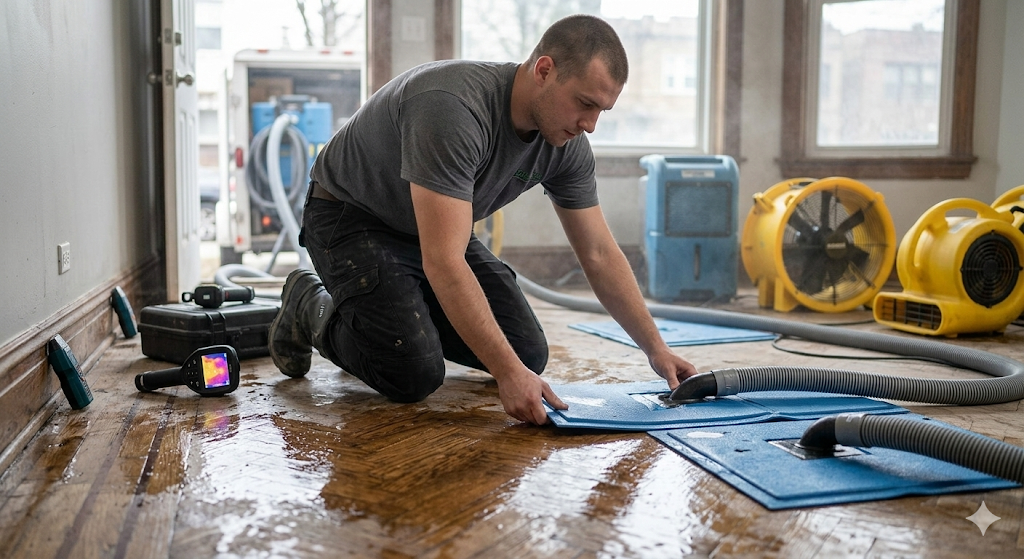
Chicago’s historic homes often feature beautiful oak or maple hardwoods. When these get wet, they “cup”—the edges rise up. Most contractors will tell you they are ruined. At Redefined Restoration, we use “Pressure Mats.” These mats seal to the floor and use high-pressure suction to pull moisture directly through the wood grain. If we get there within our 90-minute window, we can often save these floors, preserving the character of your Chicago home.
The Health Implications of Unresolved Water Intrusion
Floodwater is more than a structural threat; it is a health threat. In 2026, we are seeing a rise in “Damp Building Syndrome” among Chicago residents who didn’t properly mitigate water damage.
Aerosolized Contaminants
When floodwater evaporates, it doesn’t just disappear. It leaves behind microscopic particles of whatever was in the water—bacteria, chemicals, and toxins. These particles become “aerosolized,” meaning they float in the air you breathe. We utilize HEPA air scrubbers during the entire drying process. These machines act like a “liver” for your home’s air, filtering out 99.97% of contaminants.
The Silent Threat of Mycotoxins
Mold doesn’t just cause allergies; it produces “mycotoxins”—chemical byproducts that can cause “brain fog” and fatigue. By the time you smell that “musty” Chicago basement odor, the mycotoxins are already present. Our 24/7 flood damage restoration service is designed to stop the mold cycle before it begins, protecting your family’s long-term health.
Why “Local” is Your Best Asset in a 2026 Crisis
In the age of national franchises, Redefined Restoration remains a deeply rooted Chicago company. This isn’t just about pride; it’s about performance.
Knowledge of Chicago Soil and Topography
We know that the soil in Beverly is different from the soil in Rogers Park. We understand how the “lake effect” influences the drying rate of a home. This local expertise allows us to calibrate our equipment for the specific Chicago micro-climate, ensuring faster drying times than a “one-size-fits-all” national company.
The 24/7 Chicago Infrastructure
We aren’t waiting for a corporate office in another time zone to approve a crew. Our emergency response team lives in the neighborhoods we serve. We are familiar with the “Chicago Grid,” the alleyway access points, and the municipal water shut-off locations. When every second counts, this local “street smarts” is what ensures we meet our 60-90 minute arrival promise.
Summary: Restoring Your Peace of Mind
A flood is a traumatic event. It is an invasion of your sanctuary. But in 2026, it doesn’t have to be a permanent disaster. With a rapid, professional response, most flood damage can be fully reversed.
At Redefined Restoration, we combine over four decades of heritage with the most advanced 2026 technology to provide an authoritative, high-precision recovery. We don’t just “mop up”; we perform a forensic restoration of your property’s health. From the first 60 minutes of extraction to the final moisture log for your insurance company, we are with you every step of the way.
Chicago is a city that knows how to rebuild. Whether it’s after the Great Fire or a 2026 spring flood, we are a community that values resilience. We are proud to be part of that resilience, one home at a time.