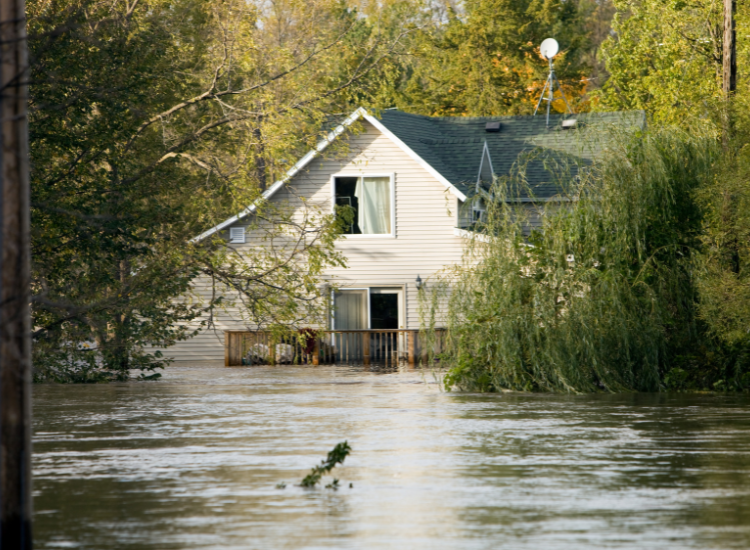
You are standing in your basement in Lincoln Square, and the sound isn’t the usual hum of the furnace. It’s a rhythmic, heavy splashing. A pipe has burst behind the drywall, or perhaps the notorious Chicago “flash flood” has sent the city’s combined sewer system surging back into your garden-level unit. In that moment, your brain shifts into survival mode. You grab towels, you move the heirloom rug, and you start searching for help.
What most property owners in the Windy City don’t realize is that the water you can see—the puddles reflecting your flashlight—is only about twenty percent of the problem. The real crisis is the water you cannot see. It is currently wicking up your wall studs like a straw and soaking into the porous Chicago common brick of your foundation. This is where the gap between “cleaning up” and “professional restoration” becomes a chasm. In 2026, the standard for a healthy home has moved beyond surface-level drying. To truly protect your investment, you need to understand the structural physics that the best water damage restoration companies use to save a building from the inside out.
The Hidden Mechanics of Structural Wicking
When water enters a room, it doesn’t just sit on the floor. It is opportunistic. Through a process called “capillary action,” water moves upward through porous materials against the force of gravity. Think of a sponge dipping into a glass of water; the water travels up into the sponge even though the sponge is “above” the water line.
In our local architecture, from the historic greystones to the modern glass high-rises in the West Loop, this wicking can happen at an alarming speed. Drywall, insulation, and wood framing act like a giant wick for a candle. If you only dry the floor, the water trapped inside the walls stays there. This trapped moisture creates a “micro-environment” where mold spores—which are naturally present in the Chicago air—can settle and thrive. Within forty-eight hours, a simple leak can turn into a biological event that compromises the air quality of the entire property.
How Modern Restoration Science Outsmarts Moisture
Professional water damage restoration companies do not rely on “feel” or “sight” to determine if a room is dry. In 2026, we use a discipline called Psychrometry. This sounds like a complex medical term, but it is actually the science of how air and water vapor interact.
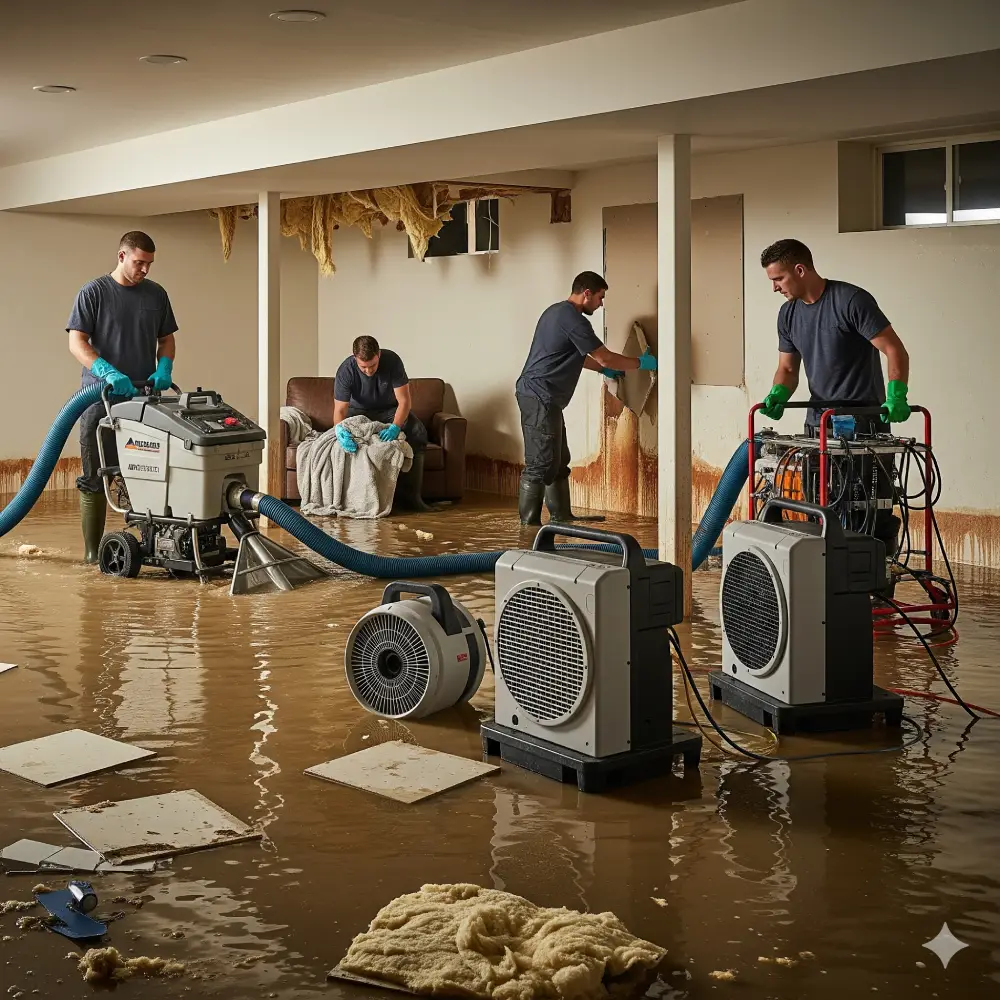
Essentially, we use the air as a tool to pull water out of your floors and walls. To do this, we have to create “thirsty air.” When the air in your home is humid, it’s like a sponge that is already full of water; it can’t soak up any more. By using industrial-grade dehumidifiers—which act like high-powered magnets for moisture—we strip the water out of the air. Once the air is “thirsty,” it starts to pull the water out of your carpet and wood studs.
This is a delicate balance. If you dry a room too fast, you can cause “case hardening,” where the outside of a wood beam dries and shrinks so quickly that it cracks the interior, causing structural weakness. If you dry it too slowly, you invite rot. The elite teams at Redefined Restoration monitor these “drying curves” daily to ensure your home returns to its original structural strength without secondary damage.
The Chicago Context: Weather and Architecture
Chicago presents a unique set of challenges that restoration companies in other parts of the country rarely face. Our local climate and building styles dictate a very specific approach to moisture management.
The Seasonal Humidity Swing
During a humid Chicago summer, the outdoor air is often already saturated. If a pipe leaks in July, we cannot simply open the windows to “air the place out.” Doing so would actually invite more moisture into the home. Conversely, in the dead of a freezing January, the indoor air is incredibly dry, but the structure itself may be frigid. If we don’t manage the temperature of the wet materials, the water won’t evaporate. In 2026, we utilize specialized heating systems to “excite” the water molecules in your floor, making them move faster so our dehumidifiers can catch them more easily.
Older Brick Foundations
Many homes in Avondale, Logan Square, and Bridgeport are built with “Chicago Common Brick.” This brick is incredibly porous compared to modern masonry. When a basement floods, this brick soaks up water like a terracotta pot. If a company doesn’t use deep-penetrating moisture meters to check the “core” of the brick, they might leave pounds of water trapped inside. This leads to “efflorescence”—that white, powdery salt you see on basement walls—which is a sign that water is still moving through the masonry, potentially weakening the mortar over time.
The Professional Workflow: What Happens Next
When you call one of the leading water damage restoration companies, the process follows a strict technical order. This isn’t just for efficiency; it’s to prevent “cross-contamination.”
1. Thermal Inspection and Moisture Mapping
We don’t start by tearing down walls. We start by seeing the invisible. Using infrared cameras, we can see temperature differences in your walls. Since wet materials are usually cooler than dry ones, the infrared camera shows us exactly where the water traveled. We create a “map” of the moisture, which allows us to be surgical in our approach rather than gutting the entire room.
2. High-Velocity Extraction
It is much more cost-effective to “vacuum” water out than it is to “dry” it out. We use truck-mounted extraction units that have thousands of times more suction power than a standard shop-vac. These units can pull water out of the deep “padding” beneath your carpet, often saving the carpet itself if the water was clean.
3. Structural Stabilization
Once the standing water is gone, we apply hospital-grade antimicrobials. This is a critical safety step. We want to make sure we aren’t just drying out a “biology project.” By sanitizing the surfaces immediately, we stop bacteria from multiplying while the drying machines do their work.
4. Controlled Evaporation
This is where the heavy equipment comes in. We use “Air Movers”—industrial fans designed to create a “cyclone” of air right at the floor level. This high-speed air “peels” the moisture off the surface so our dehumidifiers can collect it.
Comparing Professional Restoration to General Maintenance
Many property managers or homeowners believe they can handle a leak using their in-house maintenance staff. While this might save a few dollars initially, the long-term investment in a professional firm usually pays for itself by preventing structural failure and mold.
| Feature | In-House Maintenance / DIY | Professional Restoration Team |
| Moisture Detection | Touch and sight (unreliable) | Infrared and deep-penetrating meters |
| Drying Method | Standard fans and open windows | Industrial LGR dehumidifiers and axial fans |
| Bacteria Control | Household bleach (mostly water-based) | EPA-registered botanical antimicrobials |
| Documentation | None | Full moisture logs for insurance claims |
| Structural Integrity | Risk of warped floors and rotted studs | Scientific drying to “dry standard” |
| Air Quality | Risk of mold spore circulation | HEPA air scrubbing and filtration |
The Health Implications of “Almost Dry”
In 2026, we are more aware than ever of how indoor air quality affects our health. When a home isn’t dried properly, the moisture that remains trapped behind baseboards or under kitchen cabinets becomes a breeding ground for “microbial volatile organic compounds” (MVOCs). This is what creates that “musty” basement smell.
That smell isn’t just an annoyance; it is a sign that biological organisms are active in your home. For families in Chicago with children or elderly residents, this can lead to respiratory irritation or an increase in allergy symptoms. Professional water damage restoration companies use HEPA air scrubbers during the drying process. These machines act like a “liver” for the air in your house, filtering out 99.97% of the tiny particles, dust, and spores that the drying fans might stir up. This ensures that while we are fixing the floor, we aren’t compromising the air you breathe.
Navigating the Chicago Insurance Maze
One of the most stressful parts of a water emergency is dealing with the insurance company. Adjusters in 2026 are looking for data, not just photos. They want to see “moisture logs” that prove the home was brought back to a “dry standard.”
A “dry standard” is a measurement we take from a part of your house that didn’t get wet. For example, if your basement flooded, we take a reading from a dry stud on the first floor. This tells us what “normal” looks like for your specific home and its materials. We then monitor the wet areas until they match that dry standard. When you work with Redefined Restoration, we provide this technical documentation to your insurance carrier, making the claim process much smoother. It turns the conversation from an argument about what “feels dry” into a factual report based on physics.
The Silent Threat: Secondary Damage
If a professional company isn’t brought in, “secondary damage” is almost a guarantee. This is damage that wasn’t caused by the initial leak but was caused by the high humidity that the leak created.
Imagine a pipe bursts in your kitchen. You mop the floor, but you don’t use professional dehumidifiers. The air becomes so wet that the moisture starts to condense on the cooler surfaces upstairs. Suddenly, you have “ghosting” (dark streaks) on your bedroom ceiling, or your high-end wooden furniture in the dining room starts to “cloud” (develop white spots in the finish). The right restoration team manages the entire volume of air in the property, not just the room where the water was found.
Safety and Structural Stability
Water is heavy. When a ceiling or a subfloor becomes saturated, it loses its “shear strength.” This means it can no longer hold the weight it was designed for. In older Chicago homes with plaster-and-lath ceilings, a leak on the second floor can lead to a sudden, dangerous collapse of the plaster below.
Professional restoration teams are trained to identify when a material is no longer safe. Sometimes, the most professional thing we can do is tell you that a ceiling needs to come down for your safety. We look at the “load-bearing” capacity of wet materials to ensure that as the home dries, it doesn’t become a hazard to your family.
Why 2026 Standards Favor “Restoration” over “Replacement”
A decade ago, the standard response to a flood was to “gut the house.” Today, because the technology of water damage restoration companies has advanced so much, we can save a significant amount of the original structure.
- Hardwood Floor Drying: We use “pressure mats” that use suction to pull moisture directly through the pores of the wood. This can often save expensive oak or maple flooring that would have previously warped and required replacement.
- Injection Drying: For walls that are wet on the inside but look fine on the outside, we can sometimes drill tiny holes and “inject” dry air directly into the wall cavity. This saves the cost of tearing out and replacing the drywall.
- In-Place Carpet Drying: If the water is from a clean source (like a supply line), we can often dry the carpet and the padding without even pulling it up, using high-powered sub-surface extraction tools.
This “restore over replace” philosophy is not only faster, but it is also much more environmentally friendly. It keeps tons of construction debris out of our local landfills and gets your life back to normal days or even weeks sooner.
The Biohazard Reality: Category 1 vs. Category 3
Not all water is created equal. In the restoration industry, we categorize water based on its cleanliness.
- Category 1 (Clean Water): From a broken water supply line or a leaking faucet. It doesn’t pose a substantial risk if handled quickly.
- Category 2 (Gray Water): This might be from a dishwasher or a washing machine. It contains “nutrients” (like soap or skin cells) that can allow bacteria to grow quickly.
- Category 3 (Black Water): This is the most dangerous. This is sewer backup or rising floodwater from the street. It contains pathogens, viruses, and chemicals.
When you deal with Category 3 water in Chicago, the mitigation process is entirely different. Everything porous—like carpet padding or drywall—that was touched by the water usually must be removed. This is where the expertise of Redefined Restoration is vital. We have the training to handle these biohazards safely, using personal protective equipment (PPE) and containment barriers to make sure that the “black water” contaminants don’t spread to the clean parts of your home.
Final Thoughts for the Chicago Property Owner
A water emergency is a test of your home’s resilience, but more importantly, it is a test of the partners you choose to fix it. In a city like Chicago, where the weather is tough and the architecture is varied, you cannot afford to guess.
Whether you are dealing with a slow drip that has been hiding behind a vanity for months or a sudden burst pipe that has turned your living room into a lake, the goal is the same: return the property to its pre-loss condition as quickly and safely as possible. By choosing among the top water damage restoration companies that prioritize 2026 drying technology and scientific documentation, you are doing more than just fixing a leak. You are ensuring the long-term health of your family and the structural integrity of your home.
When you see our trucks in your neighborhood, know that we aren’t just there to move air; we are there to protect the very “bones” of the city we love. From the first thermal image to the final moisture reading, our commitment is to provide a result that makes the emergency feel like a distant memory.