The rhythmic sound of heavy rain against a windowpane is often considered soothing, but for property owners in Chicago, it frequently triggers a familiar sense of anxiety. As we navigate the early months of 2026, the unique architectural and geographical landscape of the Windy City continues to present significant challenges for below-grade structures. When the sky opens up over neighborhoods from Rogers Park to Beverly, the battle against basement water damage begins in earnest.
In a city built on a marsh, the transition from a dry, functional lower level to a saturated disaster zone can happen in a matter of minutes. Whether it is a slow seepage through a foundation crack or a catastrophic sewer backup during a Lake Michigan-effect storm, the implications for your property’s structural integrity and your family’s health are profound. At Redefined Restoration, we understand that recovering from these events requires more than just a shop vacuum and a few fans; it requires a scientific approach to moisture equilibrium and a deep familiarity with the specific building codes and climate conditions of Chicago, IL.
The Geography of Risk: Why Chicago Basements Flood
To effectively address water intrusion, one must first understand why it is so prevalent in our region. Chicago’s geography is a double-edged sword. While our proximity to the lake provides beauty and commerce, it also creates a high water table.
The Clay Dilemma
Much of the soil in the Chicago area is composed of heavy clay. Unlike sandy soils that allow water to percolate downward quickly, clay acts like a sponge. It absorbs water, expands, and holds that moisture against your foundation walls. This creates tremendous hydrostatic pressure. When the ground is saturated, the water seeks the path of least resistance, which is often a tiny fissure in your concrete floor or the seam where the wall meets the floor (the cove joint).
The Combined Sewer System
Chicago’s infrastructure is a marvel of 19th-century engineering, but its “combined sewer” system is a primary culprit for basement water damage. In many parts of the city, stormwater and sanitary sewage flow through the same pipes. During an intense 2026 downpour, these pipes can reach capacity. When the city’s Deep Tunnel system (the Tunnel and Reservoir Plan) is overwhelmed, the excess pressure can push mixed sewage back through the floor drains of residential and commercial basements. This is not just a water problem; it is a biohazard event that requires professional decontamination.
Categorizing the Threat: Not All Water is Equal
In the restoration industry, we don’t just see “wet” or “dry.” We categorize water based on its source and its potential to cause harm. Understanding these categories is essential for determining the scope of the cleanup and what materials can be salvaged.
Category 1: Clean Water
This originates from a sanitary source, such as a broken supply line or a leaking faucet. While initially “clean,” Category 1 water can quickly degrade into more dangerous categories if left untreated. In the humid environment of a Chicago basement, clean water can begin to support microbial growth in as little as 24 to 48 hours.
Category 2: Gray Water
This water contains significant contamination and has the potential to cause discomfort or sickness if contacted. Common examples include discharge from washing machines, sump pump failures (depending on the source), and dishwasher overflows. Gray water contains nutrients that act as “food” for mold and bacteria, accelerating the degradation of building materials.
Category 3: Black Water
This is the most dangerous classification and is common during Chicago floods. Black water is grossly unsanitary and contains pathogenic, toxigenic, or other harmful agents. This includes all sewage backups, rising water from rivers or the lake, and wind-driven rain from storms. When black water enters a basement, porous materials like carpets, pads, and even some drywall are generally considered non-salvageable.
The Hidden Chemistry of Foundation Seepage
Many homeowners notice a damp smell or white, powdery stains on their basement walls long before a major flood occurs. This is the result of capillary action and efflorescence.
Capillary Action
Concrete is porous. Even without a visible crack, water can be pulled through the wall on a molecular level. This constant moisture migration can weaken the concrete over decades, leading to structural spalling.
Efflorescence
Those white crystals you see on your foundation walls are salts. As water moves through the concrete, it dissolves minerals. When the water evaporates on the interior side of the wall, it leaves the salt behind. While efflorescence itself isn’t mold, it is a definitive warning sign that your basement is under constant hydrostatic pressure and is a prime candidate for future basement water damage.
Psychrometry: The Science of Structural Drying
When Redefined Restoration arrives at a site, our goal is not just to “remove the water.” Our goal is to achieve “dry standards.” This is accomplished through psychrometry—the study of the thermodynamic properties of air and water vapor.
The Drying Triangle
To dry a basement effectively, we must balance three elements:
- Air Movement: High-velocity air movers are used to disturb the “boundary layer” of saturated air sitting on the surface of wet materials, encouraging evaporation.
- Dehumidification: As water evaporates, the relative humidity in the room spikes. If we don’t remove that moisture from the air using industrial LGR (Low Grain Refrigerant) dehumidifiers, the air becomes “full,” and drying stops.
- Temperature: Heat increases the vapor pressure of the moisture trapped inside wood and drywall, making it easier to pull out.
In a typical Chicago basement, which is often cooler than the rest of the house, managing these three variables is a delicate dance. If we move too much air without sufficient dehumidification, we risk “secondary damage”—where moisture from the floor ends up condensing on the ceiling or inside electronics on the upper floors.

Structural Impacts on Chicago’s Unique Architecture
Chicago is home to a diverse array of building types, each of which reacts differently to water intrusion.
The Historic Chicago Bungalow
The iconic bungalow often features solid masonry construction. While brick is durable, it is also highly absorbent. If a bungalow basement floods, the “Chicago Common Brick” can wick water several feet above the actual flood line. This requires specialized drying techniques to ensure the moisture doesn’t rot the wooden floor joists above.
The Modern West Loop High-Rise
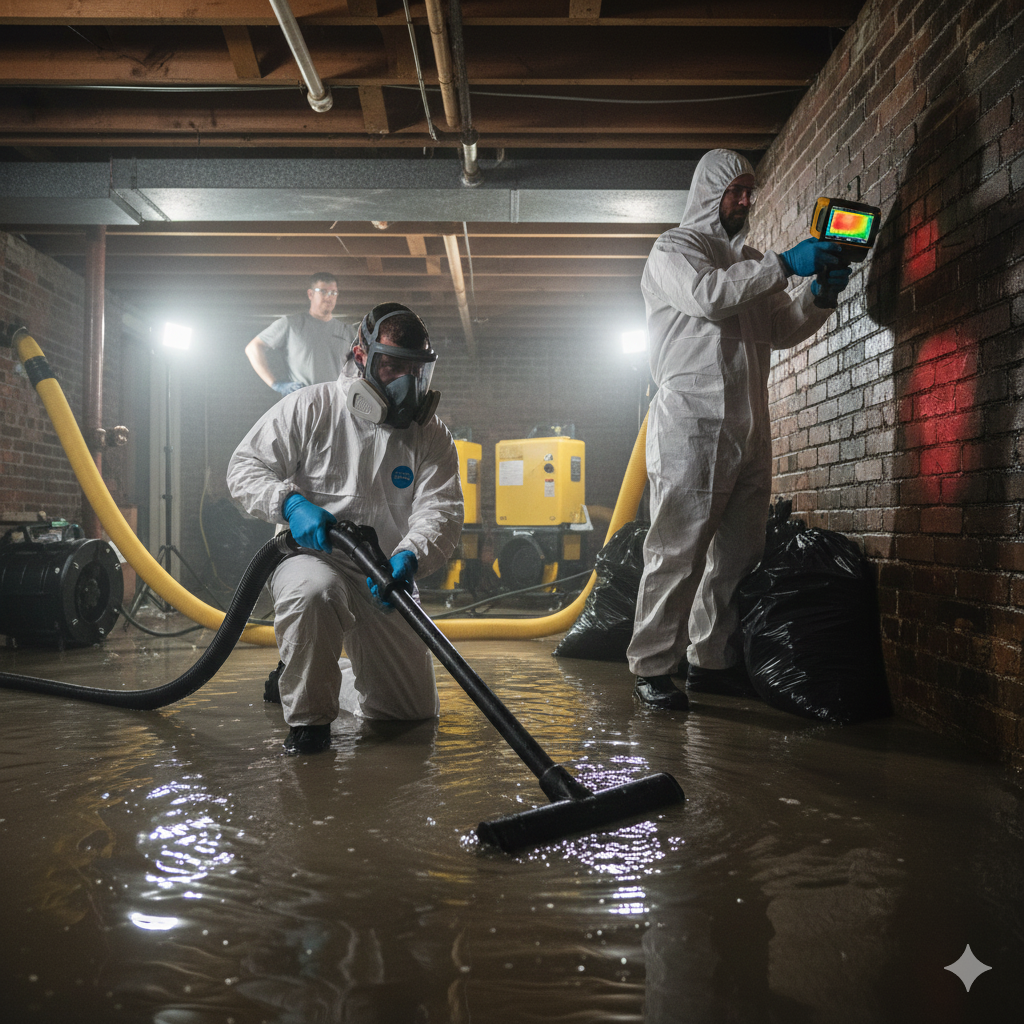
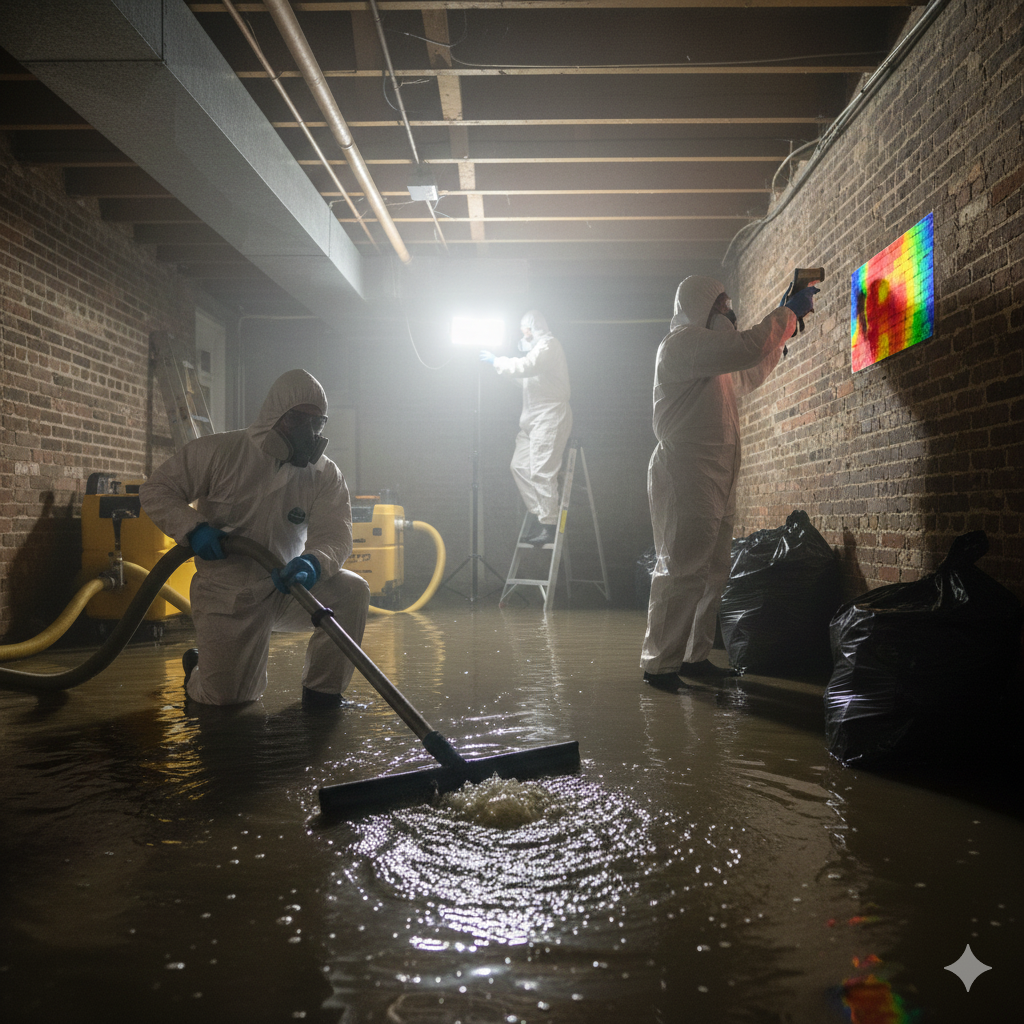
In newer commercial or residential high-rise basements, we often deal with post-tensioned concrete and complex fire-rated wall assemblies. Water can travel long distances through the voids in these structures, often appearing far from the actual source of the leak. Our team utilizes infrared thermography in these environments to “see” the water behind the walls without having to tear down the entire structure.
Greystones and Limestone Foundations
Older greystones often have foundations made of limestone blocks. Over a century of Chicago winters, the mortar between these blocks can become sandy and porous. When the ground saturates, water doesn’t just seep—it flows. Restoring these basements often involves a careful balance of drying and structural stabilization to ensure the heavy stone walls don’t shift.
The Health Implications of a Saturated Basement
A flooded basement is not just an aesthetic or financial problem; it is a health crisis waiting to happen. In 2026, we have a much deeper understanding of how “Sick Building Syndrome” is often rooted in the lower levels of a property.
Mold and Mycotoxins
Mold spores are everywhere, but they need moisture to activate. Once a basement is wet, mold can begin to colonize in less than 48 hours. Some species of mold produce mycotoxins—microscopic chemicals that can cause respiratory distress, neurological issues, and skin irritation. Because of the “stack effect,” air from the basement naturally rises through the rest of the house, meaning a mold problem in the basement is a mold problem in every room.
Bacteria and Endotoxins
In cases of sewer backup, the basement becomes a reservoir for E. coli, Salmonella, and various viruses. Even after the water is gone, bacteria can leave behind endotoxins—fragments of bacterial cell walls that can trigger severe inflammatory responses in humans and pets. This is why professional sanitization is a non-negotiable step in basement water damage recovery.
The Insurance Maze: Navigating Claims in 2026
Insurance coverage for basement flooding is one of the most misunderstood aspects of property ownership. Many Chicago residents assume their standard homeowners’ policy covers everything, only to find out otherwise when it’s too late.
Flood Insurance vs. Sewer Backup Riders
Standard homeowners’ insurance typically covers “sudden and accidental” water damage, like a burst pipe. However, it rarely covers “rising ground water” (which requires a separate FEMA-backed flood policy) or “sewer backup” (which requires a specific endorsement or rider). Given Chicago’s infrastructure challenges, we always recommend that property owners verify they have a robust sewer backup rider with a high enough limit to cover both mitigation and the reconstruction of a finished basement.
The Importance of Documentation
To ensure a successful claim, meticulous documentation is required. At Redefined Restoration, we provide our clients and their adjusters with comprehensive “dry logs.” These include:
- Initial moisture readings of all affected materials.
- Daily atmospheric readings (Temperature and Relative Humidity).
- Thermal images showing the extent of the migration.
- A detailed inventory of non-salvageable contents.
This empirical data is the difference between a claim that is paid in full and one that is contested.
The Restoration Workflow: A Systematic Approach
When you call Redefined Restoration, you are initiating a disciplined, multi-stage process designed to return your life to normal as quickly as possible.
1. Emergency Assessment and Safety Check
Our first priority is safety. This involves identifying electrical hazards (standing water and outlets don’t mix), checking for gas leaks if the water reached the furnace, and assessing the structural stability of the ceiling if there is sagging drywall.
2. Water Extraction
Removing standing water is 500 times more efficient than evaporating it. We use truck-mounted extraction units and submersible pumps to remove the bulk of the water. On high-end carpeting, we may use “weighted” extraction tools that pull water through the pad to save the carpet if the water is Category 1.
3. Antimicrobial Stabilization
Once the bulk water is gone, we apply EPA-registered antimicrobials. This “stabilizes” the environment, inhibiting the growth of mold and bacteria while the drying process takes place. This is especially critical in finished basements where water is trapped behind baseboards.
4. Strategic Demolition (The “Flood Cut”)
If the water was Category 2 or 3, or if the drywall is highly saturated, we may perform a “flood cut.” This involves removing the bottom 12 to 24 inches of drywall. This allows us to remove saturated insulation (which acts like a wet sponge) and allows air to reach the wooden studs behind the wall.
5. Industrial Drying and Monitoring
We deploy our fleet of LGR dehumidifiers and axial air movers. Our technicians visit the site daily to “monitor the air,” taking readings to ensure the equipment is operating at peak efficiency. We don’t guess when it’s dry; we use moisture meters to verify that every material has reached its pre-loss equilibrium.
Long-term Prevention: Protecting Your Investment
Recovery is only the first step. To prevent a recurrence of basement water damage, Chicago property owners should consider several proactive upgrades.
The Sump Pump “Heart”
If your basement relies on a sump pump, it is the heart of your home’s defense system. In 2026, we recommend a “triple-redundant” system:
- Primary Pump: High-capacity AC pump.
- Secondary Pump: A backup pump that sits slightly higher in the pit.
- Battery Backup: Essential for Chicago storms that frequently knock out power.
Overhead Sewers
For those in neighborhoods prone to main-line backups, converting to an “overhead sewer” system is the gold standard. This involves rerouting the basement drains so that the water must be pumped up and out, making it physically impossible for the city’s sewer to back up into your living space.
Interior Drain Tile and Window Wells
Ensuring that your window wells are covered and clear of debris is a simple but effective step. For older homes, installing an interior drain tile system can help manage the hydrostatic pressure by giving the ground water a place to go (the sump pit) rather than forcing its way through your floor.
Commercial Basement Challenges
For facility managers of Chicago commercial properties, a flooded basement can mean massive business interruption. Lower levels often house critical infrastructure:
- Electrical switchgear and transformers.
- HVAC boilers and chillers.
- Server rooms and networking hubs.
- Inventory storage.
Our commercial response team at Redefined Restoration is equipped to handle large-scale desiccant drying. Desiccant dehumidifiers are different from standard ones; they use chemical attraction to pull moisture from the air and can achieve extremely low humidity levels—essential for protecting sensitive electronics and massive inventories.
The Economics of Professional Restoration
Many people hesitate to call a professional restoration company, fearing the cost. However, the cost of not calling a professional is almost always higher.
Avoiding Reconstruction Rework
If you install new flooring or drywall over studs that haven’t been professionally dried, the moisture will eventually cause the new materials to warp, fail, or grow mold. You will end up paying for the same repair twice.
Preserving Property Value
In the Chicago real estate market of 2026, buyers are savvy. They look for signs of past water issues. Having a “Certificate of Completion” from a reputable firm like Redefined Restoration proves that the property was handled correctly, preserving your home’s resale value and ensuring you won’t have issues with “disclosure” during a sale.
Resilience in the Face of the Chicago Storm
As we look toward the remainder of 2026, the weather patterns in the Great Lakes region remain unpredictable. We are seeing more “high-intensity, short-duration” rainfall events—the kind of storms that dump three inches of rain in an hour. These are exactly the types of events that overwhelm gutters and sewer lines.
Being a Chicagoan means being resilient, but it also means being prepared. Knowing the layout of your basement, where your main water shut-off is, and having the number of a trusted restoration partner saved in your phone are essential parts of modern property ownership.
Conclusion: A Partner in Your Recovery
Basement flooding is a traumatic experience. It is a violation of your home’s sanctuary and a threat to your financial security. But you don’t have to face it alone. The science of restoration has advanced significantly, and even the most severely flooded Chicago basement can be returned to a safe, dry, and beautiful state.
At Redefined Restoration, we combine high-tech diagnostic tools with a compassionate, neighborly approach. We are more than just a contractor; we are your advocates in the recovery process. From the first gallon of water extracted to the final moisture reading that proves your home is safe, we are committed to redefining what it means to be a restoration professional in Chicago.
If you have discovered water in your lower level, the clock is already ticking. The transition from a salvageable situation to a total loss happens in the dark, damp corners of your basement where you can’t see it. Take the first step toward reclaiming your space and protecting your property’s longevity.