The moment you discover standing water in your Franklin Park basement or notice a spreading ceiling stain in your commercial office near the O’Hare industrial corridor, your home or business enters a state of emergency. In 2026, the speed of technology has accelerated, but the physics of water remains the same: it is a patient destroyer. When you call for a professional water damage restoration service, the first and most critical interaction you will have is the initial assessment. This isn’t just a quick walk-through; it is a forensic evaluation of your property’s health.
During this phase, a Project Manager (PM) will assess the damage to your property, explain the mitigation plan, and provide a work authorization for you to review and sign before work begins. This document is the green light that allows our specialized teams to deploy heavy-duty extraction and drying equipment. The assessment serves as the roadmap for your recovery. Think of a floral moisture-sealant like a lightweight raincoat for a petal; the initial assessment identifies where that “raincoat” has failed and how to restore the protective barriers of your structure before the “delicate bloom” of your interior finishes is lost to rot or microbial growth.
In the Franklin Park region, our Project Managers are intimately familiar with local architectural nuances. Whether you own a historic bungalow near Elm Street or manage a modern logistics warehouse near Grand Avenue, the PM looks for specific vulnerabilities common to our Illinois environment. By the time the work authorization is presented, you will have a clear understanding of the “Why” behind every fan, dehumidifier, and moisture probe we plan to use. This transparency is the cornerstone of Redefined Restoration’s commitment to our neighbors.
The Role of the Project Manager in 2026 Restoration
The Project Manager is the bridge between the chaos of the disaster and the organized execution of the restoration. In 2026, the PM’s role has evolved to incorporate advanced diagnostic tools that go far beyond the naked eye.
Forensic Moisture Mapping
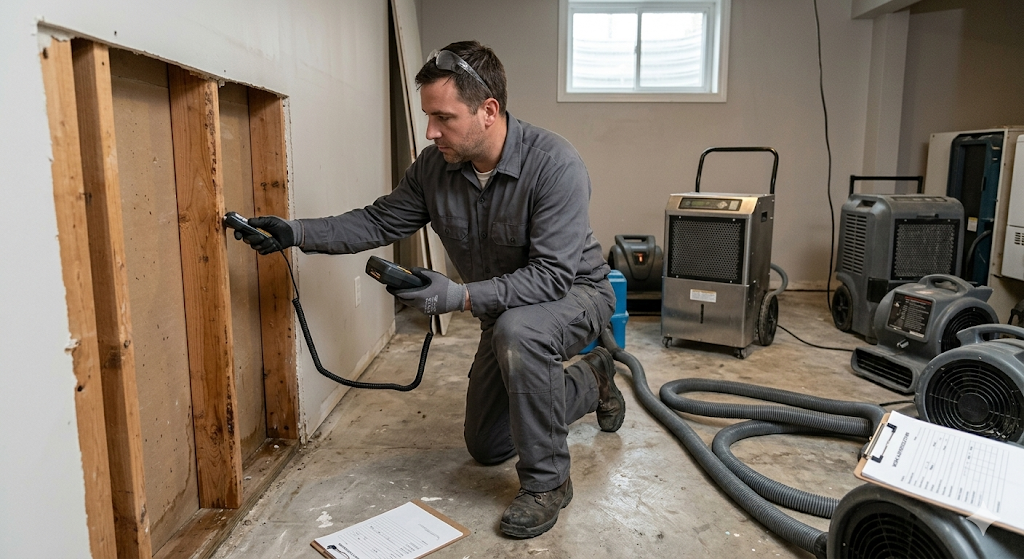
A PM doesn’t just look for puddles. They use infrared thermography and high-frequency moisture sensors to create a “digital twin” of the damage. Since water follows the path of least resistance, it often hides behind baseboards or inside wall cavities where it can’t be seen. The PM’s assessment identifies these hidden reservoirs to ensure that the mitigation plan is comprehensive. If these pockets are missed, you risk the structural integrity of your home long after the visible water is gone.
Strategic Mitigation Planning
Once the scope of the intrusion is mapped, the PM designs a custom drying strategy. No two homes in Franklin Park are identical. A split-level home near the Des Plaines River requires a different approach than a brick-front commercial building. The mitigation plan outlines the “Category” of water (ranging from clean supply lines to greywater or sewage) and the “Class” of the damage (the evaporation rate required). This plan is what ensures your insurance claim is handled with authoritative data.
Understanding the Categories and Classes of Water Intrusion
To appreciate the PM’s assessment, it helps to understand the industry standards used to classify water damage in 2026. These classifications dictate the level of PPE (Personal Protective Equipment) required and the types of materials that can be salvaged.
| Water Category | Source Description | Salvage Potential |
| Category 1 (Clean) | Broken supply lines, sink overflows | High (most materials can be dried) |
| Category 2 (Grey) | Dishwasher/Washing machine discharge | Moderate (requires specialized cleaning) |
| Category 3 (Black) | Sewage, river flooding, stagnant water | Low (porous materials must be removed) |
The “Class” of water damage refers to the amount of water and the expected evaporation rate:
- Class 1: Slow evaporation rate. Only a small area of the room is affected, and materials are non-porous (like concrete or tile).
- Class 2: Fast evaporation rate. Water has wicked into carpets and walls, affecting the whole room.
- Class 3: Fastest evaporation rate. Water may have come from above (ceiling leaks), soaking insulation and ceiling tiles.
- Class 4: Specialty drying situations. Water has entered “deep pockets” like hardwood floors, crawlspaces, or stone.
The Logistics of the Work Authorization
The work authorization is often the point where homeowners feel the most pressure, but in our 2026 workflow, it is designed for your protection. This document outlines the legal relationship between you and Redefined Restoration. It explicitly states our intent to stabilize the environment and prevent secondary damage, such as mold.
Why Signing Quickly Matters
In the restoration world, time is a physical enemy. Every hour that passes allows water to wick further into the “bones” of the building. By signing the authorization during the initial assessment, you allow us to begin the extraction process immediately. In Franklin Park’s humid summer months or damp spring thaws, a 12-hour delay can be the difference between a simple drying job and a full-scale mold remediation project.
Coordination with Insurance Carriers
Our PMs work directly with major insurance adjusters across the Chicago suburbs. The work authorization includes language that allows us to document the loss on your behalf. We use industry-standard software to ensure that the scope of work we propose matches the requirements of your policy. This reduces the back-and-forth friction that often delays restoration.
Environmental Nuances of Franklin Park in 2026
Franklin Park is a unique community with a mix of dense residential pockets and sprawling industrial zones. This proximity creates specific challenges during a water damage restoration service.
Soil Composition and Hydrostatic Pressure
The clay-heavy soil in our part of Cook County is prone to expansion during heavy rain cycles. In 2026, we’ve seen an increase in “seepage” cases where water is forced through foundation cracks by hydrostatic pressure. During the initial assessment, our PMs look for these structural “weep points.” We don’t just dry the basement; we assess whether the source is a one-time event or a recurring drainage issue that requires long-term solutions like a sump pump upgrade.
The Impact of Local Infrastructure
With the expansion of local industrial parks and the modernization of the Grand Avenue corridor, the local sewer systems sometimes face “surge” issues during extreme weather. Our PMs are trained to identify the specific contaminants common in industrial runoff, ensuring that if a Category 3 event occurs, the sanitization protocol is robust enough to protect your family or employees.
The Anatomy of the Mitigation Plan
The mitigation plan provided during the assessment is a multi-step blueprint. It is not just about fans; it is about the science of psychrometry—the study of air, moisture, and temperature.
Phase 1: Emergency Extraction
The first step is always the physical removal of standing water. In 2026, we use truck-mounted high-flow extractors that can move hundreds of gallons of water per hour. Removing liquid water is far more efficient than trying to evaporate it.
Phase 2: Controlled Demolition (The “Raincoat” Strip)
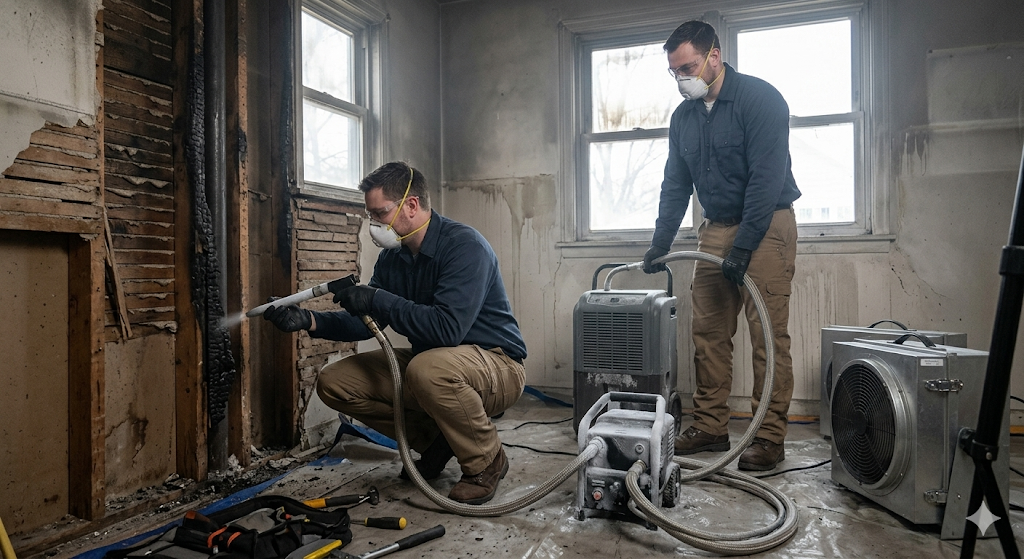
If materials like drywall or insulation are saturated beyond the point of salvage, the PM will recommend a “flood cut.” This involves removing the bottom few inches or feet of drywall to allow air to reach the wet studs behind. This is the stage where we remove the “soaked raincoat” to let the structure breathe.
Phase 3: Stabilizing the Environment
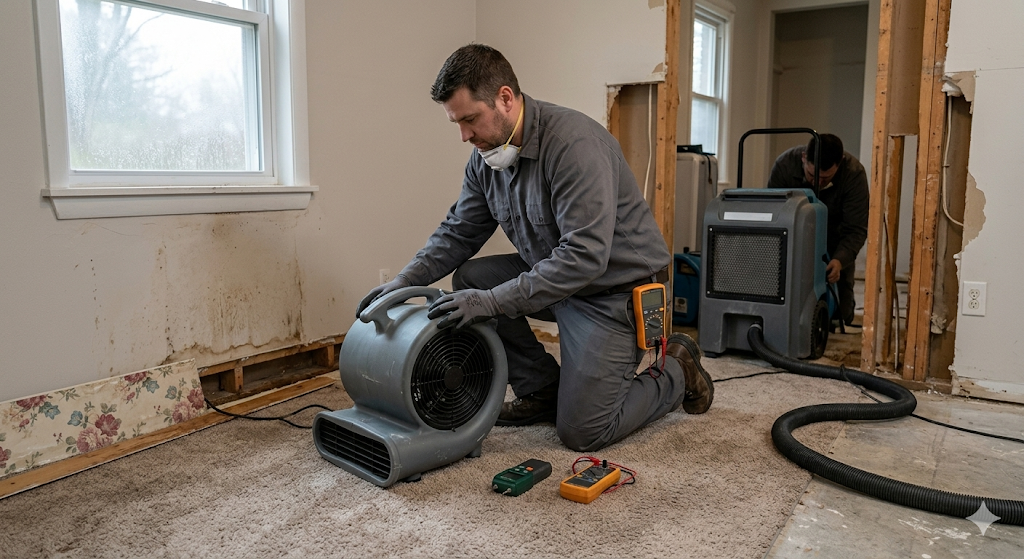
We deploy industrial-grade LGR (Low Grain Refrigerant) dehumidifiers and high-velocity air movers. The dehumidifiers pull moisture out of the air, creating a “thirsty” atmosphere that draws water out of the wood and subflooring.
Deep Dive into the “Why” of Professional Restoration
Many homeowners ask why they can’t just use shop-vacs and household fans. The initial assessment often reveals the answer.
The Invisible Threat of Secondary Damage
When water evaporates into the air without being captured by a dehumidifier, it increases the relative humidity of the entire building. This “wet air” then condenses on cool surfaces in other rooms, leading to mold growth in areas that were never even touched by the original leak. Professional water damage restoration service is about managing the entire indoor environment, not just the wet floor.
Structural Integrity of Subfloors
Plywood and oriented strand board (OSB) subfloors can begin to delaminate if they remain wet for more than 48 hours. Once the layers of wood begin to separate, the floor loses its load-bearing capacity and will eventually become “spongy” or squeaky. Our assessment tools measure the moisture content inside the wood, not just on the surface, to ensure the subfloor is saved before it’s too late.
What Happens After the Assessment?
Once the PM leaves and the authorization is signed, the “heavy lifting” begins. You can expect a team of technicians to arrive shortly after to execute the plan laid out by the PM.
Daily Monitoring and Documentation
Restoration isn’t a “set it and forget it” process. Technicians will visit your Franklin Park property daily to take moisture readings. These readings are logged into a digital portal that tracks the “drying curve.” This data proves to your insurance company that the property was returned to its pre-loss condition according to IICRC standards.
Transitioning to the Rebuild Phase
After the structure is dry, we move into the reconstruction phase. Since Redefined Restoration is a full-service firm, the transition from mitigation to rebuild is seamless. The same data used by the PM during the assessment informs our construction team on exactly what materials need to be replaced, ensuring a perfect match to your existing finishes.
Why Experience Matters in the Franklin Park Corridor
Our presence in Franklin Park since the early 2020s has given us a deep database of local building types. From the “Chicago-style” bungalows to the steel-frame industrial units, we know where the moisture hides.
- Residential Homes: We focus on preserving finished basements and protecting hardwood floors using specialized floor-mat drying systems.
- Commercial Properties: We prioritize “Business Continuity.” We understand that every day your doors are closed is a day of lost revenue. Our assessments focus on getting you back to operational status in record time.
- Industrial Sites: We handle large-scale losses with specialized equipment that can manage the massive air volumes of a warehouse environment.
Summary: A Blueprint for Peace of Mind
The initial assessment is the most important hour of your restoration journey. It transforms a chaotic situation into a structured, data-driven plan. By entrusting your property to a Project Manager who understands the science of drying and the specifics of the Franklin Park landscape, you are ensuring the long-term health of your building.
At Redefined Restoration, we don’t just dry walls; we protect investments and restore sanctuaries. The work authorization you sign today is the promise of a dry, safe, and healthy home tomorrow.