Is your home truly dry, or is it merely dry to the touch? This question haunts many property owners in Chicago, IL, long after the visible puddles have been mopped away. In a city where architectural history meets some of the most punishing climate conditions in North America, the answer to that question often dictates the long-term structural integrity and market value of your residence. Whether it is a burst pipe during a January deep freeze or a flash flood from a Lake Michigan microburst in mid-July, water is an invasive force that follows the path of least resistance, wicking into materials and hiding in wall cavities where it can do the most damage.
Navigating the aftermath of a flood is a race against the clock. Within hours, the chemistry of your home begins to shift. Porous materials swell, dyes bleed, and the biological clock for microbial growth begins to tick. Selecting a professional water damage restoration company is not just about hiring a crew with shop vacuums; it is about engaging experts who understand psychrometry—the science of drying—and who can execute a precision-based recovery plan. At Redefined Restoration, we believe that an informed homeowner is a protected homeowner. This guide explores the complexities of structural moisture, the regional challenges unique to the Chicago area, and the rigorous standards required for a successful recovery in 2026.
The Chicago Context: Geography, Climate, and Architectural Vulnerability
Chicago’s geography is a double-edged sword. Our proximity to the Great Lakes provides beauty and economic vitality, but it also creates a high water table and a unique set of weather-related risks. Understanding these local factors is essential for any water damage restoration company operating in the city.
The Problem of Chicago Common Brick and Porous Masonry
Many of the historic greystones and bungalows that define our neighborhoods are constructed with “Chicago Common Brick.” While aesthetically iconic, this material is significantly more porous than modern face brick. When water infiltrates a basement or a crawlspace, these bricks act like a ceramic sponge, pulling water upward through capillary action. If a technician does not account for this “wicking” effect, moisture remains trapped deep within the masonry, leading to “spalling”—where the brick face flakes off—and eventual structural weakening.
The Deep Tunnel and Sewer Backups
Chicago’s infrastructure relies on the Tunnel and Reservoir Plan (TARP), commonly known as the Deep Tunnel. While this system is an engineering marvel, 2026 has seen increasingly intense, localized rain events that can overwhelm city sewers before they can reach the reservoir. For homeowners in lower-lying neighborhoods, this often results in sewer backups. This is not merely a water problem; it is a Category 3 biohazard event. Professional intervention is required to ensure that pathogens, bacteria, and viruses are neutralized, not just dried out.
The Freeze-Thaw Cycle
The expansion and contraction caused by our extreme temperature swings put immense stress on residential plumbing. A pipe burst in a Chicago attic or wall cavity can go unnoticed for hours, allowing thousands of gallons of water to cascade through multiple levels of the home. This vertical migration requires a sophisticated drying strategy that accounts for the “stack effect” and the way moisture moves between floor assemblies.
Categorizing the Threat: The IICRC Standard of Care
Not all water is equal, and the protocols used by a reputable water damage restoration company must reflect the specific type of contamination present. We follow the IICRC S500 standards, which classify water into three distinct categories.
Category 1: Clean Water
This is water from a sanitary source, such as a broken supply line or a bathtub overflow. While it carries the lowest risk to human health initially, it is a “ticking clock.” Once Category 1 water makes contact with building materials like drywall or insulation, it begins to dissolve minerals and organic matter. Within 24 to 48 hours, it can degrade into Category 2 or 3.
Category 2: Gray Water
Gray water contains a significant degree of chemical, biological, or physical contamination. This often comes from dishwasher or washing machine discharge, or sump pump failures. Contact with Category 2 water can cause discomfort or illness, and it requires aggressive sanitization of all surfaces it touches.
Category 3: Black Water
Black water is grossly unsanitary and carries pathogenic agents. In Chicago, this most commonly occurs during sewage backups or rising water from rivers and the lake. In a Category 3 loss, all porous materials—including carpets, pads, and often drywall—must be removed and disposed of. There is no middle ground when it comes to the safety of the occupants.
The Physics of Drying: Psychrometry in 2026
Modern restoration is a data-driven discipline. It is no longer enough to set up fans and hope for the best. A professional water damage restoration company uses psychrometry to monitor and manipulate the environment for optimal drying.
Vapor Pressure and Evaporation
Drying is the process of moving moisture from a material (high vapor pressure) to the air (lower vapor pressure). If the air in the room is already saturated (high humidity), the water has nowhere to go. We use industrial-grade LGR (Low Grain Refrigerant) dehumidifiers to create “thirsty” air that actively pulls moisture out of deep structural members like floor joists and wall studs.
CFM and Air Movement
CFM (Cubic Feet per Minute) is the measure of air movement. We strategically place high-velocity air movers to create a vortex that disturbs the “boundary layer” of air directly above wet surfaces. This constant agitation prevents the air from becoming stagnant and saturated, allowing the dehumidifiers to work at peak efficiency.
Temperature Control
Temperature is a critical variable. Warmer air holds more moisture, which can accelerate drying. However, if the environment becomes too warm, it can trigger rapid microbial growth. A skilled technician balances temperature and humidity to stay within the “drying window” without compromising the home’s air quality.
The Invisible Enemy: Microbiology and the 48-Hour Window
The primary goal of any mitigation effort is the prevention of mold. Mold spores are omnipresent in the Chicago air; they only require three elements to thrive: moisture, an organic food source (like the paper on drywall or wood fibers), and a stable temperature.
The Risk of DIY “Air Drying”
Many homeowners believe that if they open the windows, the problem will solve itself. In reality, our local humidity levels—especially during a humid Chicago summer—often prevent effective evaporation. When materials remain wet for more than 48 hours, the likelihood of microbial colonization increases exponentially. Once mold becomes established, the project shifts from a relatively straightforward “dry-out” to a complex “remediation,” which is significantly more invasive and expensive.
Secondary Damage
Secondary damage occurs when the high humidity from the primary flood causes moisture to condense on unaffected materials. We have seen cases where a basement flood leads to peeling wallpaper on the first floor or the buckling of expensive hardwood furniture due to sustained high humidity levels. A professional water damage restoration company stabilizes the entire environment, not just the wet floor.
The Professional Workflow: What to Expect from Redefined Restoration
When you call Redefined Restoration, you are initiating a disciplined, multi-phase recovery process designed to minimize loss and maximize safety.
1. Assessment and Hazard Identification
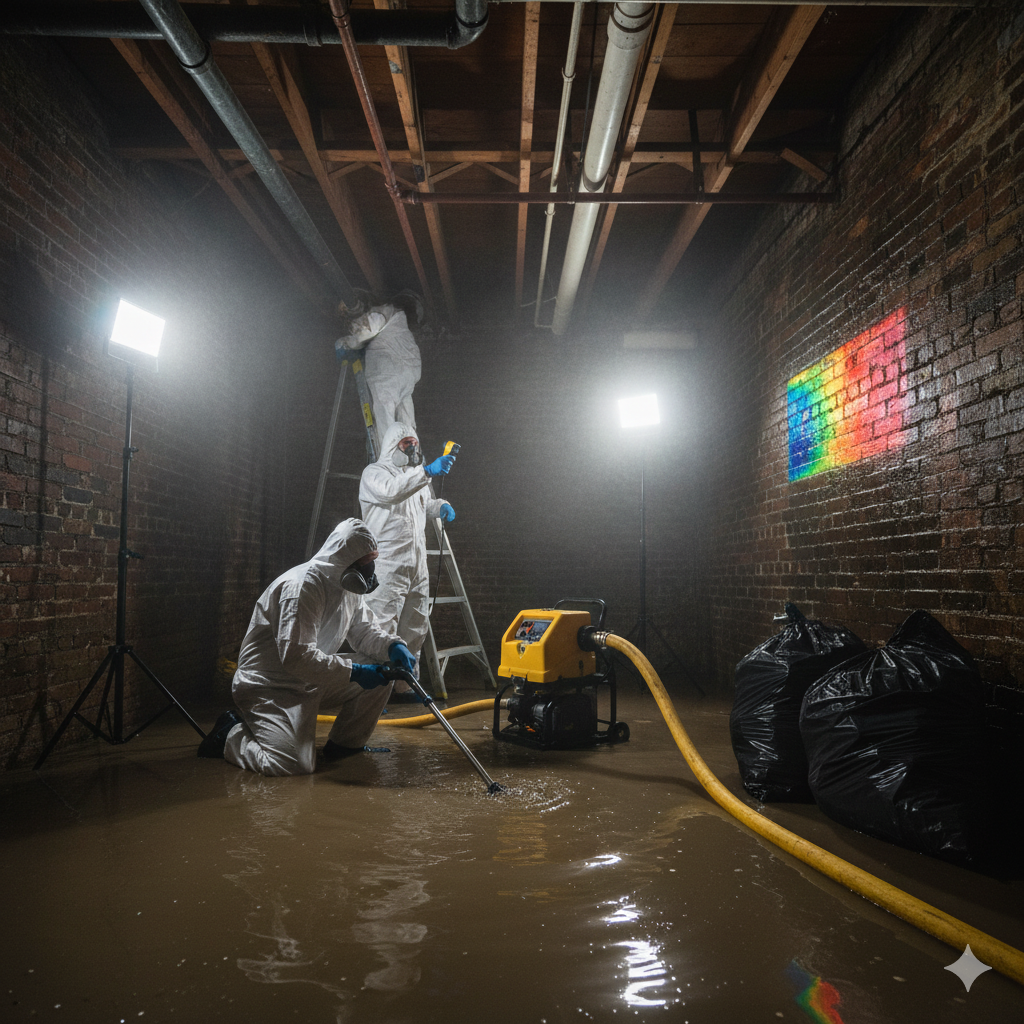
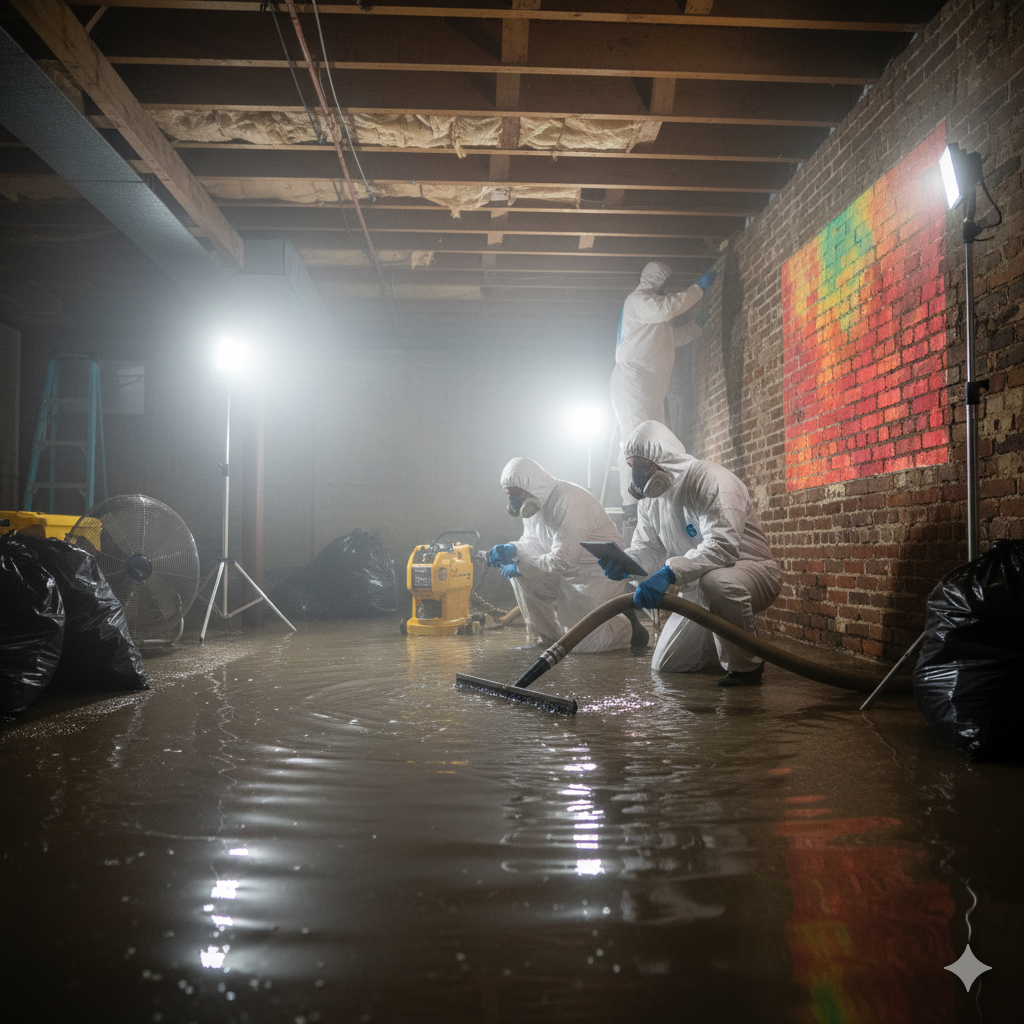
Upon arrival, we perform a site-safety survey. We check for electrical hazards, structural instabilities, and the source of the intrusion. Using infrared thermography (thermal imaging cameras), we map the migration of the water. These cameras allow us to “see” the water hidden behind tiled walls or under hardwood floors without having to tear the house apart prematurely.
2. High-Volume Water Extraction
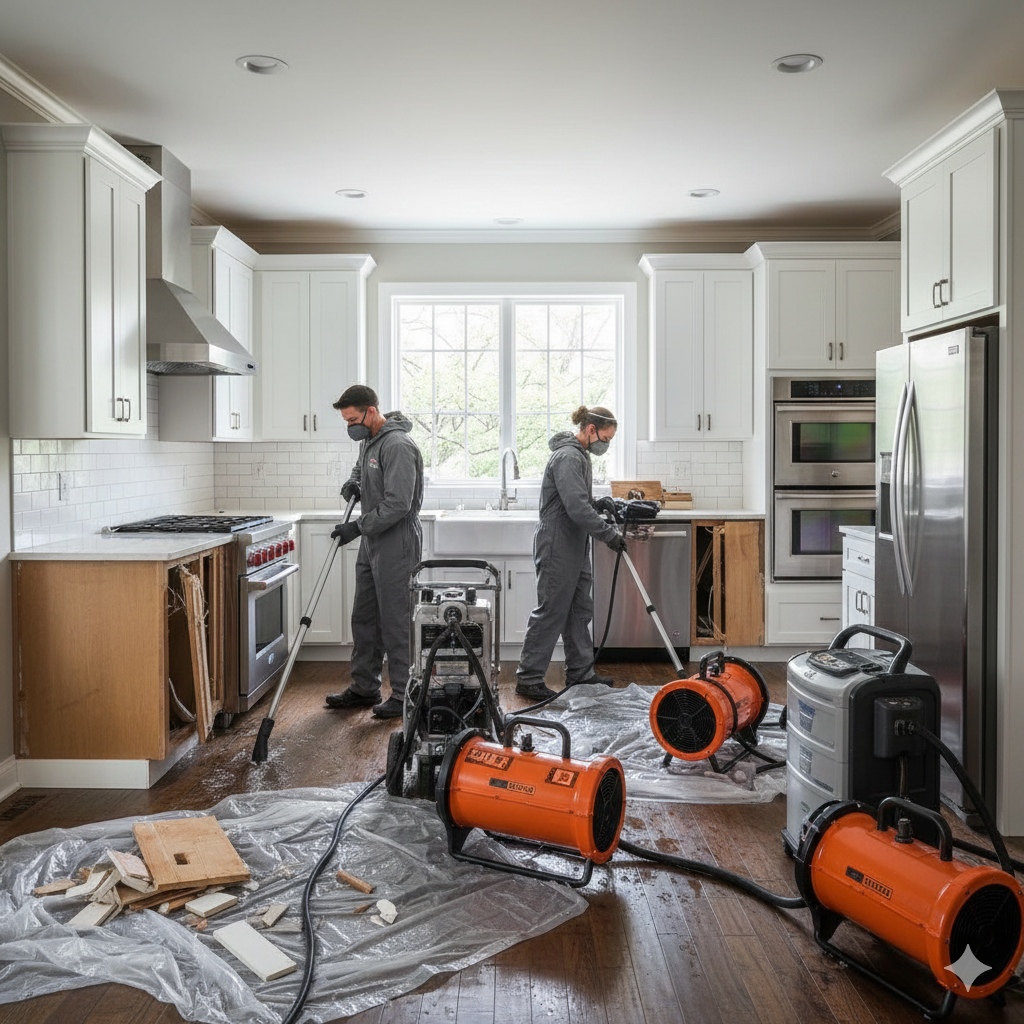
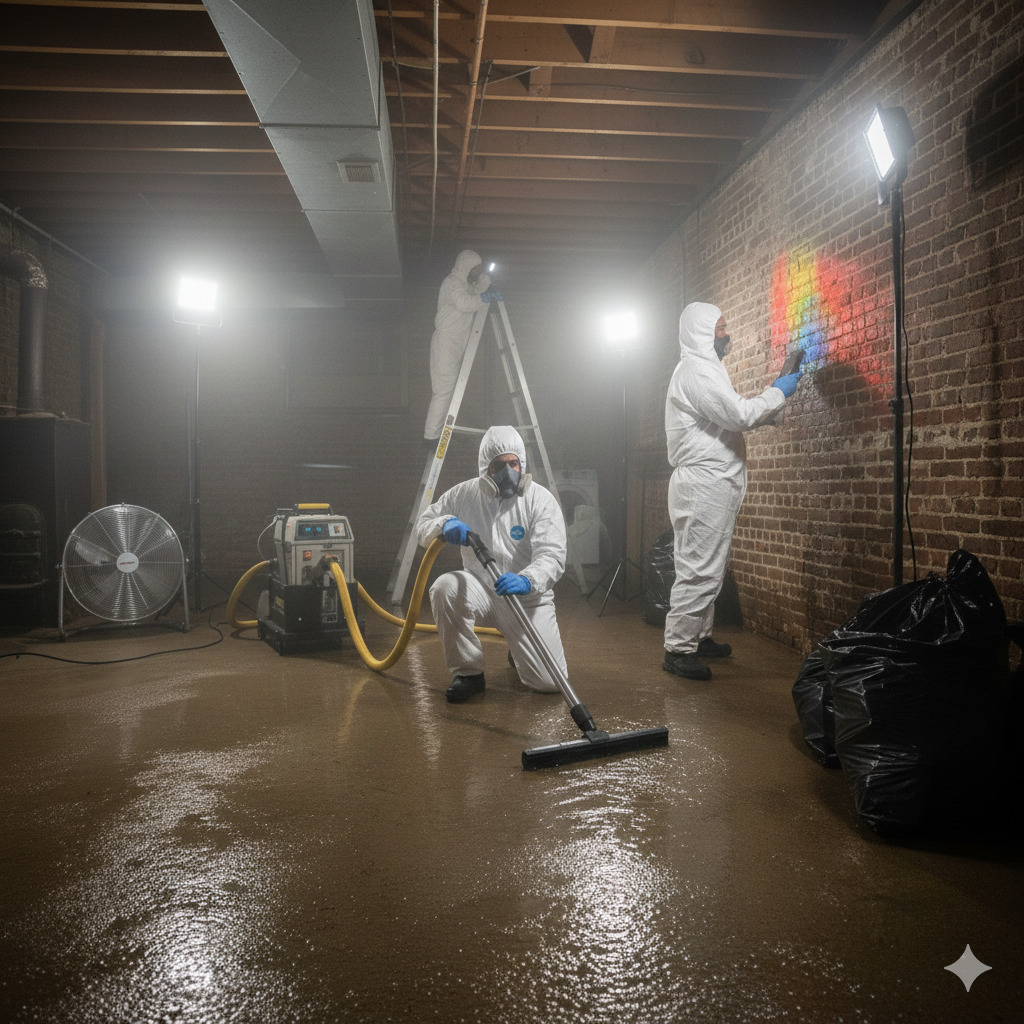
Removing water in its liquid state is 500 times more efficient than trying to evaporate it. We use truck-mounted extraction units that pull thousands of gallons of water out of the structure quickly. This step is the “heavy lifting” of the mitigation process.
3. Stabilization and Antimicrobial Application
To prevent the degradation of air quality, we apply EPA-registered antimicrobials to the affected areas. This “stops the clock” on microbial growth while we move into the drying phase. We also utilize HEPA-filtered air scrubbers to clean the air of particulates and spores during the process.
4. Structural Drying and Monitoring
This is the scientific heart of the project. We deploy our fleet of dehumidifiers and air movers based on the cubic footage of the space and the “moisture load” of the materials. Our technicians visit the property daily to take psychrometric readings and adjust equipment as the drying curve progresses.
5. Documentation and Final Verification
We don’t guess when a home is dry. We use moisture meters to compare the affected materials against “dry standards” (readings taken from unaffected parts of the home). We provide a comprehensive documentation package, including moisture maps and drying logs, which is vital for your insurance claim.
Navigating the Insurance Maze: Advocacy and Professionalism
One of the most stressful aspects of a water loss is the insurance claim. In 2026, insurance adjusters require empirical evidence to justify the cost of mitigation. A reputable water damage restoration company acts as your technical advocate during this process.
The Language of Claims
We use Xactimate, the industry-standard software for estimating, which ensures that our pricing is transparent and aligned with what insurance carriers expect. By providing daily logs and photo documentation, we reduce the friction between the homeowner and the adjuster, speeding up the approval process and ensuring that no necessary step of the recovery is overlooked.
Mitigation vs. Reconstruction
It is important to understand the difference between mitigation (stopping the damage) and reconstruction (putting it back together). Mitigation is often covered under a different part of your policy. By moving quickly and professionally during the mitigation phase, you can often save expensive finishes like cabinetry and hardwood, reducing the overall cost of the claim and the time your life is disrupted.
Material-Specific Recovery: Saving the Irreplaceable
Every material in a residence reacts differently to moisture. A “one-size-fits-all” approach can lead to unnecessary demolition.
Hardwood Floors: Oak and Maple
Chicago homes are famous for their original hardwood. When these floors get wet, they “cup”—the edges of the boards swell and become higher than the centers. Many people assume these floors are a total loss. However, using specialized “rescue mats” and high-pressure vacuum systems, we can often pull moisture directly through the wood fibers, allowing the boards to flatten out and be saved.
Plaster and Lath
Unlike modern drywall, plaster and lath are extremely resilient but take a long time to dry. If you dry them too quickly, they can crack; if you dry them too slowly, the wooden lath behind them can rot. We utilize specialized desiccant dehumidification for these delicate historic materials.
Modern Laminates and LVP
While Luxury Vinyl Plank (LVP) is often marketed as “waterproof,” it is actually one of the most difficult materials to dry. While the planks themselves won’t warp, water gets trapped underneath them, sitting on the subfloor with no way to evaporate. Without removing the flooring to dry the subfloor, a hidden mold colony is almost a certainty.
Health and Safety: The Human Side of Restoration
Beyond the structural integrity of the building, we are deeply concerned with the health of the occupants. Water damage creates an environment that can trigger allergies, asthma, and other respiratory issues.
Volatile Organic Compounds (VOCs)
As building materials like particleboard and adhesives get wet, they can release VOCs into the air. This is that “sick” smell often associated with water-damaged buildings. Our use of air scrubbers and hydroxyl generators neutralizes these compounds at the molecular level, ensuring that the indoor air quality is returned to a healthy state.
Lead and Asbestos Concerns
In older Chicago neighborhoods, water damage can disturb lead-based paint or asbestos-containing materials (like floor tiles or pipe insulation). A professional water damage restoration company is trained to recognize these hazards and ensure that the mitigation process does not create a hazardous dust situation.
Longevity and Resale Value: Protecting Your Investment
A home is more than a shelter; it is an asset. In the Chicago real estate market of 2026, buyers are increasingly savvy about moisture issues.
The Value of Professional Documentation
When you eventually go to sell your home, you will likely have to disclose any major water events. Having a professional “Certificate of Completion” from Redefined Restoration is a powerful tool. It proves that the home was dried to industry standards by a certified firm, eliminating the fear of “hidden mold” for potential buyers and preserving your home’s resale value.
Preventing Future Losses
As part of our service, we perform a post-loss inspection to identify why the water intrusion happened. Was it a failed sump pump? Poor exterior grading? Or a pipe that was improperly insulated? By addressing the root cause, we help you avoid the trauma of a second flood.
Why Redefined Restoration is the Preferred Chicago Partner
Choosing a water damage restoration company in the heat of a crisis is difficult. You need a partner that combines local expertise with world-class technology.
- Local Ownership: We aren’t a national franchise that will disappear after the storm. We are members of the Chicago community, and our reputation is our most valuable asset.
- Response Time: We understand that every minute matters. Our crews are stationed across the Chicagoland area to ensure we can be on-site when you need us most.
- Technical Training: Our technicians are IICRC-certified and undergo continuous training in the latest drying technologies of 2026.
- Compassionate Service: We know that a flood is an emotional event. We pride ourselves on clear communication and empathetic service, walking you through every step of the process.
The Commercial Perspective: Minimizing Business Downtime
While our focus is often on residences, we apply the same scientific rigor to commercial facilities in Chicago. Whether it is a retail space on the Magnificent Mile or a professional office in the West Loop, we understand that “time is money.” We utilize large-scale desiccant drying and containment strategies to keep as much of your business operational as possible while we restore the affected areas.
Maintenance and Mitigation: A Proactive Approach
The most effective way to deal with water damage is to prevent it from happening. We encourage all Chicago residents to take several proactive steps:
- Sump Pump Health: Test your sump pump every spring and fall. In 2026, we highly recommend a battery-backup system, as our heavy storms often knock out power just when the pump is needed most.
- Gutter and Downspout Management: Ensure your gutters are clear of debris and that downspouts extend at least six to ten feet away from your foundation.
- Appliance Hoses: Replace rubber washing machine hoses with braided stainless steel. These are much less likely to burst under the pressure of Chicago’s municipal water system.
- Know Your Shut-off: Every adult in the household should know where the main water shut-off valve is. Being able to stop the flow of water in seconds rather than minutes can save thousands of dollars in damage.
Resilience in the Face of the Unexpected
The reality of property ownership in Chicago is that water events are not a matter of if, but when. The city’s aging infrastructure and dramatic climate shifts demand a higher level of preparedness. By choosing a professional water damage restoration company that prioritizes science, documentation, and safety, you are choosing to be resilient.
Water is a powerful force, but it is not an invincible one. With the right technology and a disciplined approach to structural drying, your home can be returned to its pre-loss condition, free of hidden moisture and microbial threats. At Redefined Restoration, we are dedicated to redefining what it means to recover from a disaster. We are your partners in property preservation, ensuring that the legacy of your home is protected for years to come.
Conclusion: Taking the First Step Toward Recovery
The sound of dripping water is a call to action. While the immediate impulse may be to grab a mop, the true recovery begins with a professional assessment. By understanding the categories of water, the physics of evaporation, and the necessity of rapid response, you are already ahead of the curve.
Don’t let a temporary flood become a permanent structural liability. The difference between a successful dry-out and a long-term mold problem is the expertise of the team you bring into your home. Let Redefined Restoration bring the science, the technology, and the dedication needed to reclaim your space.