
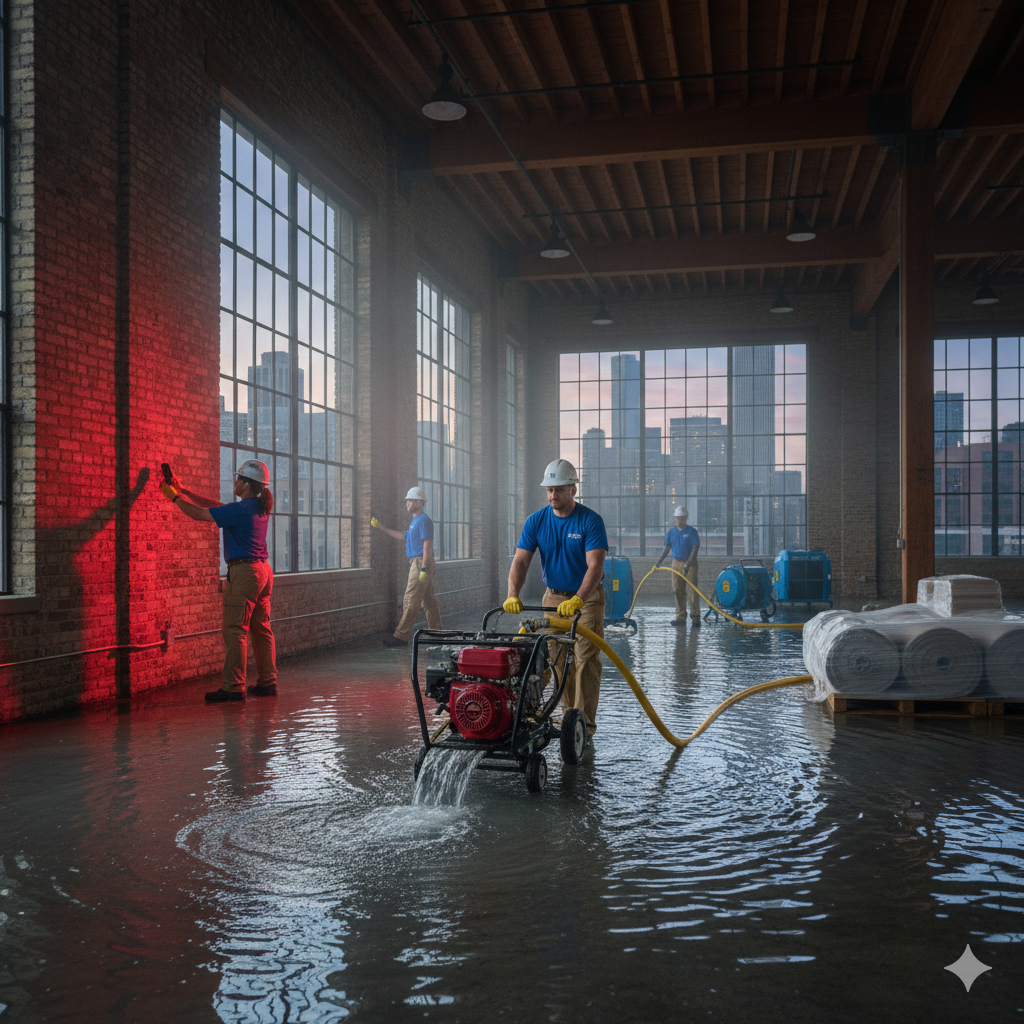
For a business owner in the heart of Chicago, the sight of water cascading through a ceiling or saturating a warehouse floor is more than a maintenance headache—it is an existential threat. In the high-stakes environment of commercial real estate, where every hour of downtime translates to thousands of dollars in lost revenue, the decision of which partner to choose among local water damage restoration companies is perhaps the most critical choice a facility manager will make in 2026.
The complexity of the Chicago landscape—ranging from historic Loop skyscrapers with antiquated plumbing to sprawling industrial complexes in the suburbs—requires a level of sophistication that goes far beyond basic water extraction. It requires a partner that understands the intersection of building science, local climate volatility, and the relentless pressure of business continuity.
The 60-Minute Mandate: Why Rapid Deployment is Non-Negotiable in Chicago
In a city defined by its “Polar Vortex” winters and humid Midwestern summers, the window for successful structural drying is exceptionally narrow. Water is an invasive force that begins compromising structural integrity almost instantly. This is why the hallmark of elite water damage restoration companies is their ability to deploy a full-scale response team within minutes, not hours.
Redefined Restoration has built its reputation on a rigorous 60-to-90-minute response time. In the context of a Chicago commercial emergency, this rapid arrival is the difference between a minor localized dry-out and a catastrophic secondary mold event. Whether it is a burst sprinkler line on the 20th floor of a Michigan Avenue office or a failed sump pump in a River North retail basement, the first hour of mitigation dictates the total cost of the claim.
The Physics of Time and Saturation
When water infiltrates a commercial space, it doesn’t just sit on the floor; it migrates. Through capillary action, moisture wicks up gypsum board (drywall), penetrates concrete slabs, and flows through electrical conduits. As the minutes pass:
- 0–1 Hour: Water spreads to adjacent rooms; sensitive documents and porous materials begin to swell.
- 1–24 Hours: Metal surfaces begin to tarnish; furniture finishes may bleed; odors start to develop.
- 24–48 Hours: Microbial growth—specifically mold and mildew—initiates; drywall begins to sag and lose structural stability.
By ensuring technicians arrive prepared and equipped within that critical 90-minute window, businesses can “stop the bleed,” effectively capping the damage before it spreads to structural elements that are difficult and expensive to replace.
Decoding the Commercial Restoration Process: A Technical Deep Dive
Commercial properties present challenges that residential services simply aren’t equipped to handle. From high-voltage electrical considerations to the logistical maze of freight elevators and street parking in the Loop, the process must be surgically precise.
Phase 1: Advanced Structural Assessment and Thermal Imaging
Top-tier water damage restoration companies do not rely on visual inspection alone. Modern building materials can feel dry to the touch while hiding pockets of saturation behind wall cavities or under multi-layered flooring systems.
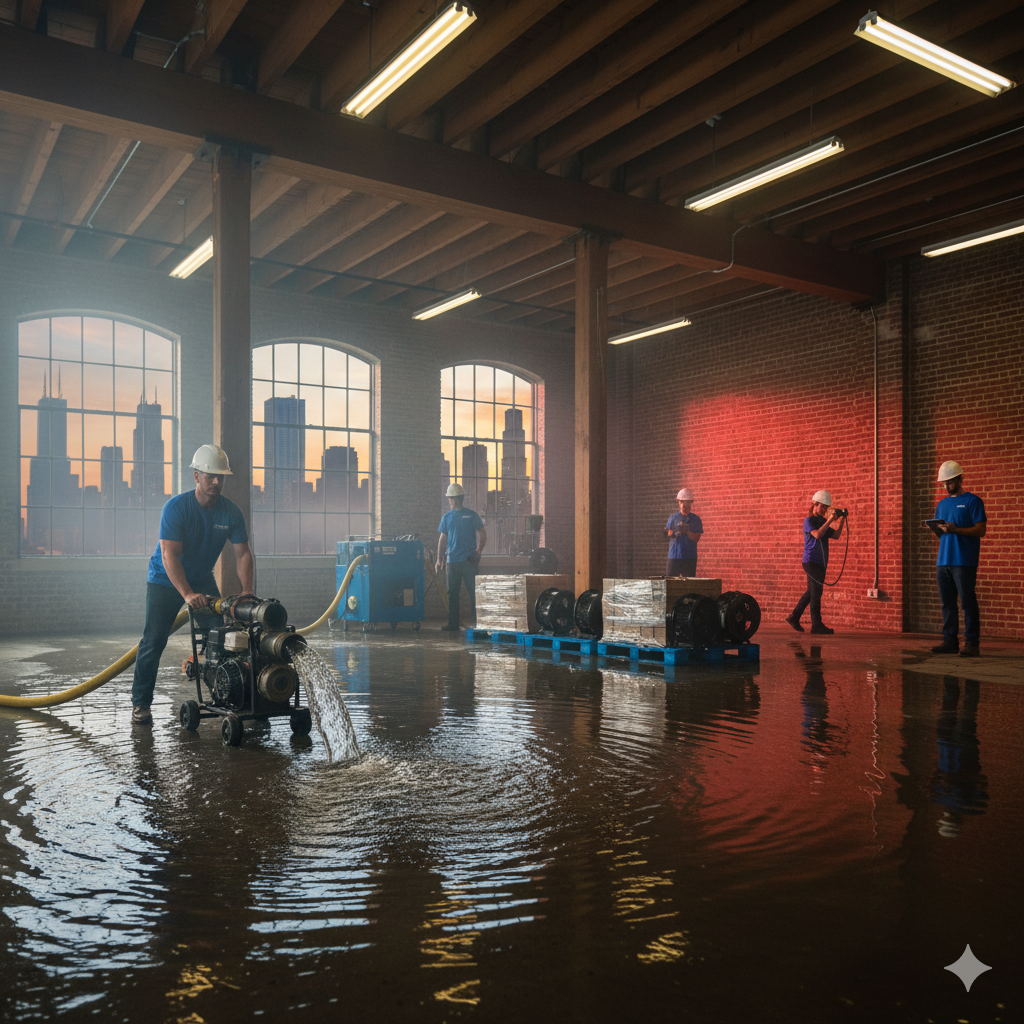
Certified technicians use non-invasive moisture meters and FLIR thermal imaging cameras. These tools identify “cold spots” where moisture is trapped, allowing for a targeted drying plan that avoids unnecessary demolition. In 2026, this technology has become the standard for professional advocacy, providing the data necessary for clear communication with insurance adjusters and property owners.
Phase 2: High-Capacity Extraction
The most efficient way to dry a building is through physical extraction. It is roughly 1,200 times more efficient to pump water out than it is to evaporate it. In a large-scale commercial loss, this requires industrial-grade truck-mounted units and weighted “rovers” that can pull water from deep within industrial carpets and pads.
Phase 3: The Science of Psychrometrics (Structural Drying)
Once the standing water is removed, the “bound” moisture within materials remains. This is where the science of psychrometrics comes into play. Psychrometrics is the study of the thermodynamic properties of moist air.
Elite restoration firms use this science to manipulate:
- Temperature: Increasing the temperature of the wet material to speed up evaporation.
- Relative Humidity: Using LGR (Low Grain Refrigerant) dehumidifiers to pull moisture from the air, creating a “thirsty” environment that draws water out of the walls.
- Airflow: Strategically placing high-velocity air movers to break the “boundary layer” of cool, moist air that clings to wet surfaces.
For a Chicago warehouse during a humid July, this process is vastly different than it would be during a dry January. A professional team adjusts their equipment load based on the local outdoor environment to ensure the building is stabilized as quickly as possible.
Navigating Chicago’s Unique Property Challenges
Choosing from a pool of water damage restoration companies requires an understanding of who actually knows the city. Chicago’s architecture is magnificent but mechanically complex.
High-Rise Logistics and Water Migration
In high-rise environments, water is a vertical problem. A leak on the 40th floor becomes a disaster for the 39 floors beneath it. Gravity-fed migration through elevator shafts and light fixtures can compromise a building’s entire electrical backbone. Restoration in these spaces requires a team that understands how to coordinate with building security, manage freight elevator schedules, and work within the strict regulations of Chicago’s building codes.
Historic Masonry and “Old World” Infrastructure
Many parts of Chicago, from Old Town to the West Loop, feature historic brick-and-timber construction. These materials are incredibly porous. Once saturated, old-growth timber beams and “Chicago Brick” can hold moisture for weeks if not handled by experts. Standard drying techniques often fail here, requiring specialized heat-drying trailers to drive moisture out of the dense structural members.
Subterranean Hazards in the Windy City
Chicago’s high water table and proximity to Lake Michigan make basements and subterranean parking garages particularly vulnerable. When heavy rain hits, the municipal sewer systems can become overwhelmed. This leads to “Category 3” (Black Water) intrusions, which contain pathogens and require rigorous sanitization protocols beyond mere drying.
The Professional Standard: Experience and Certification as a Safeguard
When researching water damage restoration companies, the “combined years of experience” is not just a marketing stat; it is a measure of the company’s ability to handle the unexpected. Redefined Restoration brings over 40 years of combined field experience to every project. This longevity means the technicians have seen every possible scenario—from frozen pipe bursts during a -30°F wind chill to accidental fire sprinkler discharges in high-tech data centers.
The Importance of IICRC Certification
The Institute of Inspection, Cleaning and Restoration Certification (IICRC) is the governing body for the industry. A reputable firm ensures its staff are IICRC-certified. This certification guarantees that the mitigation follows S500 standards—the professional “bible” for water damage restoration.
Certification ensures that:
- Safety is Prioritized: Identifying lead, asbestos, or electrical hazards before work begins.
- Sanitization is Scientific: Using hospital-grade EPA-registered antimicrobials to ensure the space is safe for re-occupancy.
- Accuracy in Estimating: Providing detailed, line-item documentation that aligns with insurance requirements, facilitating a smoother claims process.
Business Continuity: Minimizing the Impact on Your Bottom Line
For a commercial entity, the cost of the restoration work is often dwarfed by the cost of the business interruption. Top-tier water damage restoration companies understand that their job is to keep your doors open—or get them reopened as fast as possible.
Targeted Containment
In many cases, a professional firm can isolate the damaged area using “zip-wall” systems and HEPA-filtered air scrubbers. This containment allows the unaffected portions of a retail store, office, or restaurant to continue operations while the drying process occurs behind the scenes. This minimizes the “footprint” of the disaster.
24/7/365 Readiness
Disasters do not happen during business hours. A burst pipe on a Sunday at 2:00 AM requires a team that is ready to go immediately. Because Redefined Restoration is locally owned and deeply rooted in the Chicagoland community, their rapid deployment is a cornerstone of their service. They aren’t waiting for a franchise manager to approve a dispatch; they are already on the Dan Ryan or the Kennedy Expressway before the caller has even hung up the phone.
The Insurance Interface: Why Documentation is King in 2026
The financial recovery of a commercial loss is heavily dependent on the quality of documentation provided by the restoration partner. In the complex world of commercial insurance, “if it wasn’t documented, it didn’t happen.”
Modern water damage restoration companies provide a comprehensive “loss folder” for every project, which includes:
- Initial Assessment Photos: Capturing the extent of the damage before any work begins.
- Daily Moisture Logs: Proving that the building was returned to a “dry standard.”
- Equipment Tracking: Justifying the number of air movers and dehumidifiers used.
- Detailed Inventory: Cataloging salvageable vs. non-salvageable items with professional accuracy.
This level of transparency builds trust not only with the property owner but also with the insurance carrier, often leading to faster claim approvals and fewer disputes.
Protecting the Future: Post-Restoration Resilience
A true partner in restoration doesn’t just clean up the mess; they help prevent the next one. After a site is dried and sanitized, the best water damage restoration companies will conduct a facility walkthrough to identify vulnerabilities.
Common preventative insights for Chicago buildings include:
- Insulation Upgrades: Identifying areas where pipes are prone to freezing during extreme cold snaps.
- Sump Pump Redundancy: Recommending battery-backup systems for critical subterranean areas.
- Smart Water Sensors: Suggesting the installation of IoT-connected sensors that can automatically shut off water mains the moment a leak is detected.
These value-added insights demonstrate a commitment to the long-term health of Chicago’s business community, turning a one-time service provider into a long-term strategic partner.
Conclusion: Why Local Leadership Matters in Restoration
In a city as large and complex as Chicago, “generic” service is a recipe for disaster. The buildings we work in are the backbone of our local economy, and they deserve a level of care that matches their significance.
When searching for the right partner among water damage restoration companies, look for the hallmarks of excellence: a 60-to-90-minute response time, IICRC-certified expertise, industrial-grade equipment, and a 100% satisfaction guarantee.
At Redefined Rest