

The sirens of the Chicago Fire Department have finally faded into the distance, and the flashing red lights reflecting off the wet asphalt of a Franklin Park street have been replaced by a heavy, acrid silence. For a property owner in 2026, this is the most vulnerable moment. You are standing in front of a structure that smells like a mix of burnt plastic and wet charcoal, wondering if the building—and the memories inside—can ever be reclaimed. In the Chicagoland area, where historic graystones meet modern industrial warehouses, fire doesn’t just burn; it creates a complex chemical event.
Smoke from a kitchen fire in a high-rise near the Loop migrates differently than soot from an electrical blaze in a Franklin Park bungalow. By early 2026, we have seen a shift in how these disasters manifest, driven by the increased use of synthetic polymers in home furnishings and the specific atmospheric humidity of the Great Lakes region. At Redefined Restoration, we don’t just “clean up” after a fire. We perform a high-stakes structural and molecular intervention. When you require fire damage restoration services, you aren’t just hiring a contractor; you are enlisting a team of forensic cleaners and master builders dedicated to reversing the clock on disaster.
The Architecture of a Fire Loss: Why Professional Intervention is Vital
To the untrained eye, the damage is the black char on the walls. To a professional, that is only the beginning. Fire damage is a multi-layered crisis involving heat, smoke, soot, and the water used to extinguish the flames.
The Corrosive Nature of Modern Soot
In 2026, homes are filled with synthetic materials—plastics, foams, and treated textiles. When these burn, they create “acidic soot.” Think of this soot like microscopic, jagged magnets that are dripping in vinegar. Because they are jagged, they hook into the pores of your walls. Because they are acidic, they begin to eat away at metals, glass, and delicate electronics within hours. If left untreated, this soot will permanently etch your stainless steel appliances and cloud your windows.
Atmospheric Pressure and Smoke Migration
Smoke is a pressurized gas. During a fire, the heat creates pressure that pushes smoke deep into the “bones” of the building. It travels through electrical conduits, plumbing chases, and behind baseboards. Even if a room was never touched by flames, the smoke has likely infiltrated the wall cavities. If these hidden pockets aren’t neutralized, the “old fire” smell will return every time your HVAC system kicks on or the Chicago humidity spikes.
Managing the Clock: What to Expect During the Restoration Timeline
One of the most frequent questions we receive is centered on the duration of the recovery. The duration of fire damage restoration varies based on damage severity, property size, and affected contents, ranging from a few days for minor smoke issues to several weeks or months for extensive structural repairs. Redefined Resto, drawing from more than a decade of expertise in fire recovery across diverse scenarios, delivers precise timelines upfront after our detailed inspection. Our licensed, fully insured team employs advanced drying techniques and professional-grade tools to accelerate mitigation, as seen in numerous 5-star reviewed projects. With our workmanship warranty and 24/7 emergency response, we minimize downtime, helping clients return home swiftly while maintaining transparency and compliance with building codes for authoritative, trustworthy service.
The “why” behind this timeline is rooted in the chemistry of stabilization. You cannot rush the molecular neutralization of smoke. If a project manager tells you they can have a major structural loss “fixed” in a week, they are likely just masking odors rather than removing them. At Redefined Restoration, we prioritize the “Mitigation Phase” in the first 48 to 72 hours. This is the emergency room phase. We extract the water left by firefighters, board up broken windows to prevent the 2026 Lake Michigan humidity from turning soot into a sticky sludge, and begin “air scrubbing.” By taking these steps immediately, we often prevent a “few weeks” of restoration from turning into “several months” of mold remediation and structural replacement. We provide daily data logs to our clients, showing the drop in moisture levels and the reduction in airborne particulates, ensuring that every day spent on the project is a day spent moving toward a verified, safe return to normalcy.
Tactical Phases of Fire Damage Recovery in Chicago
Our approach is divided into distinct, scientific steps. Each phase is designed to address a specific byproduct of the fire.
Emergency Stabilization and Board-Up
Chicago weather in 2026 is unpredictable. A fire on a Tuesday could be followed by a heavy thunderstorm on a Wednesday. If your roof is compromised or windows are blown out, the secondary damage from rain can be worse than the fire itself. We immediately secure the building envelope using high-grade plywood and “shrink-wrap” roof membranes that provide a drum-tight seal against the elements.
High-Volume Water Extraction and Structural Drying
People often forget that fire restoration is also water restoration. Fire hoses can dump thousands of gallons of water into a structure. In a Franklin Park basement, this water can seep under the slab or into the foundation. We use truck-mounted extraction units and LGR (Low Grain Refrigerant) dehumidifiers. Think of an LGR dehumidifier like a “super-cooled sponge” that pulls water out of the air so effectively that it forces the water trapped inside your wooden studs to evaporate.
Soot Removal and Surface Decontamination
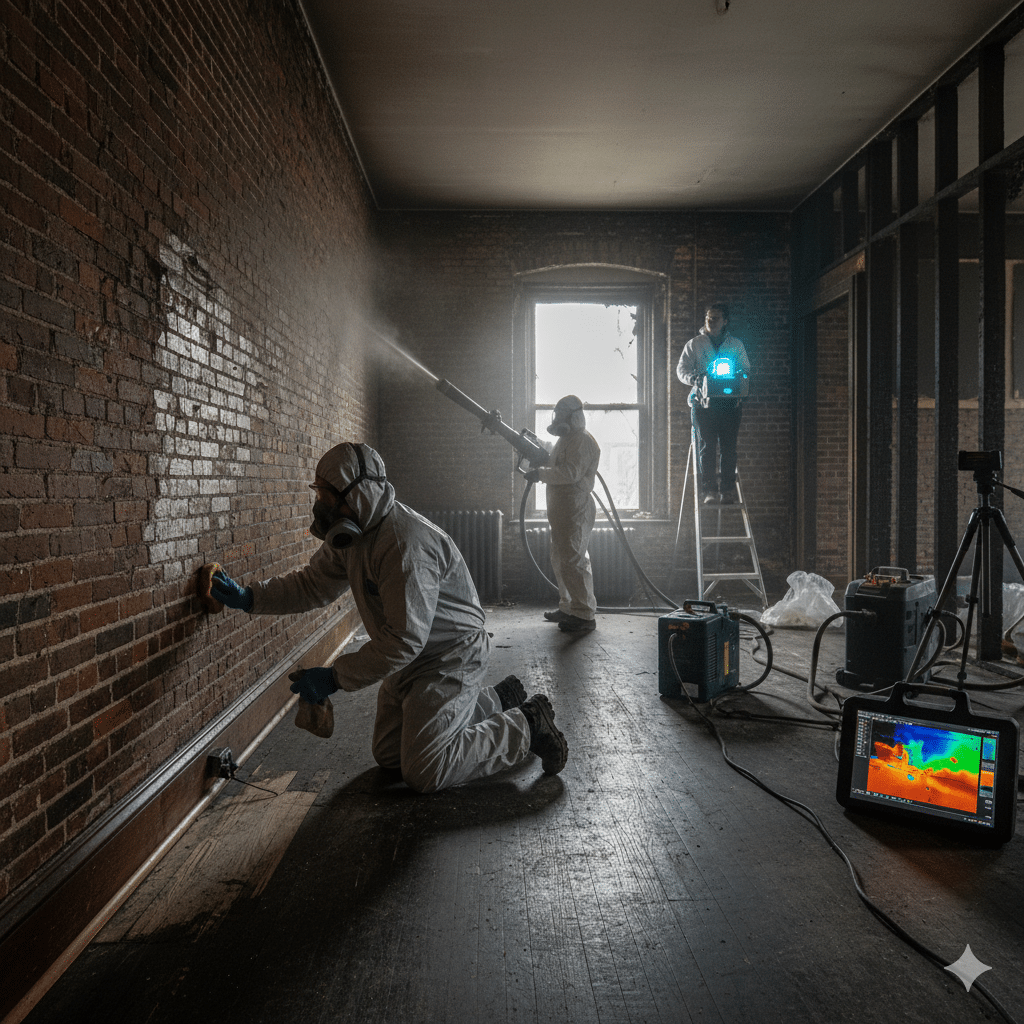
We don’t just “wipe” walls. Wiping soot without the correct chemical sponge can “set” the stain, essentially painting the wall with charcoal. We use specialized dry-chemical sponges that act like erasers, lifting the soot away. For heavy char on structural beams, we utilize “Media Blasting”—using dry ice or soda—to strip the damage away without harming the underlying wood.
The Chemistry of Deodorization: Neutralizing the Molecule
The most difficult part of fire damage restoration services is removing the scent. To do this, you have to change the molecular structure of the odor itself.
Hydroxyl Generators vs. Ozone
In 2026, we primarily use Hydroxyl technology. Think of a Hydroxyl generator as a “light-powered air cleaner.” It uses UV light to mimic the natural cleaning power of the sun, creating molecules that hunt down and break apart “stink molecules.” Unlike older ozone technology, hydroxyls are safe to use while people (and pets) are in the building, which allows us to work faster.
Thermal Fogging
To reach the smoke that is trapped inside your insulation or behind your kitchen cabinets, we use thermal fogging. This recreates the behavior of smoke. We heat a specialized deodorizer into a fine mist that has the same particle size as smoke. Because the particles are so small, they follow the exact same path the smoke took, neutralizing the odor at the source.
Comparing Restoration Strategies: Salvage vs. Replacement
| Material Type | Restoration Strategy | Outcome Goal |
| Porous Drywall | Typically removed if heavily soot-laden | Prevent hidden odor reservoirs |
| Structural Timbers | Media blasting (Dry Ice) and sealing | Retain structural integrity |
| Finished Hardwoods | Light sanding and “In-Place” drying | Restore original aesthetic |
| Synthetic Textiles | Ultrasonic cleaning and Hydroxyl treatment | 95% scent and particulate removal |
| Electronics | Forensic cleaning and de-ionization | Prevent acidic short-circuiting |
Content Restoration: Rescuing Your Legacy
Your home is more than a structure; it is a museum of your life. Our “Pack-Out” service is designed to rescue your belongings. We don’t just throw things in boxes. We barcode every item and move them to our climate-controlled facility in the Chicago area for specialized cleaning.
Ultrasonic Cleaning for Heirlooms
For items like jewelry, fine china, or even certain electronics, we use ultrasonic tanks. This involves high-frequency sound waves that create millions of tiny bubbles in a cleaning solution. These bubbles “implode” against the soot, lifting it out of tiny crevices that a human hand could never reach.
Esporta Wash Systems for Textiles
In 2026, we can save 90% of soft goods (clothes, stuffed animals, leather goods) that would have been discarded ten years ago. The Esporta system uses hydraulic pressure and specialized detergents to remove soot and bacteria without the heat of a traditional dryer, which would “bake” the smoke smell into the fabric.
Navigating the 2026 Insurance Landscape in Cook County
Dealing with insurance adjusters after a fire can be as stressful as the fire itself. At Redefined Restoration, we act as your technical advocate. The insurance industry in 2026 is increasingly data-driven. Adjusters no longer accept a bill that just says “Cleaned House.” They want a “Justification of Expenditure.”
Digital Documentation and 3D Scanning
We use 3D-scanning technology (Matterport) to create a digital “twin” of your home’s damage. This allows the adjuster to “walk through” the loss from their office. This transparency leads to faster approvals and fewer disputes over what was damaged.
Direct Insurance Coordination
We speak the language of adjusters. We provide them with moisture maps, thermal imaging reports, and chemical testing results that prove the presence of soot in “clean-looking” areas. This ensures your investment in your home is fully protected by your policy.
Structural Rebuilding: The Rebuild Phase
Once the property is clean and the air is pure, we transition into the reconstruction phase. This is the “Redefined” part of our name. We don’t just put things back the way they were; we build them back better.
Code Compliance and Safety Upgrades
Chicago and Franklin Park have strict building codes, which were updated in late 2025. When we rebuild your kitchen or living room, we ensure every repair meets 2026 safety standards. This includes:
- Fire-Rated Drywall: Adding extra layers of protection.
- Smart-Home Sensors: Integrating heat and smoke sensors that can shut off your HVAC system automatically.
- Non-Toxic Primers: Using “smoke-sealant” primers that act like a lightweight raincoat for your wall studs, locking in any microscopic remnants of the fire forever.
The Regional Challenges: Chicago vs. Franklin Park Restoration
While they are neighbors, restoring a property in downtown Chicago presents different logistical challenges than a project in Franklin Park.
Urban Density and “Stack Effect”
In Chicago high-rises or multi-unit apartments, we have to worry about the “Stack Effect.” This is when air pressure in a tall building pulls smoke from a lower floor fire up through the elevator shafts and stairwells. We often have to “air scrub” entire floors that weren’t even near the flames.
Industrial vs. Residential Franklin Park
Franklin Park has a heavy industrial presence. A fire in a warehouse or manufacturing plant often involves “Chemical Soot.” This requires a completely different cleaning chemistry than a residential grease fire. We maintain specialized equipment for large-scale industrial de-sooting to get local businesses back to work as quickly as possible.
Why “Local” Expertise Matters in 2026
You may see national franchises advertising fire restoration, but they often lack the deep-rooted knowledge of Chicagoland building history. A company that doesn’t understand the difference between 1920s plaster-and-lath and 1970s drywall will likely fail to properly deodorize a historic home.
At Redefined Restoration, we are your neighbors. We understand the specific soil conditions in Cook County that can affect how a foundation settles after it has been saturated with water. We understand the “Lake Effect” humidity that can cause mold to bloom in a damp attic within 48 hours. Our proximity to Chicago and Franklin Park allows us to maintain a 24/7 emergency response—because in fire restoration, an hour of delay can mean the difference between a restorable heirloom and a piece of trash.
The Psychological Impact of Fire Recovery
We never forget that we are working in your private sanctuary. Fire is a violation of your safety. Our technicians are trained in empathy as much as they are in chemistry. We provide:
- Clear Timelines: Knowing when the kitchen will be functional again reduces stress.
- Transparent Communication: You will have a dedicated project manager who answers your calls, not a nameless call center.
- Quality Guarantees: Our workmanship warranty ensures that you can sleep soundly, knowing your home is safe, structural, and scent-free.
Summary: A Blueprint for Resilience
Fire damage is an overwhelming event, but it is not the end of your property’s story. By leveraging 2026 technology—from ultrasonic cleaning to 3D damage mapping—we can reclaim spaces that would have been considered a “total loss” just a decade ago.
The road back to normalcy begins with the first phone call. Whether you are dealing with the aftermath of a small electrical flare-up or a major structural blaze, the goal is the same: to return your home or business to a state of “Pre-Loss Condition or Better.”
