The silence that follows a house fire in Franklin Park is often more unsettling than the sirens that preceded it. As the smoke clears over the bungalow-lined streets near Belmont Avenue or the industrial corridors along Grand, the immediate question for any property owner is one of time. You aren’t just looking at charred wood and soot; you are looking at a disrupted life. The duration of fire damage restoration varies based on damage severity, property size, and affected contents, ranging from a few days for minor smoke issues to several weeks or months for extensive structural repairs.
Redefined Restoration, drawing from more than a decade of expertise in fire recovery across diverse scenarios, delivers precise timelines upfront after our detailed inspection. Our licensed, fully insured team employs advanced drying techniques and professional-grade tools to accelerate mitigation, as seen in numerous 5-star reviewed projects. In 2026, we’ve seen how local environmental factors—like the heavy humidity of an Illinois spring or the sub-zero wind chills of a Cook County winter—can complicate recovery if not handled by localized experts. With our workmanship warranty and 24/7 emergency response, we minimize downtime, helping clients return home swiftly while maintaining transparency and compliance with building codes for authoritative, trustworthy service.
Think of a floral moisture-sealant like a lightweight raincoat for a petal; in the world of fire recovery, our immediate mitigation efforts act as that raincoat, protecting the “delicate bloom” of your home’s surviving structure from the secondary corrosive effects of soot and the water used by the fire department. In the year 2026, waiting even 48 hours to begin restoration is no longer an option if you want to salvage your investment.
The 2026 Timeline: A Breakdown of the Restoration Journey
Navigating the aftermath of a fire requires a clear roadmap. At Redefined Restoration, we categorize the journey into distinct phases, each influenced by the unique architectural styles of Franklin Park—from mid-century residential homes to the high-clearance warehouses common in our local industrial parks.
Phase 1: Emergency Stabilization (Hours 1–24)
The first 24 hours are the “Golden Hours” of restoration. As of 2026, our emergency response teams are dispatched within 60 to 90 minutes of your call. During this window, the focus is on security and preventing further loss.
- Board-Up and Tarping: We secure broken windows and compromised roofs to keep out the unpredictable Illinois weather.
- Structural Shoring: If the fire has weakened the load-bearing walls of a traditional Franklin Park Cape Cod or ranch-style home, we install temporary supports.
- Water Extraction: Firefighters often use thousands of gallons of water. We must remove this moisture immediately to prevent mold—a process we treat with the same urgency as the fire damage itself.
Phase 2: Assessment and Forensic Mapping (Days 1–3)
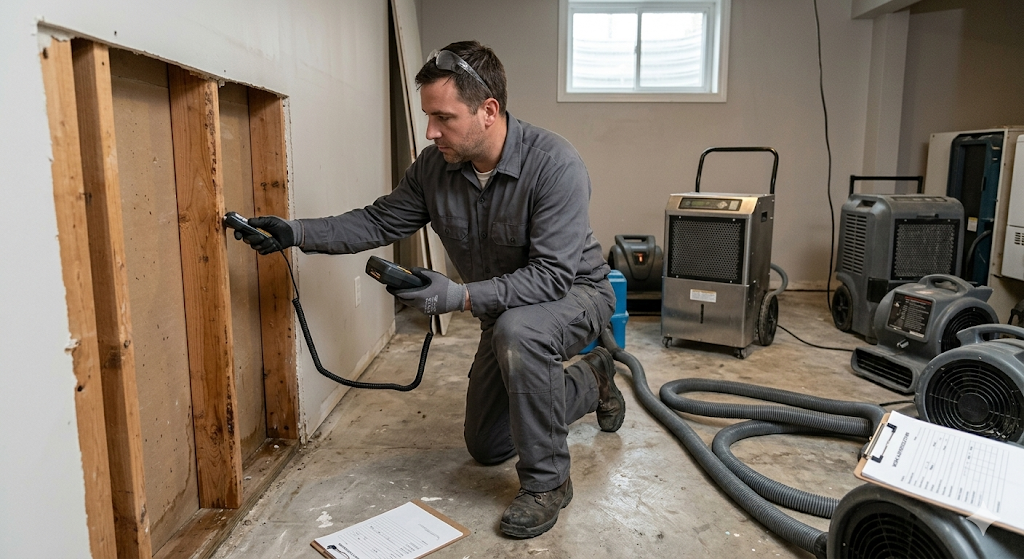
Once the property is secure, our Project Managers conduct a deep-dive inspection. In 2026, we utilize infrared thermography and air quality sensors to map the reach of “ghost smoke”—odors and soot particles that have migrated into wall cavities and HVAC systems. This phase concludes with a detailed estimate and timeline tailored to your insurance policy requirements.
Phase 3: Mitigation and Soot Decontamination (Days 3–14)
This is where the heavy lifting happens. Soot is highly acidic; if left on surfaces, it will permanently etch glass, tarnish metal fixtures, and yellow your appliances.
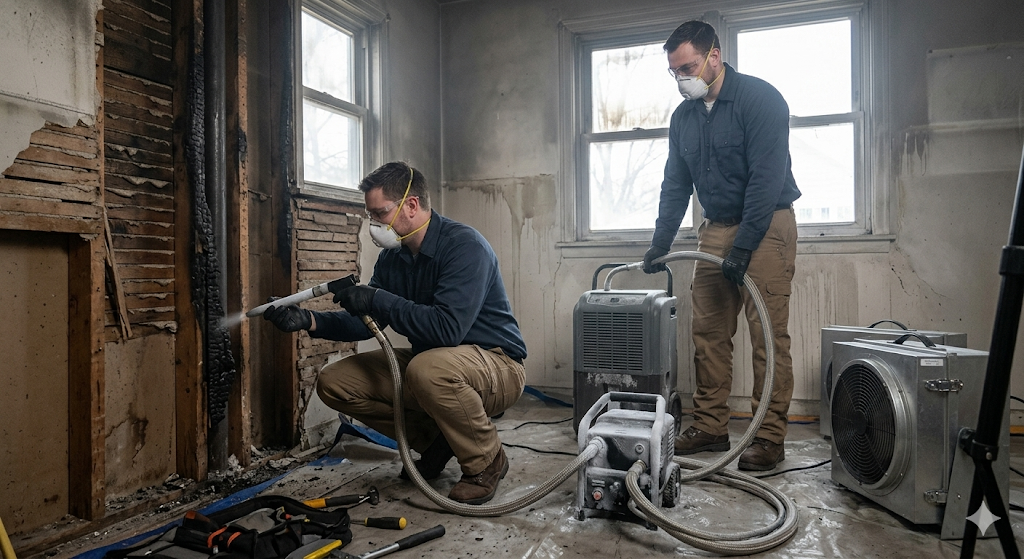
- Dry Ice Blasting: A 2026 industry standard we use for heavy char removal without the mess of traditional sandblasting.
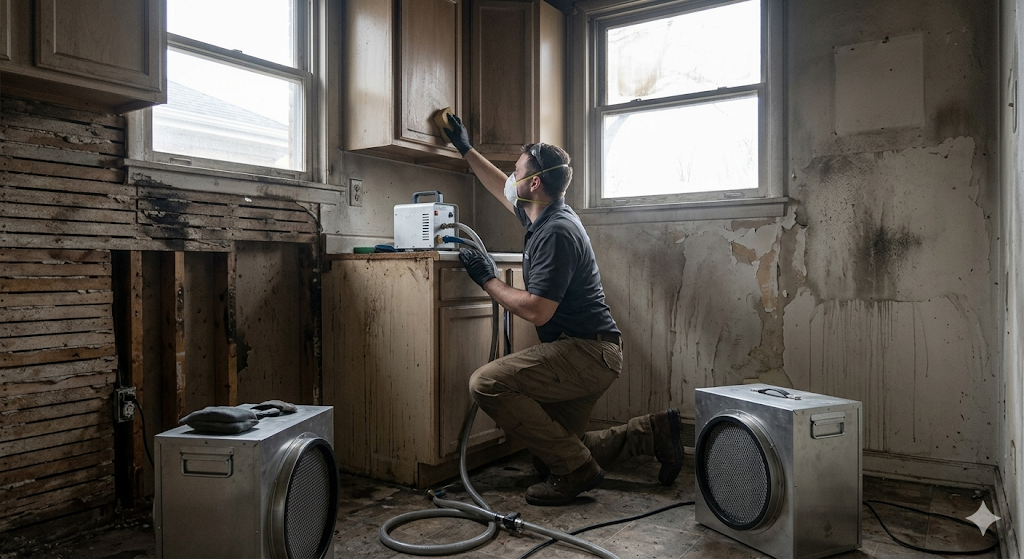
- HEPA Air Scrubbing: We utilize hospital-grade air filtration to remove 99.97% of airborne particulates.
- Hydroxyl Generation: Think of this like a high-tech “odor-eater” that neutralizes smoke molecules at the molecular level rather than just masking them.
Phase 4: The Rebuild and Restoration (Weeks 2–12+)
The final phase involves returning the home to its pre-loss condition. For minor smoke damage, this might just be a week of specialized cleaning and painting. For a major structure fire near the Des Plaines River corridor, this could involve a multi-month reconstruction project involving new framing, electrical, and plumbing to meet the updated 2026 Illinois Building Codes.
Regional Nuances: Why Franklin Park Restoration is Unique
Restoring a home in the 60131 zip code is different than in other parts of the country. Our local climate and urban density play a significant role in how we manage your timeline.
Seasonal Impacts on Structural Drying
In 2026, we’ve experienced particularly volatile winter-to-spring transitions. If a fire occurs in February, the water used to extinguish it can freeze inside the pipes and walls, causing “ice-jacking.” This requires us to use specialized heated drying trailers before we can even begin the smoke cleaning process. Conversely, the humid Franklin Park summers can turn a fire-damaged home into a mold incubator in under 48 hours, necessitating high-capacity LGR (Low Grain Refrigerant) dehumidifiers.
Compliance with Modern Illinois Building Codes
As of March 2026, the Village of Franklin Park adheres to updated energy and safety codes. When we perform fire damage restoration, we don’t just “fix what was there.” We ensure that your repairs comply with the latest 2024 International Residential Code (IRC) and National Electrical Code (NEC) updates. This might include:
- Enhanced Surge Protection: Now required for all residential service panels.
- Fire Sprinkler Retrofitting: Often required if the structural damage exceeds a certain percentage of the home’s value.
- Sustainability Standards: Using low-VOC paints and energy-efficient insulation during the rebuild.
Strategic Comparison: Professional Restoration vs. DIY Risks
Many property owners consider handling minor smoke cleanup themselves to save on the “premium tier” investment of professional services. However, the 2026 reality of smoke chemistry makes this a dangerous gamble.
| Factor | Professional Restoration (Redefined Resto) | DIY Attempt |
| Odors | Molecular neutralization (Ozone/Hydroxyl) | Masking with sprays (Odors return in humidity) |
| Health Safety | HEPA filtration & PPE used for carcinogens | Exposure to fine soot particles and toxins |
| Structural Integrity | Moisture mapping & structural shoring | Hidden rot and rust behind drywall |
| Insurance | Direct billing & detailed documentation | Difficulty proving “Scope of Work” for claims |
| Warranty | Comprehensive workmanship guarantee | No protection if damage reappears |
The “Why” Behind the Timelines: The Science of Smoke
Understanding why restoration takes weeks instead of days requires looking at the science. Smoke is not just “dark air”; it is a complex aerosol of partially burned materials, acids, and chemicals. In 2026, the materials inside our homes—modern plastics, synthetic foams, and treated woods—produce much more toxic smoke than the organic materials of fifty years ago.
The Corrosivity of Soot
Within minutes of a fire, soot begins to settle. Because it is acidic, it acts like a slow-moving solvent. On the metal fixtures common in modern Franklin Park kitchens, soot will cause “pitting” and permanent rust if not neutralized with specialized alkaline cleaners within 72 hours. Our meticulous cleaning process is designed to stop this chemical reaction in its tracks.
The “Sponge Effect” of Porous Materials
Think of your home’s insulation and drywall like a giant sponge. Smoke doesn’t just sit on the surface; it is driven deep into the pores of the material by the heat of the fire. Our fire damage restoration process often involves “thermal fogging,” which mimics the behavior of smoke to reach the same deep pockets and neutralize the smell where it lives.
Managing the Rebuild Phase: What Happens Next?
Once the mitigation phase is complete and the property is “cleared for occupancy” from a health perspective, the rebuild phase begins. At Redefined Restoration, we provide a seamless handoff between our cleaning crews and our construction teams.
Permits and Inspections
In Franklin Park, major structural repairs require a “Building Permit” and subsequent inspections from the Village Building Department. We handle this entire administrative burden. This includes:
- Fire Permit Application: Specific to fire-damaged structures.
- Electrical Final: Ensuring the new wiring meets 2026 safety standards.
- Occupancy Permit: The final “green light” from the village that your home is safe for your family to return.
Contents Restoration and Pack-Out
While the structure is being repaired, your belongings need care too. We offer a “Pack-Out” service where we inventory, move, and clean your furniture, electronics, and heirlooms in our off-site climate-controlled facility. Using ultrasonic cleaning technology, we can often save items that homeowners assume are lost forever—from high-end electronics to antique wedding dresses.
Insurance Integration: Navigating the 2026 Claim Flow
A fire is a massive financial event. In 2026, insurance platforms have become increasingly digitized, requiring faster and more detailed documentation. Redefined Restoration bridges this gap.
The Digital Claims Trail
We provide your insurance carrier with a “Digital Loss Packet” that includes:
- High-Resolution 3D Scans: We use Matterport technology to create a 3D walkthrough of the damage before we touch a single shingle.
- Moisture Logs: Proving that the water used to put out the fire was properly extracted.
- Soot Analysis: Identifying the type of soot (wet, dry, or protein) to justify the cleaning methods used.
By providing this authoritative data, we often accelerate the approval of the “premium tier” repairs your home needs, ensuring you aren’t left with a value-based patch job when you deserve a full restoration.
Why Choose Redefined Restoration for Franklin Park?
We are more than just a restoration company; we are your neighbors. We understand the specific stresses of living in the Cook County suburbs, from the property tax complexities to the local building inspectors’ expectations.
- Expertise in Franklin Park Architecture: We know how to handle the lath-and-plaster walls of older homes and the pre-engineered trusses of newer constructions.
- 24/7 Availability: Fires don’t happen during business hours. Our teams are always ready to respond to a late-night emergency near the North Avenue corridor.
- Integrity and Transparency: We provide a workmanship warranty because we believe in the quality of our craft. If you aren’t satisfied with the results, we make it right.
Protecting Your Sanctuary in a Changing Climate
As we move through 2026, the risk profiles for properties are changing. While Franklin Park has a “Minor Risk” of wildfires, the increasing intensity of summer heat and winter storms creates a higher demand for resilient building materials. During our rebuild process, we offer “Resilience Retrofits,” such as fire-rated siding and tempered glazing, to ensure that if a neighboring structure catches fire, your home is better protected.
Restoring a home after a fire is a marathon, not a sprint. While the timeline can feel daunting, having a team like Redefined Restoration by your side ensures that every step is taken with precision and care. We are here to help you navigate the complexity of the permits, the science of the smoke, and the emotional weight of the recovery.