The Silent Clock: Why Timing and Technical Precision Define Top Water Damage Restoration Companies in Chicago

water damage restoration

You are standing in your basement in Lincoln Square, and the sound isn’t the usual hum of the furnace. It’s a rhythmic, heavy splashing. A pipe has burst behind the drywall, or perhaps the notorious Chicago “flash flood” has sent the city’s combined sewer system surging back into your garden-level unit. In that moment, your brain shifts into survival mode. You grab towels, you move the heirloom rug, and you start searching for help.

What most property owners in the Windy City don’t realize is that the water you can see—the puddles reflecting your flashlight—is only about twenty percent of the problem. The real crisis is the water you cannot see. It is currently wicking up your wall studs like a straw and soaking into the porous Chicago common brick of your foundation. This is where the gap between “cleaning up” and “professional restoration” becomes a chasm. In 2026, the standard for a healthy home has moved beyond surface-level drying. To truly protect your investment, you need to understand the structural physics that the best water damage restoration companies use to save a building from the inside out.

The Hidden Mechanics of Structural Wicking

When water enters a room, it doesn’t just sit on the floor. It is opportunistic. Through a process called “capillary action,” water moves upward through porous materials against the force of gravity. Think of a sponge dipping into a glass of water; the water travels up into the sponge even though the sponge is “above” the water line.

In our local architecture, from the historic greystones to the modern glass high-rises in the West Loop, this wicking can happen at an alarming speed. Drywall, insulation, and wood framing act like a giant wick for a candle. If you only dry the floor, the water trapped inside the walls stays there. This trapped moisture creates a “micro-environment” where mold spores—which are naturally present in the Chicago air—can settle and thrive. Within forty-eight hours, a simple leak can turn into a biological event that compromises the air quality of the entire property.

How Modern Restoration Science Outsmarts Moisture

Professional water damage restoration companies do not rely on “feel” or “sight” to determine if a room is dry. In 2026, we use a discipline called Psychrometry. This sounds like a complex medical term, but it is actually the science of how air and water vapor interact.

Essentially, we use the air as a tool to pull water out of your floors and walls. To do this, we have to create “thirsty air.” When the air in your home is humid, it’s like a sponge that is already full of water; it can’t soak up any more. By using industrial-grade dehumidifiers—which act like high-powered magnets for moisture—we strip the water out of the air. Once the air is “thirsty,” it starts to pull the water out of your carpet and wood studs.

This is a delicate balance. If you dry a room too fast, you can cause “case hardening,” where the outside of a wood beam dries and shrinks so quickly that it cracks the interior, causing structural weakness. If you dry it too slowly, you invite rot. The elite teams at Redefined Restoration monitor these “drying curves” daily to ensure your home returns to its original structural strength without secondary damage.

The Chicago Context: Weather and Architecture

Chicago presents a unique set of challenges that restoration companies in other parts of the country rarely face. Our local climate and building styles dictate a very specific approach to moisture management.

The Seasonal Humidity Swing

During a humid Chicago summer, the outdoor air is often already saturated. If a pipe leaks in July, we cannot simply open the windows to “air the place out.” Doing so would actually invite more moisture into the home. Conversely, in the dead of a freezing January, the indoor air is incredibly dry, but the structure itself may be frigid. If we don’t manage the temperature of the wet materials, the water won’t evaporate. In 2026, we utilize specialized heating systems to “excite” the water molecules in your floor, making them move faster so our dehumidifiers can catch them more easily.

Older Brick Foundations

Many homes in Avondale, Logan Square, and Bridgeport are built with “Chicago Common Brick.” This brick is incredibly porous compared to modern masonry. When a basement floods, this brick soaks up water like a terracotta pot. If a company doesn’t use deep-penetrating moisture meters to check the “core” of the brick, they might leave pounds of water trapped inside. This leads to “efflorescence”—that white, powdery salt you see on basement walls—which is a sign that water is still moving through the masonry, potentially weakening the mortar over time.

The Professional Workflow: What Happens Next

When you call one of the leading water damage restoration companies, the process follows a strict technical order. This isn’t just for efficiency; it’s to prevent “cross-contamination.”

1. Thermal Inspection and Moisture Mapping

We don’t start by tearing down walls. We start by seeing the invisible. Using infrared cameras, we can see temperature differences in your walls. Since wet materials are usually cooler than dry ones, the infrared camera shows us exactly where the water traveled. We create a “map” of the moisture, which allows us to be surgical in our approach rather than gutting the entire room.

2. High-Velocity Extraction

It is much more cost-effective to “vacuum” water out than it is to “dry” it out. We use truck-mounted extraction units that have thousands of times more suction power than a standard shop-vac. These units can pull water out of the deep “padding” beneath your carpet, often saving the carpet itself if the water was clean.

3. Structural Stabilization

Once the standing water is gone, we apply hospital-grade antimicrobials. This is a critical safety step. We want to make sure we aren’t just drying out a “biology project.” By sanitizing the surfaces immediately, we stop bacteria from multiplying while the drying machines do their work.

4. Controlled Evaporation

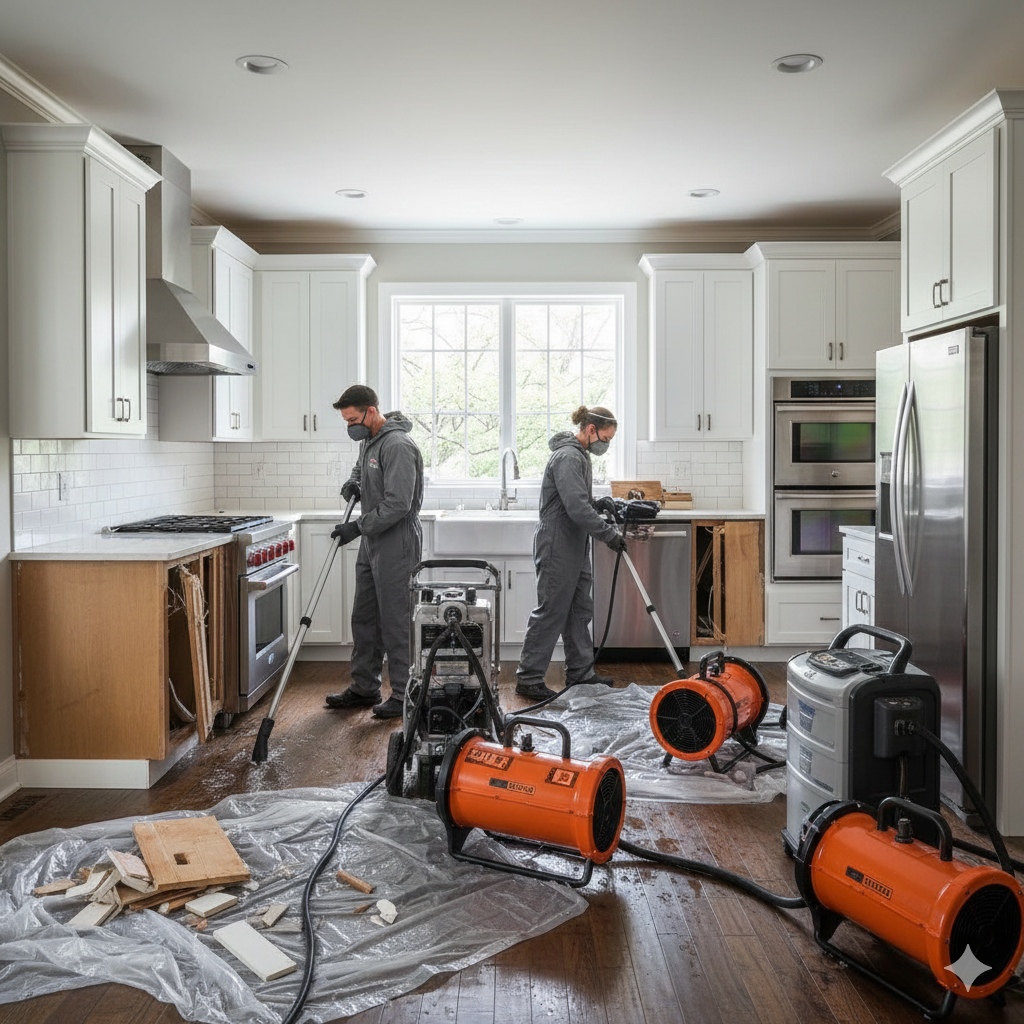
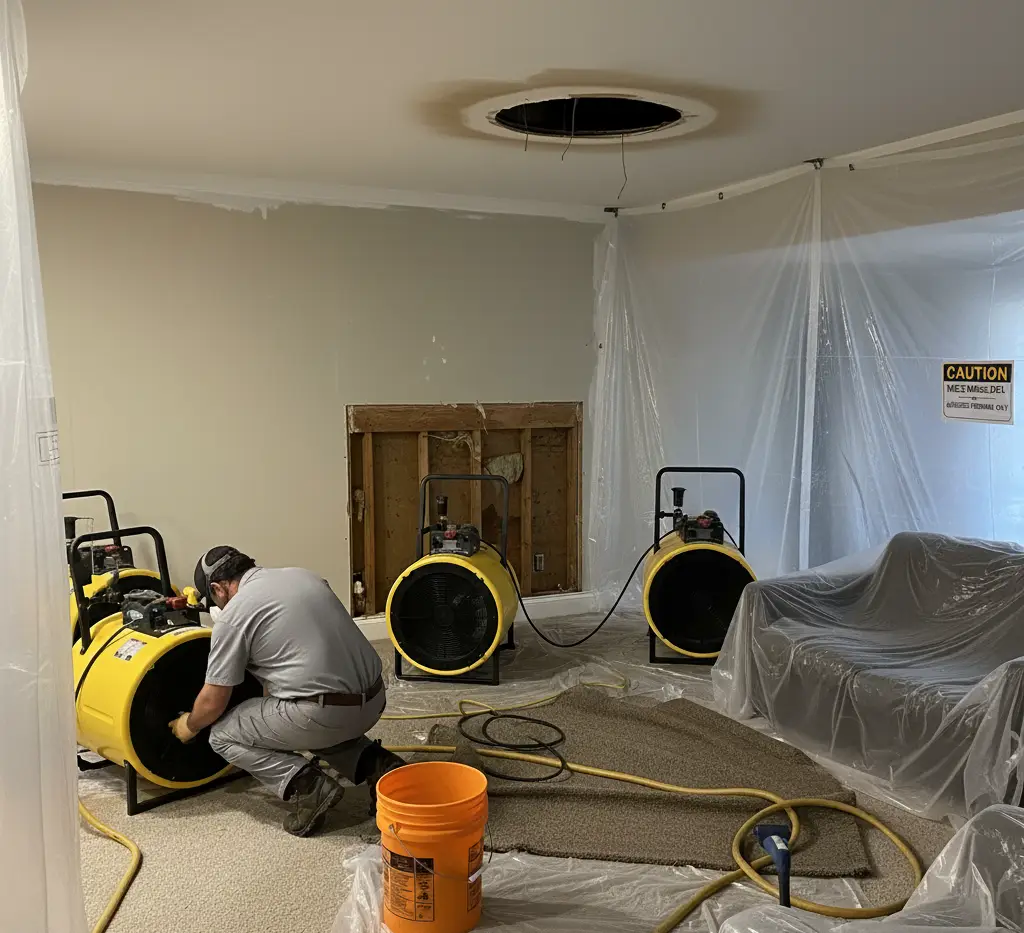
This is where the heavy equipment comes in. We use “Air Movers”—industrial fans designed to create a “cyclone” of air right at the floor level. This high-speed air “peels” the moisture off the surface so our dehumidifiers can collect it.
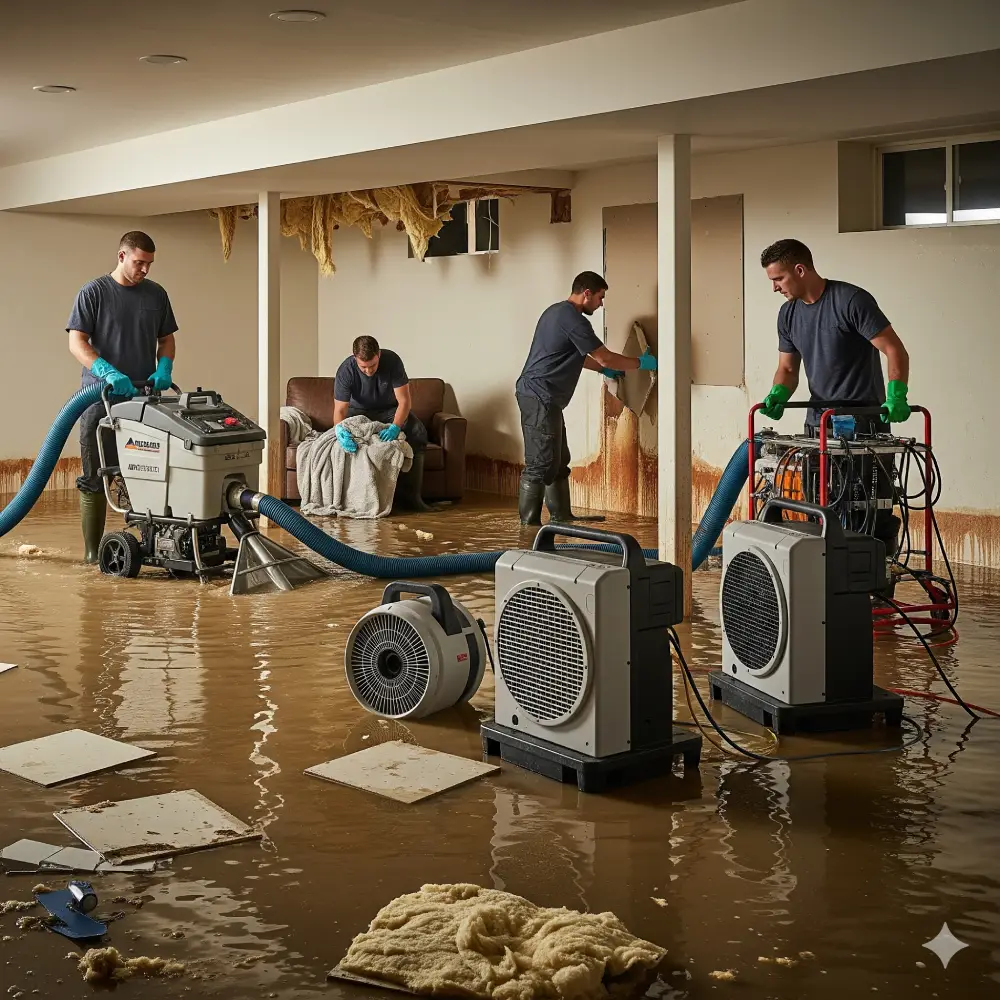
water damage restoration companies

Comparing Professional Restoration to General Maintenance

Many property managers or homeowners believe they can handle a leak using their in-house maintenance staff. While this might save a few dollars initially, the long-term investment in a professional firm usually pays for itself by preventing structural failure and mold.

Feature In-House Maintenance / DIY Professional Restoration Team
Moisture Detection Touch and sight (unreliable) Infrared and deep-penetrating meters
Drying Method Standard fans and open windows Industrial LGR dehumidifiers and axial fans
Bacteria Control Household bleach (mostly water-based) EPA-registered botanical antimicrobials
Documentation None Full moisture logs for insurance claims
Structural Integrity Risk of warped floors and rotted studs Scientific drying to “dry standard”
Air Quality Risk of mold spore circulation HEPA air scrubbing and filtration

The Health Implications of “Almost Dry”

In 2026, we are more aware than ever of how indoor air quality affects our health. When a home isn’t dried properly, the moisture that remains trapped behind baseboards or under kitchen cabinets becomes a breeding ground for “microbial volatile organic compounds” (MVOCs). This is what creates that “musty” basement smell.

That smell isn’t just an annoyance; it is a sign that biological organisms are active in your home. For families in Chicago with children or elderly residents, this can lead to respiratory irritation or an increase in allergy symptoms. Professional water damage restoration companies use HEPA air scrubbers during the drying process. These machines act like a “liver” for the air in your house, filtering out 99.97% of the tiny particles, dust, and spores that the drying fans might stir up. This ensures that while we are fixing the floor, we aren’t compromising the air you breathe.

Navigating the Chicago Insurance Maze

One of the most stressful parts of a water emergency is dealing with the insurance company. Adjusters in 2026 are looking for data, not just photos. They want to see “moisture logs” that prove the home was brought back to a “dry standard.”

A “dry standard” is a measurement we take from a part of your house that didn’t get wet. For example, if your basement flooded, we take a reading from a dry stud on the first floor. This tells us what “normal” looks like for your specific home and its materials. We then monitor the wet areas until they match that dry standard. When you work with Redefined Restoration, we provide this technical documentation to your insurance carrier, making the claim process much smoother. It turns the conversation from an argument about what “feels dry” into a factual report based on physics.

The Silent Threat: Secondary Damage

If a professional company isn’t brought in, “secondary damage” is almost a guarantee. This is damage that wasn’t caused by the initial leak but was caused by the high humidity that the leak created.

Imagine a pipe bursts in your kitchen. You mop the floor, but you don’t use professional dehumidifiers. The air becomes so wet that the moisture starts to condense on the cooler surfaces upstairs. Suddenly, you have “ghosting” (dark streaks) on your bedroom ceiling, or your high-end wooden furniture in the dining room starts to “cloud” (develop white spots in the finish). The right restoration team manages the entire volume of air in the property, not just the room where the water was found.

Safety and Structural Stability

Water is heavy. When a ceiling or a subfloor becomes saturated, it loses its “shear strength.” This means it can no longer hold the weight it was designed for. In older Chicago homes with plaster-and-lath ceilings, a leak on the second floor can lead to a sudden, dangerous collapse of the plaster below.

Professional restoration teams are trained to identify when a material is no longer safe. Sometimes, the most professional thing we can do is tell you that a ceiling needs to come down for your safety. We look at the “load-bearing” capacity of wet materials to ensure that as the home dries, it doesn’t become a hazard to your family.

Why 2026 Standards Favor “Restoration” over “Replacement”

A decade ago, the standard response to a flood was to “gut the house.” Today, because the technology of water damage restoration companies has advanced so much, we can save a significant amount of the original structure.

  • Hardwood Floor Drying: We use “pressure mats” that use suction to pull moisture directly through the pores of the wood. This can often save expensive oak or maple flooring that would have previously warped and required replacement.
  • Injection Drying: For walls that are wet on the inside but look fine on the outside, we can sometimes drill tiny holes and “inject” dry air directly into the wall cavity. This saves the cost of tearing out and replacing the drywall.
  • In-Place Carpet Drying: If the water is from a clean source (like a supply line), we can often dry the carpet and the padding without even pulling it up, using high-powered sub-surface extraction tools.

This “restore over replace” philosophy is not only faster, but it is also much more environmentally friendly. It keeps tons of construction debris out of our local landfills and gets your life back to normal days or even weeks sooner.

The Biohazard Reality: Category 1 vs. Category 3

Not all water is created equal. In the restoration industry, we categorize water based on its cleanliness.

  • Category 1 (Clean Water): From a broken water supply line or a leaking faucet. It doesn’t pose a substantial risk if handled quickly.
  • Category 2 (Gray Water): This might be from a dishwasher or a washing machine. It contains “nutrients” (like soap or skin cells) that can allow bacteria to grow quickly.
  • Category 3 (Black Water): This is the most dangerous. This is sewer backup or rising floodwater from the street. It contains pathogens, viruses, and chemicals.

When you deal with Category 3 water in Chicago, the mitigation process is entirely different. Everything porous—like carpet padding or drywall—that was touched by the water usually must be removed. This is where the expertise of Redefined Restoration is vital. We have the training to handle these biohazards safely, using personal protective equipment (PPE) and containment barriers to make sure that the “black water” contaminants don’t spread to the clean parts of your home.

Final Thoughts for the Chicago Property Owner

A water emergency is a test of your home’s resilience, but more importantly, it is a test of the partners you choose to fix it. In a city like Chicago, where the weather is tough and the architecture is varied, you cannot afford to guess.

Whether you are dealing with a slow drip that has been hiding behind a vanity for months or a sudden burst pipe that has turned your living room into a lake, the goal is the same: return the property to its pre-loss condition as quickly and safely as possible. By choosing among the top water damage restoration companies that prioritize 2026 drying technology and scientific documentation, you are doing more than just fixing a leak. You are ensuring the long-term health of your family and the structural integrity of your home.

When you see our trucks in your neighborhood, know that we aren’t just there to move air; we are there to protect the very “bones” of the city we love. From the first thermal image to the final moisture reading, our commitment is to provide a result that makes the emergency feel like a distant memory.
Beyond the Rising Water: A Strategic Guide to Flood Damage Restoration in Chicago

:

It is a Tuesday evening in April, and a sudden, violent Midwestern thunderstorm is pounding against the pavement of your street in Lakeview. You hear a sound from the basement that no homeowner ever wants to hear: the frantic, rhythmic splashing of water where there should be silence. Within minutes, the “finished” area you spent years perfecting is transforming into a dark, murky pond. As the water inches up the drywall, you realize this isn’t just a small leak; it is a full-scale environmental crisis in your own home.

In 2026, flood events in the Chicago area have become more frequent and more intense. Our city’s aging infrastructure often struggles to keep up with rapid “flash floods” that send river water, street runoff, and—most dangerously—sewer backup into the basements of historic bungalows and modern condos alike. When this happens, the clock doesn’t just start ticking; it starts racing. Most people assume that once the water is gone, the problem is solved. In reality, the departure of the water is only the end of the beginning.

The Invisible Threat of Category Three Water

In the world of professional flood damage restoration, we don’t just see “water.” we see “categories.” When a pipe bursts in your kitchen, that is Category One—clean water. However, when Lake Michigan or the Chicago River overflows, or when the city’s combined sewer system fails, you are dealing with Category Three water, often called “Black Water.”

This is the most dangerous classification of liquid a property owner can encounter. This water is not just “dirty”; it is a living soup of bacteria, viruses, chemicals, and organic matter. It carries pathogens like E. coli and Salmonella, along with whatever fertilizers or oils it picked up from the street. This is why attempting to “DIY” your flood cleanup in Chicago is more than just a difficult task—it is a significant health risk. Professional restoration is about more than just drying floors; it is about decontaminating a biological hazard zone.

The Physics of Professional Drying: Psychrometry Explained

Once the standing water is removed using high-powered, truck-mounted extraction units—which act like giant, industrial-strength vacuum cleaners for your house—the real work of flood damage restoration begins. This is where we use the science of “Psychrometry.”

Essentially, Psychrometry is the study of how air and water vapor behave. To dry a house that has been soaked through, we have to manipulate the environment using three specific levers: airflow, dehumidification, and temperature.

Creating the Thirsty Air

Think of the air in your flooded basement as a sponge. If the air is already “full” of water (high humidity), it can’t soak up any more moisture from your wet carpet or drywall. We use industrial-strength dehumidifiers that act like high-powered magnets for moisture. These machines pull the wet air in, freeze the water out of it, and blow bone-dry air back into the room. This makes the air “thirsty” again so it can continue pulling water out of your walls.

The Role of High-Velocity Air Movers

If you just turn on a standard house fan, you are only moving the surface air. In a professional flood damage restoration setup, we use centrifugal air movers. These are designed to create a “cyclone” effect right at the floor level. This high-speed air “peels” the moisture off the surface of the materials, allowing the thirsty air to do its job. It is the difference between letting a spill air-dry and using a high-pressure blow-dryer.

Chicago’s Unique Architectural Challenges

Restoring a home in the Windy City is vastly different from restoring one in a desert climate. Chicago’s architecture—from the classic brick two-flats of Avondale to the limestone-clad greystones of Lincoln Park—requires a specialized touch.

The Porous Brick Problem

Many older Chicago homes are built with “Chicago Common Brick.” This material is notoriously porous. When floodwaters rise against a brick foundation, the brick acts like a wick, sucking the water upward through a process called “capillary action.” If a technician doesn’t account for this, you might dry the floor but leave the interior of the brick walls saturated. This leads to “spalling,” where the face of the brick literally pops off as the moisture inside tries to escape.

The Modern Condo Slab

In the West Loop or the South Loop, many newer residences are built on concrete slabs with “floating” floors. If water gets under these floors, it becomes trapped in a “dead air space.” Without professional Redefined Restoration intervention, that water will sit there for months, slowly rotting the subfloor and creating a massive mold colony that you won’t even see until you start smelling it.

The Anatomy of a Professional Restoration Plan

When our team arrives at a property, we don’t just start throwing fans around. We follow a technical “Order of Operations” designed to stabilize the building and prevent “secondary damage.”

Phase One: The Inspection and Moisture Map

We use infrared cameras—which see temperature differences rather than light—to find the water. Since wet materials are usually cooler than dry ones, the infrared camera allows us to see exactly where the water is hiding behind your drywall without us having to tear the wall down. We create a “Moisture Map” to track our progress, ensuring that we don’t leave a single pocket of dampness behind.

Phase Two: Aggressive Extraction

We remove the bulk water. It is much faster to “vacuum” water out of a material than it is to “evaporate” it. If we can extract 90% of the water in liquid form, the drying phase becomes much more manageable.

Phase Three: Stabilization and Antimicrobial Treatment

Before the fans go on, we apply hospital-grade antimicrobials. This is a critical safety step. If you blow air across contaminated floodwater, you are essentially “atomizing” the bacteria—turning it into a fine mist that you can breathe in. We sanitize the environment first to ensure the air we move is safe air.

Phase Four: Controlled Drying and Monitoring

In 2026, we use “smart sensors” that allow us to monitor the drying progress remotely. These sensors send data to our technicians’ phones, telling us exactly when the wood studs have reached the “Dry Standard”—a baseline measurement of what a healthy, dry piece of wood should be in the Chicago climate.

Comparison: Restoration vs. Standard Cleaning

Many property owners confuse a cleaning service with a restoration firm. Here is a breakdown of why they are not the same:

Feature Standard Cleaning Service Professional Restoration Service
Moisture Detection Touch/Sight only Infrared cameras & moisture probes
Water Extraction Mops & Shop-Vacs Truck-mounted high-PSI extraction
Bacteria Control Household bleach (mostly water) EPA-registered botanical antimicrobials
Drying Power Household fans & open windows Industrial LGR dehumidifiers & air movers
Structural Knowledge None IICRC-certified structural drying expertise
Documentation None Full moisture logs for insurance claims

The Mold Clock: Why 48 Hours is the Magic Number

The most significant risk following a flood isn’t the water itself; it is what grows in its wake. Mold spores are naturally present in the Chicago air, but they need three things to grow: food (drywall or wood), the right temperature, and moisture.

In a flooded environment, you have all three. Mold can begin to colonize and become visible in as little as 24 to 48 hours. Once mold takes hold, your project transitions from a relatively simple drying job into a much more expensive “mold remediation” project. This is why we treat every flood damage restoration call as an emergency. By aggressively drying the structure within that first 48-hour window, we effectively “starve” the mold of the water it needs to survive.

Navigating the Chicago Insurance Maze

One of the most stressful parts of a flood is dealing with the financial fallout. In 2026, insurance companies have become incredibly data-driven. They don’t want to hear that your basement “was really wet.” They want to see the numbers.

At Redefined Restoration, we provide the “paper trail” that insurance adjusters require. This includes:

  • The Dry Standard: Proof of what a dry area of your home looks like.
  • Daily Moisture Readings: A day-by-day log showing the moisture levels dropping in your walls and floors.
  • Psychrometric Logs: Data showing that the air in your home was being properly managed to facilitate drying.

Having this technical documentation makes it much harder for an insurance carrier to deny a claim or argue that the damage was “pre-existing.” We act as your technical advocate, ensuring that the work is done correctly and documented thoroughly.

The Hidden Costs of Improper Restoration

If a home isn’t dried to professional standards, the “savings” of doing it yourself often vanish within a year. We call these “secondary losses.”

Structural Integrity and “Dry Rot”

When wood stays damp for too long, it can develop a fungus commonly called “dry rot.” This fungus eats the cellulose that gives wood its strength. In older homes, this can compromise the very “sill plates” and “joists” that hold up your house. Professional drying ensures the “bones” of your home stay strong.

The “Musty Smell” and Indoor Air Quality

Have you ever walked into a Chicago basement and immediately smelled that “old house” musty scent? That smell is actually “Microbial Volatile Organic Compounds” (MVOCs)—the gases released by mold and bacteria as they eat your home. It isn’t just an annoyance; it is a sign of poor indoor air quality that can lead to respiratory issues. Professional restoration involves “Air Scrubbing”—using HEPA-filtered machines that act like a “liver” for your home’s air, filtering out 99.97% of particles and odors.

Safeguarding Your Chicago Property for the Future

While we can’t control the rain, we can control how our homes respond to it. As part of our service, we often help homeowners identify “vulnerability points” that led to the flood.

  • Sump Pump Maintenance: In 2026, we recommend “smart” sump pumps with battery backups. If the power goes out during a Chicago storm, a standard pump is useless.
  • Grading and Gutters: Many floods in the city are caused by water pooling against the foundation because gutters are clogged with debris from our local oak and maple trees.
  • Backflow Preventers: If your flood was caused by a sewer backup, installing a backflow preventer can be a “budget-friendly” way to ensure the city’s sewage never enters your home again.

The Human Element: Empathy in a Crisis

At Redefined Restoration, we understand that we are meeting you on what might be one of the worst days of your year. You aren’t just looking at wet drywall; you are looking at damaged memories, ruined photo albums, and a disrupted life.

Our technicians are trained to be “calm in the storm.” We don’t just bring equipment; we bring a plan. From the moment we step into your home, our goal is to take the “chaos” of a flood and turn it into a structured, scientific recovery process. We handle the heavy lifting—both literally and figuratively—so you can focus on getting your family back to a sense of normalcy.

Technology in 2026: The New Standard

The tools of our trade have evolved rapidly. Today, we use “In-Place Drying” technology. In the past, if a carpet got wet from a flood, we almost always had to tear it out. In 2026, we have specialized “floor mat” systems that can pull moisture directly through hardwood or high-end carpeting without having to demolish the material.

This approach is not only faster, but it is also much more “cost-effective” and environmentally friendly. We strive to “Restore” rather than “Replace” whenever it is scientifically safe to do so. This keeps debris out of our local landfills and gets you back into your home days or even weeks sooner than a full reconstruction project would.

Understanding “Water Migration”

Water is “opportunistic.” It doesn’t just sit on the floor; it moves. Through “wicking,” water can travel up your drywall as much as four feet in a single night. It travels behind baseboards, into the “dead air spaces” between your wall studs, and even into the electrical outlets.

This “migration” is why we often have to dry areas of the house that didn’t even touch the standing water. If the humidity in your basement hits 90%, the ceiling tiles in that basement will start to soak up that moisture from the air, potentially leading to sagging and mold on the top of the room. A professional flood damage restoration plan accounts for the entire “volume” of the space, not just the square footage of the floor.

Conclusion: Turning the Tide on Flood Damage

A flood is a powerful force of nature, but it is not an invincible one. With the right combination of 2026 technology, scientific drying principles, and a deep understanding of Chicago’s unique architectural landscape, your home can be saved.

The most important thing to remember is that water is a patient enemy. It will hide in your floors and walls for months if you let it. But with aggressive, professional intervention, you can stop the damage in its tracks. You can ensure that the air your family breathes is clean, the “bones” of your house are dry, and your investment is protected.

If you find yourself standing in rising water, don’t wait for the “musty smell” to tell you there’s a problem. Take immediate action, secure your property, and bring in the experts who know how to manage the “invisible” side of restoration. Your home is more than just a building—it is your sanctuary. Let’s keep it that way.

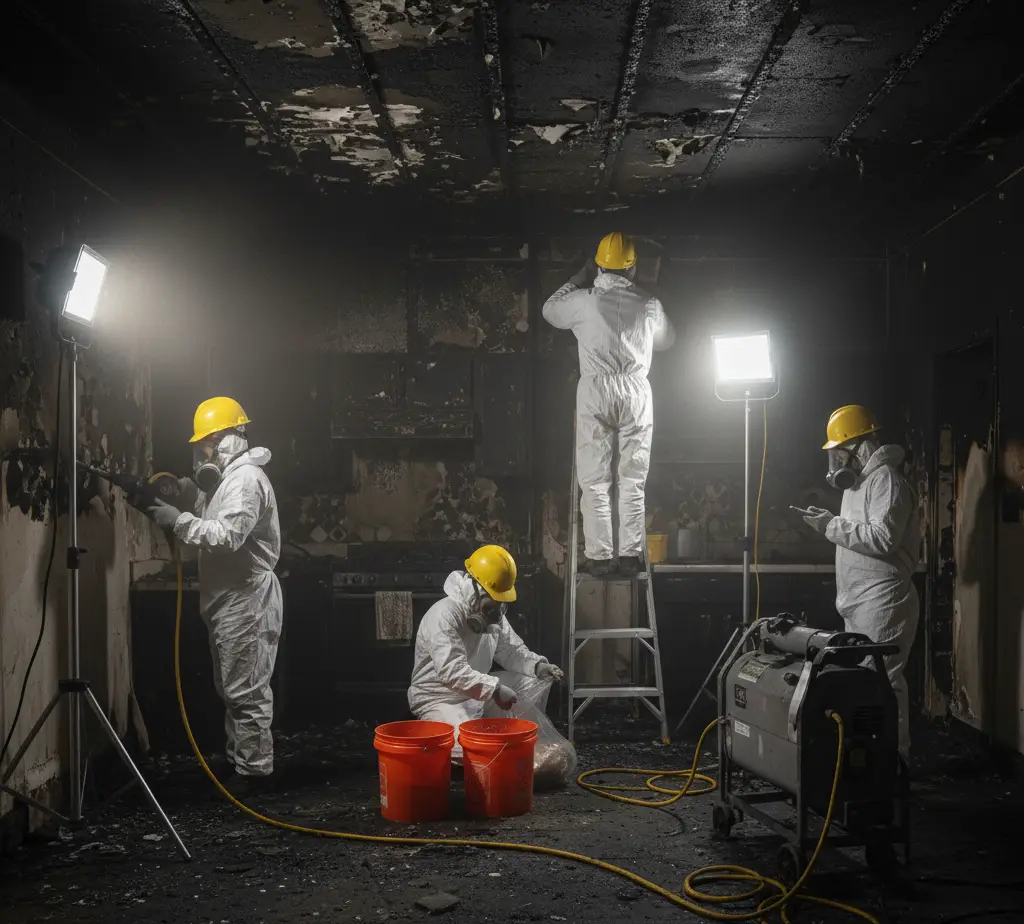
Beyond the Embers: A Comprehensive Guide to Professional Fire Damage Restoration Services in Chicago

fire damage restoration

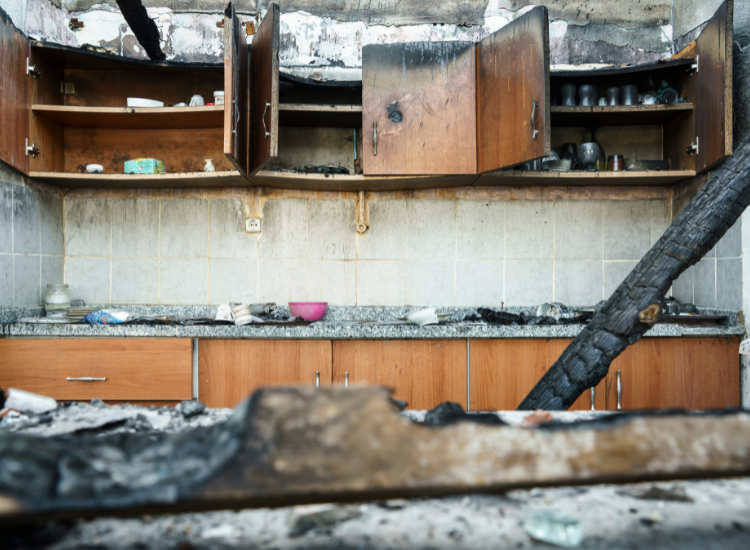
It is three in the morning in the middle of a brutal Chicago January. You are standing on the sidewalk in your bathrobe, watching the flashing blue and red lights of the Chicago Fire Department bounce off the windows of the neighboring brick two-flat. The fire is out, the hoses are being coiled, and the silence that follows is heavier than the smoke hanging in the frigid air. You look at your home—a structure that has stood through a century of Midwestern seasons—and it looks unrecognizable. There is a gaping hole in the roof, the windows are shattered, and a thick, oily scent of burnt plastic is competing with the smell of wet charcoal.

At this moment, most people feel a sense of total paralysis. The damage looks permanent. However, what you see on the surface is only the first chapter of the story. Beneath the soot and the puddles of water used to extinguish the flames, the structure of your home is undergoing a chemical transformation. From the way smoke particles move like tiny “ghosts” through your ventilation system to the way acidic soot begins to eat away at your granite countertops within hours, the clock is ticking. This is why professional fire damage restoration services are not just about cleaning up; they are a high-stakes race against chemistry and time to save your property from becoming a total loss.

The Invisible Chemistry of Fire Damage

When a fire breaks out in a modern Chicago home, it isn’t just wood and paper burning. We live in an era of synthetic materials. Your couch is likely made of polyurethane foam, your flooring might be a composite laminate, and your electronics are encased in complex plastics. When these burn, they create a “chemical cocktail” of soot.

Soot is not just “dirt.” It is a microscopic, needle-like particle that is often highly acidic. Think of soot like a tiny, invisible army of sandpaper. If it is left to sit on a delicate surface, such as a gold-plated bathroom fixture or an heirloom mirror, it will literally etch the surface, causing permanent pitting and dullness.

In 2026, our understanding of these particles has reached a point where we can categorize them into different types of “smoke behavior.” For example, a “fast-burning” fire fueled by high oxygen creates a dry, powdery soot that is relatively easy to brush off. However, a “slow, smoldering” fire—often caused by an electrical short behind the drywall of an older Lincoln Park greystone—creates a greasy, smeary residue that acts like a glue. Professional fire damage restoration services focus on identifying which “flavor” of smoke hit which room so that the cleaning process doesn’t accidentally cause more damage by rubbing the oils deeper into the pores of the walls.

The Hidden Danger of Extinguishment: Water Damage

One of the most surprising insights for homeowners is that the fire itself might only be responsible for half of the destruction. The other half comes from the thousands of gallons of water used to save the structure. In Chicago, this creates a secondary crisis: the humidity trap.

When that water hits a hot environment, it turns into steam, which carries soot and smoke deep into the “pores” of your home—the tiny gaps in wood framing and the fibers of your attic insulation. If the water isn’t extracted immediately, you aren’t just dealing with fire damage; you are inviting a massive mold outbreak. This is particularly dangerous in 2026 as Chicago’s building codes have made homes “tighter” for energy efficiency. While great for your heating bill, a tight home traps that moisture inside like a greenhouse.

Redefined Restoration approaches this by treating the site as a combined fire and water emergency. We use “thirsty air” technology—industrial-strength dehumidifiers and air movers that act like a giant sponge for the atmosphere—to pull that moisture out of the studs and floorboards before the wood starts to warp or rot.

The Tactical Stages of Restoration

To help you understand what happens once the yellow tape is removed, let’s break down the professional workflow. This isn’t a random process; it is a calculated sequence designed to stabilize the building and prevent “secondary loss.”

Stage 1: Immediate Board-Up and Stabilization

In Chicago, the weather is rarely your friend. If a fire has broken through your roof or blown out your windows, your interior is now exposed to the elements. Whether it’s a sudden thunderstorm or the sub-zero wind off Lake Michigan, “open” property is vulnerable property. We prioritize “wrapping” the building. Think of this like putting a cast on a broken arm. We board up windows and tarp the roof to make sure no more water gets in and to protect the property from “unauthorized visitors.”

Stage 2: The “Triage” of Belongings

Not everything in a fire is a lost cause. We perform a “content pack-out,” where we carefully move your items to a controlled environment. We use a “keep, clean, or discard” system. In 2026, we have access to ultrasonic cleaning tanks. These machines use sound waves to create millions of tiny bubbles in a specialized solution. These bubbles act like a million microscopic scrubbing brushes, reaching into the tiny gears of a watch or the crevices of a piece of jewelry to remove soot that hand-wiping could never touch.

Stage 3: Structural Soot Removal

Cleaning a wall after a fire isn’t like cleaning a kitchen counter. If you use the wrong liquid, you will set the stain permanently. We often use “dry chemical sponges” that act like a giant eraser, lifting the soot off the paint without moisture. For more heavy-duty areas, like the basement of an older brick home where the soot is thick, we might use “media blasting.” This is a process where we spray a soft material—sometimes even dry ice pellets—at the surface. The pellets “explode” on contact, lifting the char and soot away without damaging the original wood underneath.

Stage 4: Deodorization and Molecular Cleaning

The smell of a fire is notoriously difficult to remove because it isn’t just on the surface; it is a gas that has soaked into the materials. In 2026, we have moved beyond simple “air fresheners.” We use “Ozone Generators” or “Hydroxyl Generators.” These machines create a chemical reaction in the air that actually breaks the “odor molecule” apart. It’s the difference between masking a smell with perfume and actually destroying the source of the smell at a molecular level.

Why Chicago Homes Require a Local Perspective

Restoring a home in the Windy City isn’t the same as doing it in a desert or a tropical climate. Our unique architecture and weather patterns dictate the strategy.

The Greystone and Bungalow Challenge

Chicago is famous for its “Bungalow Belt” and historic greystones. These homes often feature “lath and plaster” walls rather than modern drywall. Plaster is much more porous and holds onto heat and moisture longer. A restoration team that doesn’t understand the density of plaster might leave the walls “wet” on the inside, leading to structural cracking months later.

The Winter “Freeze-Thaw” Cycle

If a fire happens in December, the water used by the fire department can actually freeze inside your pipes or within the masonry of your brick walls. When we begin the restoration and start heating the house back up, that ice turns to water, potentially causing a “second flood.” We have to manage the “thaw” carefully, using controlled heat to ensure we don’t cause the very pipes we are trying to save to burst.

High-Density Living and Soot Migration

In Chicago’s condo buildings and high-rises, a kitchen fire in Unit 4B doesn’t stay in Unit 4B. Smoke is a pressurized gas; it looks for “utility chases”—the holes where pipes and wires go between floors. It can travel three floors up and settle in a neighbor’s closet. Our fire damage restoration services involve “mapping” the smoke path, checking the HVAC systems and the common areas to ensure that the soot hasn’t compromised the air quality for the entire building.

Comparison: Professional Services vs. General Cleaning

Many homeowners wonder if they can just hire a standard maid service or do the work themselves. Here is how professional restoration compares to a general approach:

Feature General Cleaning / DIY Professional Restoration Standard (2026)
Soot Handling Often smeared into surfaces with wet rags. Removed using dry sponges or ultrasonic technology.
Odor Control Masked with scented sprays or candles. Molecular destruction via Hydroxyl or Ozone.
Safety High risk of inhaling toxic ash and carcinogens. Use of full PPE and HEPA air scrubbers.
Hidden Damage Ignored (behind walls and in ducts). Thermal imaging and borescope inspections.
Documentation Hand-written notes or basic photos. Digital “matterport” scans and insurance-ready data.

The Emotional and Psychological Impact

We often say that we are in the “peace of mind” business as much as the cleaning business. A fire is a traumatic event. It feels like a violation of your “safe space.”

When you see a professional team walk in with a clear, calm plan, the “chaos” of the event starts to fade. In 2026, the technology of Redefined Restoration allows us to give you a digital “roadmap” of the progress. We can show you exactly which rooms have been cleared and which items have been successfully restored. This transparency is a vital part of the healing process for a family.

The Science of Air Quality: The “Lung” of Your House

The air you breathe after a fire is technically a biohazard. Ash and soot are made of fine particles that can settle deep in the lungs. Furthermore, as things burn, they release “VOCs” (Volatile Organic Compounds) like formaldehyde and benzene.

Professional restoration involves installing “Air Scrubbers.” These are machines that act like a giant, high-powered lung for your house. They pull the air through a series of “HEPA” filters—filters so fine they can catch particles much smaller than a human hair. By the time we are finished, the air inside your home is often cleaner than the air outside on a busy Chicago street.

Managing the Insurance Maze

Navigating an insurance claim in 2026 can be a full-time job. Insurance adjusters are looking for specific data: “proof of loss,” “detailed inventory,” and “documented moisture levels.”

Most homeowners don’t have the technical vocabulary to describe the difference between “protein smoke” and “petroleum soot,” but the insurance company does. When we provide our fire damage restoration services, we act as the technical bridge. We provide the data-driven reports that justify the work being done, ensuring that you get the full value of your policy. We speak the “language” of insurance to make sure no corner is cut in the safety of your home.

Structural Integrity: Is the House Still Safe?

A significant concern after a fire is the “invisible weakness.” Intense heat can actually change the molecular structure of steel beams or cause concrete to “spall” (where chunks of the surface pop off).

Our team doesn’t just look at the paint; we look at the skeleton of the building. We check the “load-bearing” members to ensure that the heat hasn’t made them brittle. In 2026, we use specialized sensors that can detect if a wooden joist has lost its “structural moisture,” which makes it more likely to snap under weight. If a beam is compromised, we reinforce it before we ever start the cosmetic work.

Long-term Value and Property Resale

If fire damage isn’t handled correctly, it can come back to haunt you years later when you try to sell your Chicago home. A savvy home inspector will look in the attic or crawlspace for “char” or smell the vents for a faint odor of smoke. If they find it, it can slash your property value or kill a sale entirely.

By investing in professional fire damage restoration services, you are getting a “Certificate of Completion” that proves the home was professionally remediated to modern standards. It is an investment in your property’s future resale value as much as it is a fix for the current crisis.

Protecting What Matters: A Focus on Heirloom Recovery

While the structure can be rebuilt, the “things” are what make a house a home. We have a saying: “We don’t just clean stuff; we rescue memories.”

Whether it is a box of photos that has been soot-damaged or a wedding dress that smells like smoke, the technology of 2026 gives us a much higher “recovery rate” than we had a decade ago. We use a process called “CO2 cleaning” for delicate fabrics, which uses “liquid carbon dioxide” to lift stains and odors without using any water or harsh chemicals. It is the same technology used to preserve historical artifacts in museums.

The Critical First 24 Hours: A Checklist

If you have just experienced a fire, the steps you take in the first day are vital. Here is the professional recommendation for immediate action:

  • Call for Professional Help: The longer soot sits, the more likely it is to cause permanent “etching.”
  • Avoid the “Wet Rag” Mistake: Do not try to wipe the walls. You will likely “smear” the oily soot and set the stain.
  • Limit Movement: Walking through the house can grind soot particles into the carpet fibers, making them much harder to remove.
  • Do Not Turn on the HVAC: Your furnace or air conditioner will suck the smoke particles from the fire-damaged room and blow them into the “clean” rooms.
  • Inventory from the Door: If you can, take photos of the damage from the doorway without entering the structure (safety first!).

Sustainability in Restoration

In 2026, we are also focused on the environmental impact of our work. Redefined Restoration utilizes botanical cleaning agents whenever possible. These are cleaners derived from plants that are incredibly powerful at breaking down oils and soot but are safe for pets and children. We also strive to “restore rather than replace,” which keeps tons of debris out of Chicago’s landfills. Every floorboard we save is a floorboard that doesn’t need to be cut from a forest and transported across the country.

Restoration as an Engineering Discipline

It is helpful to think of fire restoration as a form of “reverse engineering.” A fire is a chaotic event that breaks a building down. We have to understand how that building was put together to systematically “un-break” it.

Whether it is checking the integrity of the electrical wiring that was exposed to heat or ensuring that the “vapor barrier” in your walls wasn’t melted, the process is technical and rigorous. We aren’t just “painters”; we are structural guardians.

Summary: The Path Forward

The day after a fire, your world feels small and dark. But as the restoration process begins, you will start to see the “bones” of your home reappear. You will see the soot disappear, the smell fade, and the structural strength return.

Professional fire damage restoration services are the bridge between a disaster and a fresh start. In a city like Chicago, with its deep history and its tough climate, you need a partner who understands the local landscape. You need a team that sees the potential in the charred remains and has the 2026 technology to bring that potential back to life.

Your home is more than just bricks and mortar; it is the stage where your life happens. When that stage is damaged, we are here to ensure the “show” goes on. From the first board-up to the final coat of “smoke-sealing” primer, our commitment is to provide a result that makes the fire feel like a distant memory.

At Redefined Restoration, we don’t just restore buildings; we restore lives. We take the “Redefined” part of our name seriously, taking a situation defined by loss and redefining it through professional excellence and technical precision.

The Invisible Deadline: Strategic Water Mitigation for Chicago Property Owners

water damage restoration

Imagine walking down into your basement in a classic Logan Square bungalow or a modern West Loop condo, only to find the floor reflecting the light in a way it shouldn’t. That shimmering surface isn’t a design choice; it is an active threat to your property’s structural integrity. Many homeowners in our city assume that if they can just get the standing water out with a shop-vac and a few towels, the problem is solved. In reality, the water you see is only about twenty percent of the actual issue. The remaining eighty percent is currently migrating into your wall studs, under your floorboards, and deep into the porous materials of your home.

This is where the concept of water mitigation becomes the most important term in your vocabulary. It is a race against a biological clock that starts the second moisture hits a surface. In the specific climate of Chicago, IL, where we deal with intense humidity in the summer and deep-freeze cycles in the winter, the stakes for proper moisture control are higher than in almost any other region.

Understanding the Mitigation Clock

Water mitigation is not the same thing as “cleaning up.” Mitigation is the specialized process of reducing or preventing the amount of damage that happens after a leak or flood. It is essentially an emergency medical procedure for your house. If you don’t stabilize the “patient” immediately, the long-term complications—like rot and structural failure—become inevitable.

In 2026, the standards for stabilizing a home have evolved. We no longer just wait for things to feel dry to the touch. We use physics to prove a building is safe. When we talk about mitigation, we are talking about a window of roughly twenty-four to forty-eight hours. That is the time it takes for mold spores, which are naturally present everywhere in the city air, to find that moisture, settle down, and start a colony. Once that happens, your project changes from a simple drying job to a much more complex “remediation” project.

The Local Challenge: Why Chicago Architecture Demands More

Chicago is famous for its “City in a Garden” motto, but for property owners, it is a city of diverse and challenging building materials. From the historic brick two-flats in Avondale to the high-rise steel and glass of the Gold Coast, every structure reacts to water differently.

The Porous Nature of Historic Brick

Many of our older homes use “common brick.” While it looks sturdy, brick is actually like a very hard, dense sponge. It has thousands of tiny pores. When a basement floods in an older Chicago home, the water doesn’t just sit against the wall; it gets sucked up into the brick through a process called “capillary action.” Think of it like a sponge dipping into a glass of water; the water moves upward, against gravity. If a professional doesn’t use high-powered equipment to pull that moisture back out, that brick will stay damp for months, slowly rotting any wood beams that touch it.

The Modern Condo Dilemma

In newer constructions, we see a lot of “engineered wood” and “high-density fiberboard.” These materials are budget-friendly and look great, but they are incredibly sensitive to moisture. When these materials get wet, they don’t just “soak”; they delaminate. This means the glues holding them together fail, and the material swells and falls apart. In a high-density living environment like a Chicago condo building, water mitigation is also a matter of being a good neighbor. A leak on the fourth floor doesn’t stay on the fourth floor; it follows the path of least resistance down through light fixtures and utility chases.

The Science of the “Thirsty Air”

To a layperson, drying a room looks like putting out a few big fans. To a specialist, it is an exercise in “Psychrometry.” This is just a fancy word for the study of how air and water vapor interact.

When your home is wet, the air inside is “saturated.” It is like a sponge that has already soaked up as much water as it can hold. If the air is full of water, the water in your carpet has nowhere to go. It can’t evaporate because the air is “full.”

Our goal during the mitigation phase is to create “thirsty air.” We do this by using three specific tools in harmony:

  1. High-Capacity Air Movers: These aren’t just fans. They are designed to create high-velocity airflow across a surface. This “peels” the moisture off the floor and pushes it into the air.
  2. LGR Dehumidifiers: LGR stands for “Low Grain Refrigerant.” In 2026, these are the gold standard. These machines act like high-powered magnets for moisture. They pull the wet air in, freeze the water out of it, and blow bone-dry, warm air back into the room.
  3. Temperature Control: Warm air can hold more water than cold air. By carefully managing the temperature of the room, we can make the drying process move much faster, beating that forty-eight-hour mold deadline.

The Professional Mitigation Workflow

When you contact, the process follows a strict technical path designed to save as much of your property as possible. We don’t just start tearing things out; we evaluate the “salvability” of every item.

Step 1: The Moisture Map

Before a single machine is turned on, we have to find the “hidden” water. We use infrared cameras—which see temperature differences—and moisture meters. Because wet materials are usually cooler than dry ones, the infrared camera allows us to see exactly how far up the water traveled inside a wall without us having to cut a hole in it. We create a “map” of the moisture so we can track our progress over the next few days.

Step 2: Extraction (The Most Important Step)

It is much faster to “vacuum” water out of a carpet than it is to “dry” it out with a fan. We use truck-mounted extraction units that have incredible suction power. We often use “weighted” extraction tools that use the technician’s own body weight to squeeze water out of the carpet padding—the foam layer underneath your carpet that acts like a giant, hidden reservoir for bacteria.

Step 3: Stabilization and Sanitization

Once the bulk of the water is gone, we apply hospital-grade antimicrobials. This is a crucial step in the water mitigation process. We need to make sure that we aren’t just drying out a “biology project.” We want to kill any bacteria or viruses that the water brought in, especially if the water came from a “Category 3” source like a backed-up Chicago city sewer.

Step 4: Controlled Evaporation

This is the “waiting” phase. Over the next three to five days, we monitor the moisture levels in your wood studs, drywall, and flooring. We don’t stop until the moisture levels match a “dry standard”—a measurement we take from a part of your house that didn’t get wet.

Comparison: Professional vs. In-House Mitigation

Many property managers or homeowners try to handle the situation themselves. Here is how that usually compares to a professional 2026 standard:

Feature DIY / “Mop and Bucket” Redefined Restoration Standard
Detection “Looks dry” or “Feels dry” Thermal imaging and deep-probe moisture meters
Extraction Shop-vac (leaves 30-50% of water behind) High-pressure truck-mounted extraction (95% removal)
Airflow Box fans (moves surface air only) Industrial centrifugal air movers (forces air into pores)
Humidity Opening windows (often makes it worse in Chicago) LGR Dehumidification (lowers grains per pound)
Microbial Control Household bleach (mostly water, can feed mold) EPA-registered botanical antimicrobials
Documentation None Full moisture logs and photo evidence for insurance

The Insurance Advocacy Component

One of the most stressful parts of a water emergency in Chicago is dealing with the insurance claim. In 2026, insurance companies are more data-driven than ever. They don’t want to hear that your basement “was really wet.” They want to see “moisture logs.”

Part of our role as your mitigation partner is providing the technical proof that the work was necessary. We document the “Dry Standard,” the “Daily Moisture Readings,” and the “Equipment Logs.” This data makes it very difficult for an insurance adjuster to claim that the drying wasn’t needed or that the damage was pre-existing. By hiring a professional Law Firm (metaphorically speaking, a firm that knows the “laws” of restoration), you are protecting your financial investment as much as your physical property.

Beyond the Surface: Hidden Dangers of Improper Mitigation

If you don’t use professional water mitigation services, you might face “secondary damage.” This is damage that wasn’t caused by the initial leak, but by the humidity that the leak created.

“Ghosting” and Ceiling Sag

When a basement stays wet for too long, the humidity levels in the whole house can spike. This moisture can condense on the cooler parts of your ceiling or walls upstairs. Over time, this can cause “ghosting” (dark streaks on the walls) or cause the tape and “mud” on your drywall joints to fail, leading to sagging ceilings in rooms that were never even touched by the flood.

Structural Integrity of the “Sill Plate”

The sill plate is the piece of wood that sits directly on your concrete foundation. It carries the weight of your entire house. When a basement floods, this is the first thing to get wet and the last thing to dry. If it stays damp, it becomes a target for wood-boring insects and “dry rot” (which is actually a fungus that thrives on damp wood). Professional drying ensures that these structural foundations are bone-dry, preserving the “bones” of your home for the next fifty years.

The Impact on Indoor Air Quality

A home that hasn’t been properly mitigated often has a “basement smell.” That smell is actually “VOCs” (Volatile Organic Compounds) being released by bacteria and mold as they eat the materials in your home. It isn’t just an annoyance; it is a respiratory irritant. In 2026, as we spend more time in our homes, the health of our indoor air is paramount. Proper mitigation includes the use of “HEPA Scrubbers”—machines that act like a giant liver for your house, filtering out 99.97% of the particles in the air while we are working.

Regional Weather Patterns and Mitigation

In Chicago, we have to adjust our mitigation strategy based on the time of year.

The “Deep Freeze” Mitigation (December – March)

When pipes burst in the winter, we have a unique problem: the water can freeze inside the walls. If we just turn on fans, we are blowing cold air. We have to use “portable heaters” to bring the structure up to a temperature where the water can actually evaporate. We also have to be careful not to create “ice dams” on the exterior of the house by venting too much warm, moist air out of the building.

The “Sultry Summer” Mitigation (June – August)

In the summer, the air in Chicago is already “full” of water. If we open the windows, we are just letting more moisture in. During these months, our dehumidifiers have to work twice as hard. We often have to use “desiccant” dehumidifiers—machines that use a special chemical (like those “do not eat” packets you find in shoe boxes) to pull water out of the air.

Strategic Materials: What Can and Cannot Be Saved?

A major part of the Redefined Restoration philosophy is “Save over Replace.” However, the “Category” of water determines what we can safely keep in your home.

  • Category 1 (Clean Water): Think of a broken supply line to your sink. We can usually save everything: drywall, carpet, and even the padding, provided we start the water mitigation process within twenty-four hours.
  • Category 2 (Gray Water): This is water from a dishwasher or washing machine. It has some “nutrition” in it (like skin cells or food particles) that mold loves. We can usually save the carpet and drywall, but the carpet padding usually has to be replaced because it is impossible to sanitize.
  • Category 3 (Black Water): This is sewage or rising water from the street. This water is a biohazard. In this scenario, anything porous—carpeting, padding, drywall, and insulation—must be removed and disposed of. The risk of disease is simply too high to try and “dry it out.”

Long-term Value: Mitigation as an Investment

When you look at the cost of a professional mitigation project, it is helpful to view it as “insurance against reconstruction.” Replacing an entire basement’s worth of drywall, trim, and flooring is an investment that can take weeks or months. By spending the time and effort on high-level mitigation in the first four days, you often avoid the need to replace those materials.

Furthermore, when it comes time to sell your Chicago property, having a “Certificate of Dryness” from a reputable firm like Redefined Restoration is a powerful tool. It shows potential buyers that a previous leak was handled with scientific rigor and that they don’t have to worry about hidden mold behind the walls.

The Role of the “Trained Eye”

While 2026 technology is incredible, the most important tool in a mitigation project is the experience of the technician. There are thousands of “decision points” in a drying project.

  • Should we remove the baseboards to allow air to get behind the wall?
  • Should we use a “floor mat” system to pull moisture through the hardwood?
  • Is the insulation inside the wall “wicking” moisture upward?

These are things that an app or a rental machine can’t tell you. Our technicians are trained to “think like water.” We know how water moves through different types of Chicago “lumber” and how it hides in the “dead air spaces” of a building.

Summary of the Mitigation Process

If you find yourself standing in water, here is the mental checklist you should follow:

  1. Safety: Is the water touching any electrical outlets? If so, stay out.
  2. Source: Can you turn off the main water valve?
  3. Call: Contact a professional for water mitigation immediately. The clock is ticking.
  4. Protect: Put aluminum foil or plastic coasters under the legs of any wood furniture to prevent “stain transfer” to your carpet.
  5. Don’t Wait: Do not “wait until morning” to see if it dries on its own. It won’t.

The Science of Success

Property restoration is often seen as a “blue-collar” trade, but in 2026, it is a high-tech discipline that combines microbiology, thermodynamics, and structural engineering. The goal of every Redefined Restoration project is to return your home to a “pre-loss condition”—or better.

We take pride in the fact that we can walk into a chaotic, wet, and stressful situation and provide a calm, data-driven plan for recovery. We aren’t just drying a floor; we are preserving a piece of Chicago’s history and ensuring that your family has a safe, dry, and healthy place to live.

Water is a patient enemy. It can sit quietly inside a wall for weeks, slowly eating away at the integrity of your home. Professional water mitigation is the only way to ensure that the enemy is truly gone. We use the most advanced sensors, the “thirstiest” air, and the most experienced eyes in the industry to make sure that when we say your house is dry, it is “scientifically” dry.

Looking Forward: Protecting Your Future

As we look at the urban landscape of Chicago in 2026, our homes are becoming more complex. We have more electronics, more finished basements, and more “smart” materials. Each of these requires a specialized approach to moisture. By understanding the importance of the mitigation phase, you are taking the most important step in property ownership: being a proactive guardian of your investment.

If you ever find yourself facing the “shimmer” on the floor that shouldn’t be there, remember that you aren’t just fighting water; you are fighting time. And in that fight, professional mitigation is your strongest ally. We are here to help you win that race, every time, in every neighborhood of this great city.